Physicists Back OpenAI's Yang-Mills Existence Proof
A committee led by David Gross released OpenAI's Lean code and says it proves pure Yang-Mills existence. It does not prove a mass gap. What it means.
The mathematics behind AI, and AI's growing role in mathematics itself. Posts derive optimizers like Muon and AdamW, Wasserstein GANs and score-based diffusion, and cover news such as an AI-assisted proof of the 3D Ghys conjecture and Terence Tao's warning.
A committee led by David Gross released OpenAI's Lean code and says it proves pure Yang-Mills existence. It does not prove a mass gap. What it means.
Startup PSI says a non-public Anthropic model found a Lean-checked proof of the Aaronson-Ambainis conjecture. Scott Aaronson believes it is correct.
11 free courses, books and videos for the linear algebra, calculus and probability behind machine learning, plus two paid Coursera courses.
Meta FAIR's h1 wraps frontier models in a plain Lean loop. It settled eight open problems and beat AlphaProof Nexus on five Erdős problems for less.

Axiom says AI agents put the 15,000-page finite simple groups proof into Lean in 24 days. Mathematicians felt relief; Hacker News asked about trust and cost.
Axiom says AI agent swarms helped produce about 43.1M lines of Lean proving the finite simple groups classification in 24 days. What still needs checking.
A research team led by mathematicians from Great Bay University and the Shanghai Artificial Intelligence Laboratory has published a complete proof of the three-dimensional Ghys conjecture, resolving a 31-year-old open problem in dynamical systems. The proof relied on Shanghai AI Lab's Shusheng-S2 multimodal scientific foundation model to explore deduction pathways, followed by formal computer verification in the Lean proof assistant conducted by researchers at Peking University. The achievement

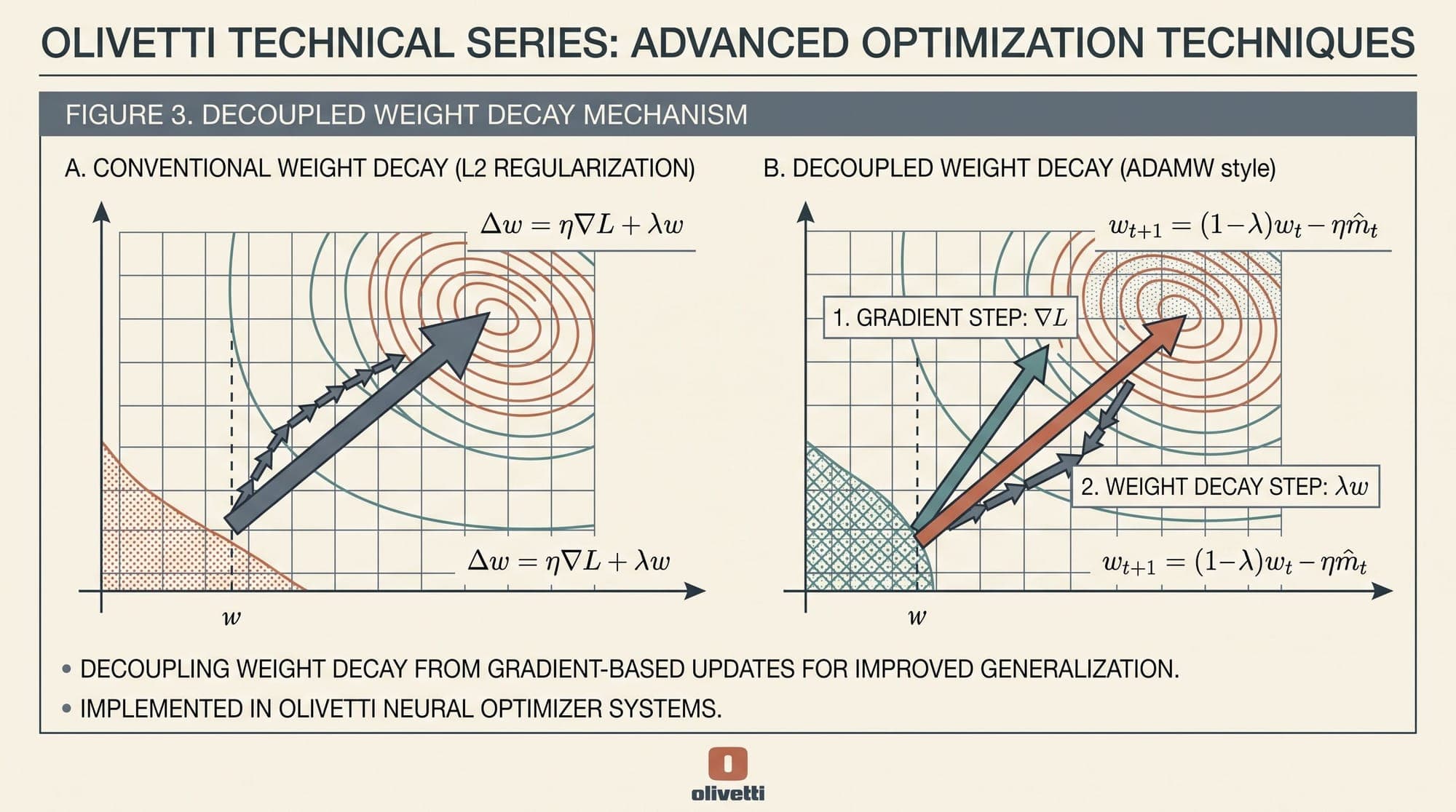
Transformer pre-training has long relied on AdamW as the default first-order optimizer. While AdamW provides coordinate-wise scale invariance through running estimates of first and second gradient moments, it treats every weight parameter as an isolated scalar. For modern neural networks composed primarily of two-dimensional linear projections, attention transformations, and feed-forward weight matrices, this coordinate-wise factorization neglects the structural transformation properties of matr

Decoupled weight decay regularization, formalized by Ilya Loshchilov and Frank Hutter in 2017 and published at ICLR 2019, resolved a fundamental flaw in how adaptive gradient algorithms like Adam implemented weight regularization. Prior to AdamW, deep learning frameworks implemented weight decay as L2 regularization by adding the gradient of the squared L2 norm directly to the loss gradient. While mathematically identical for standard stochastic gradient descent (SGD), this formulation breaks do
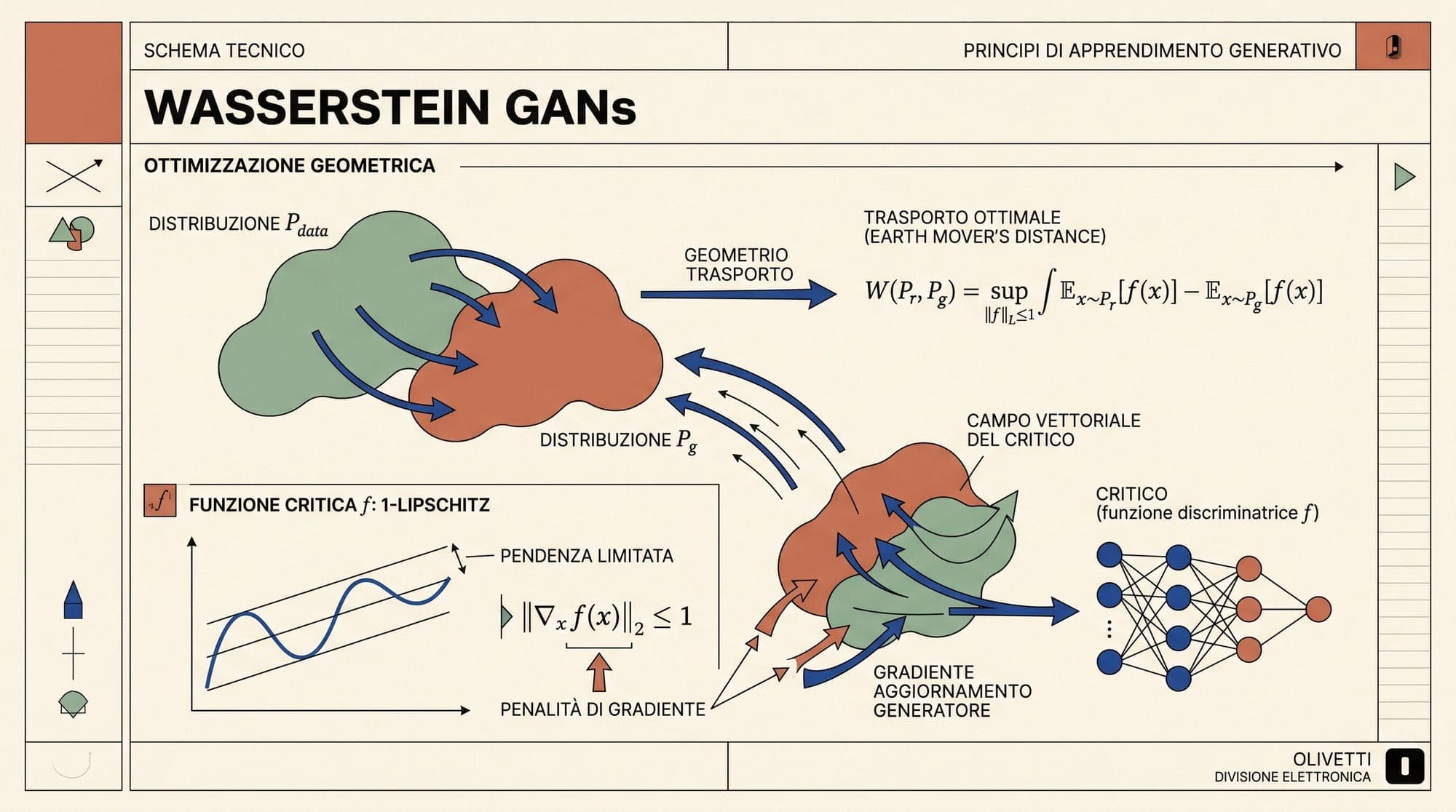
Wasserstein GANs: How Earth Mover's Distance, Kantorovich-Rubinstein Duality, and Gradient Penalties Fixed Generative Adversarial Training Generative Adversarial Networks (Goodfellow et al., 2014) established an influential paradigm for generative modeling: formulating data synthesis as a minimax game between a generator mapping latent noise to data space and a discriminator distinguishing synthetic samples from real empirical data. Despite early empirical success, the original GAN formulation
Neural Ordinary Differential Equations: How Continuous-Depth Dynamics and Adjoint Sensitivity Solve the Memory Bottleneck in Deep Learning Deep neural networks are traditionally structured as a discrete sequence of layers. An input tensor passes through layer after layer, transforming its representation at fixed, integer time steps. In standard architectures like Residual Networks (ResNets), each successive block computes an additive update: h_{t+1} = h_t + f(h_t, \theta_t) In 2018, researche
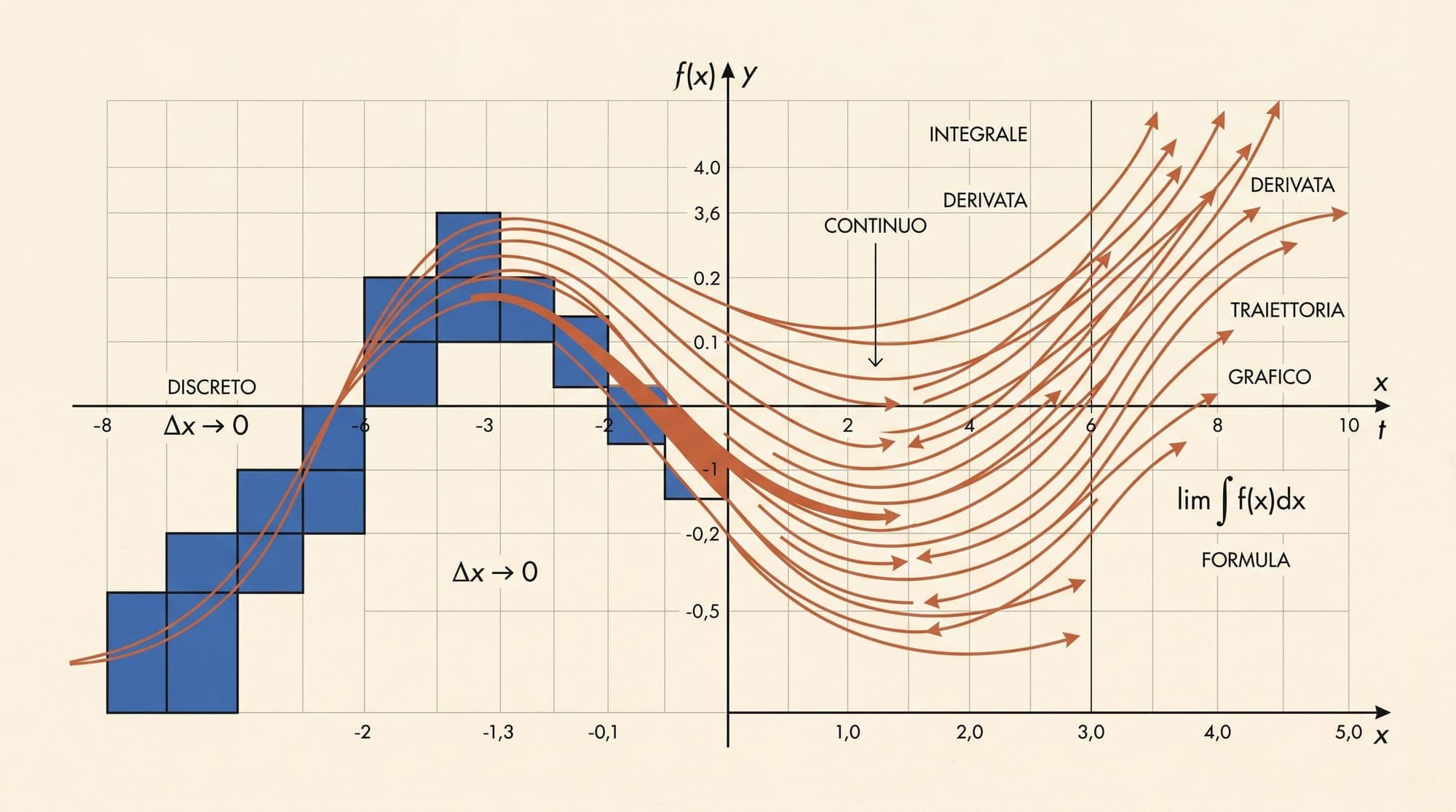
Diffusion and score-based models represent one of the foundational paradigms of modern generative artificial intelligence, underpinning systems across image synthesis, video generation, audio modeling, and continuous multimodal representations. For years, generative diffusion was approached from two distinct perspectives: discrete-step denoising diffusion probabilistic models (DDPM) pioneered by Sohl-Dickstein et al. and Ho et al., and score matching with Langevin dynamics (SMLD / NCSN) introduc
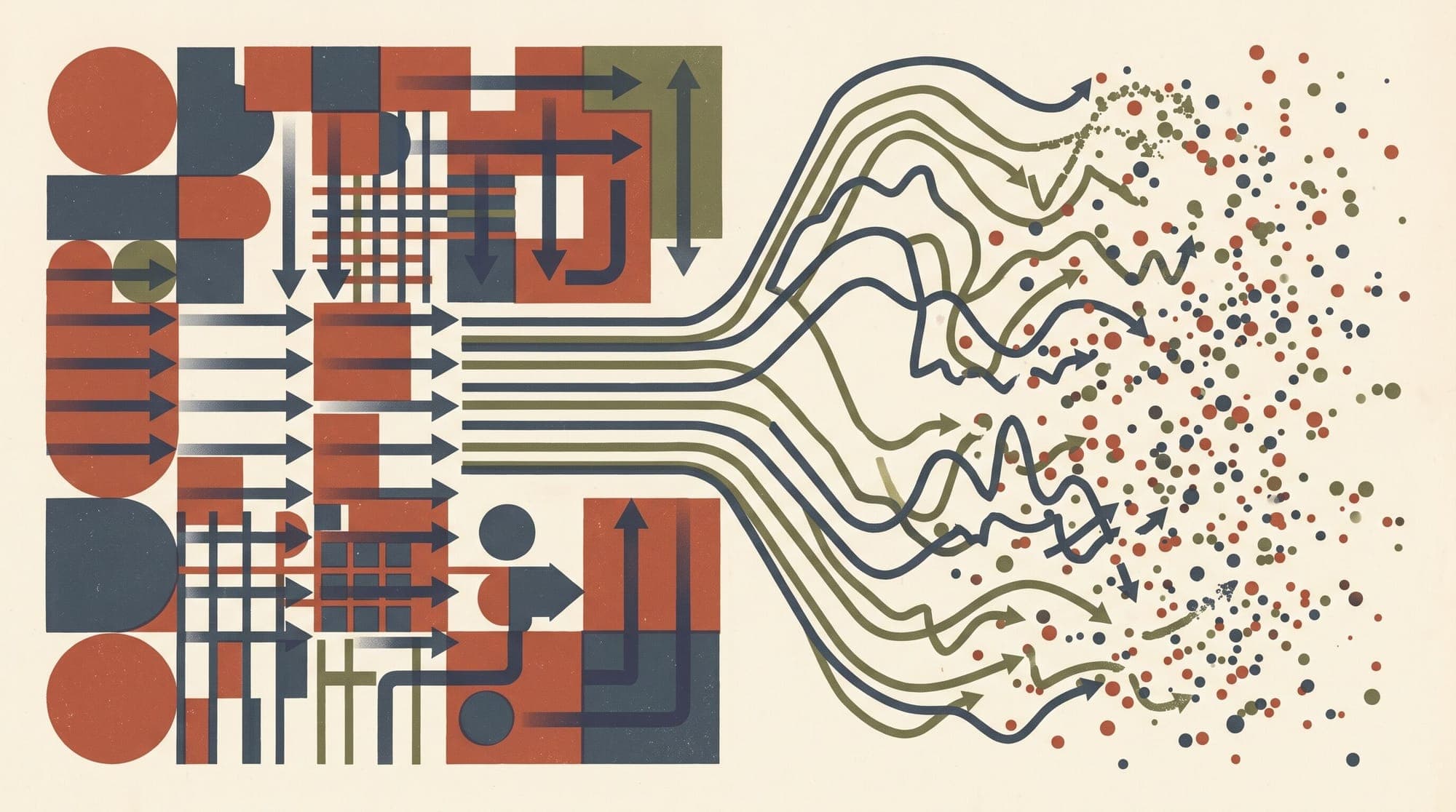
In a paper prepared for the 2026 International Congress of Mathematicians, mathematician Terence Tao argues that artificial intelligence will force a restructuring of mathematical research practices, publication criteria, and education. The essay, released on arXiv (2608.16753), outlines how the transition from proof scarcity to proof abundance creates operational and epistemological challenges distinct from earlier debates over automated theorem proving. Tao frames the incoming disruption agai
A neurosurgery resident with no formal advanced mathematics training has solved Crouzeix's conjecture, a 22-year-old open problem in numerical linear algebra, using a 16-hour autonomous run of GPT-5.6 Sol in ChatGPT Work mode. Dr. Shanmu Jin, a postdoctoral researcher and neurosurgery resident at Peking Union Medical College Hospital, prompted ChatGPT 5.6 on July 30, 2026 to work on the conjecture. The model ran autonomously for approximately 16 hours, exploring proof strategies through a branc

OpenAI has named its next major model, Astra, by publishing ten mathematical results it says were generated by an internal version of the system. The company released a technical paper, reasoning walkthroughs and Lean certificates that allow the formal proofs to be checked by software. The more important part of the announcement is not the count. AI-generated mathematics has produced enough false starts that a headline number alone is weak evidence. OpenAI's decision to publish machine-checkabl