
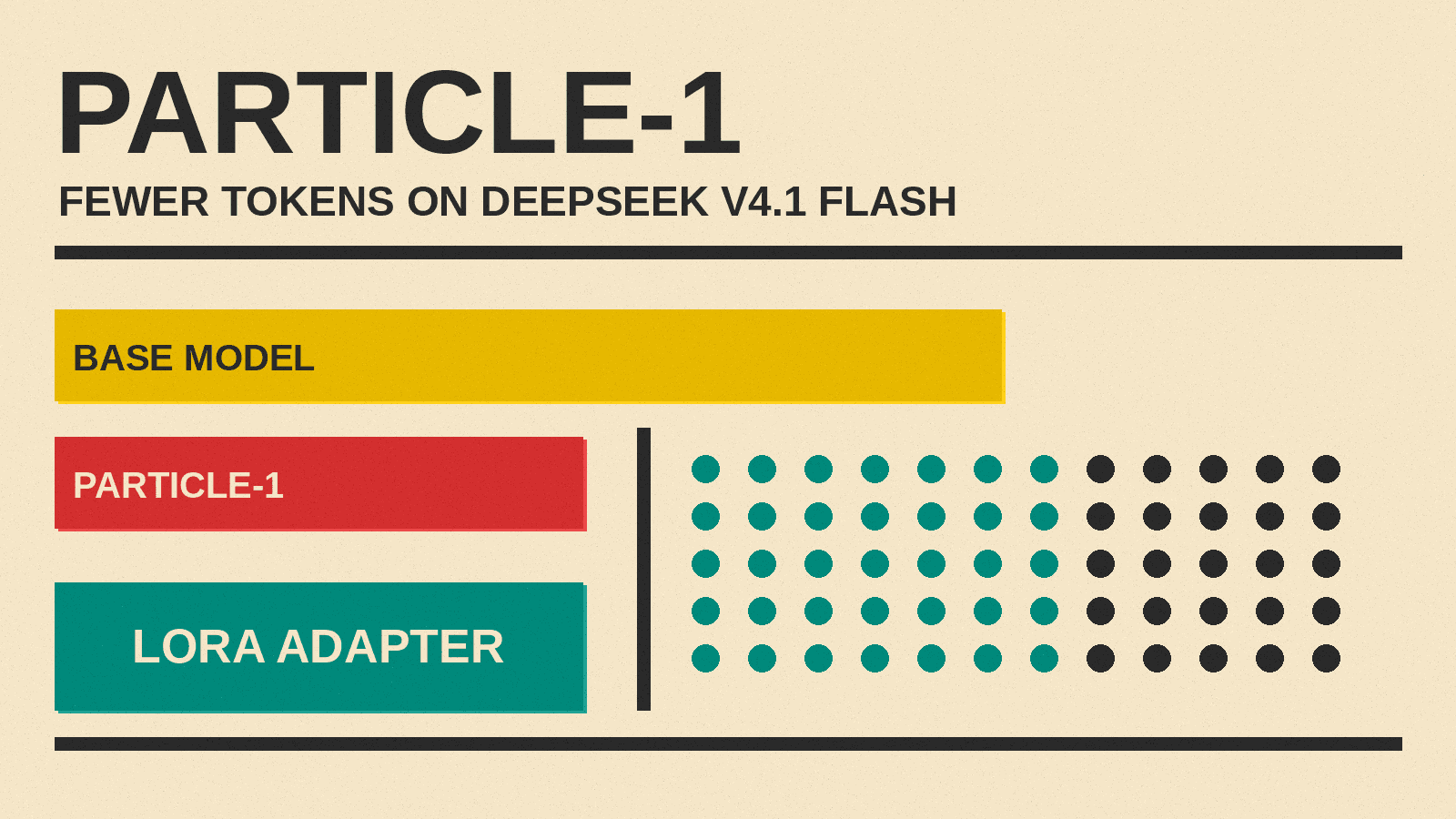
A new startup called Particle has launched Particle-1, a model post-trained on top of the open-weight DeepSeek V4.1 Flash. The goal is narrow and practical: finish the same coding tasks while writing far fewer tokens. Particle says the model uses about 45% fewer tokens on average across a wide variety of tasks, with accuracy that stays within the confidence intervals of the base model.
The release is a clear example of a growing pattern around open-weight models. A lab ships strong weights, and smaller companies tune them for one job and sell the result as a service. Particle-1 itself is offered through the Particle API. The launch post does not mention downloadable weights for the tuned model.
What Particle-1 is
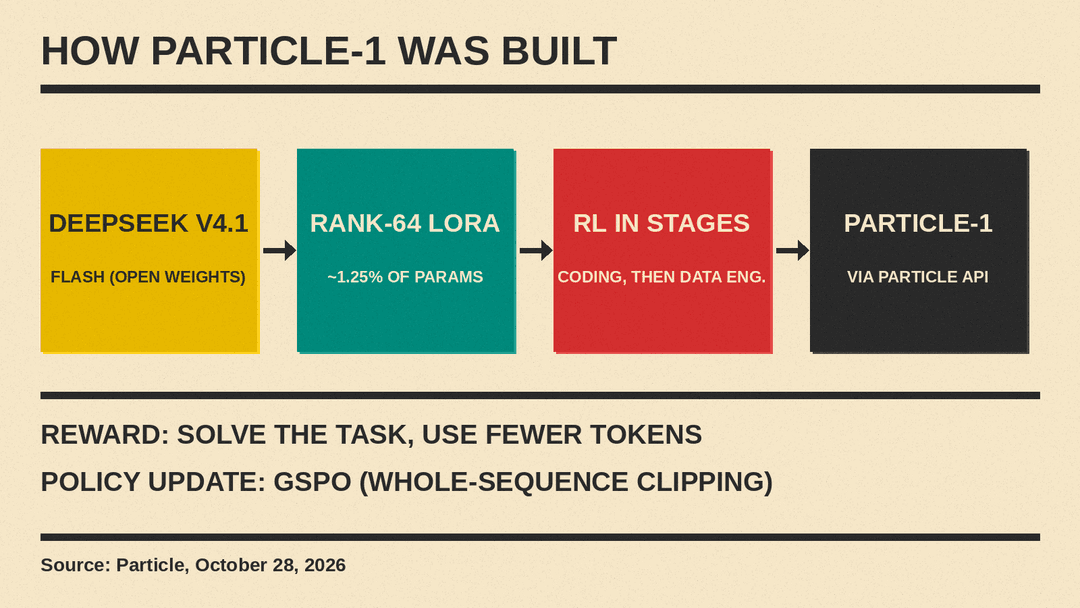
According to the launch post, Particle-1 is DeepSeek V4.1 Flash plus a rank-64 LoRA adapter that covers the experts in all layers. LoRA is a common fine-tuning method that trains a small set of extra weights instead of changing the full model. Particle says the adapter's trainable parameters equal about 1.25% of the model's parameter count.
The first release focuses on software engineering. Particle says it plans to bring the approach to other domains in later releases.
The company says it is "building a new AI inference layer for open weight models" on its home page, which lists DeepSeek V4.1 Flash, GLM 5.3 Flash and Particle-1 as available models.
The claimed results
Particle tested the model on four agent benchmarks, all run with the Terminus 2 agent, a 512k-token limit, temperature 1, top_p 0.95 and maximum reasoning:
- Terminal-Bench 2.1: terminal workflows such as compiling software, debugging code and configuring systems.
- ReactBench: building and fixing React applications.
- ADE Bench: analytics and data engineering tasks on real dbt projects and databases.
- DeepSWE 1.1: longer software engineering tasks that need codebase understanding, changes and verification.
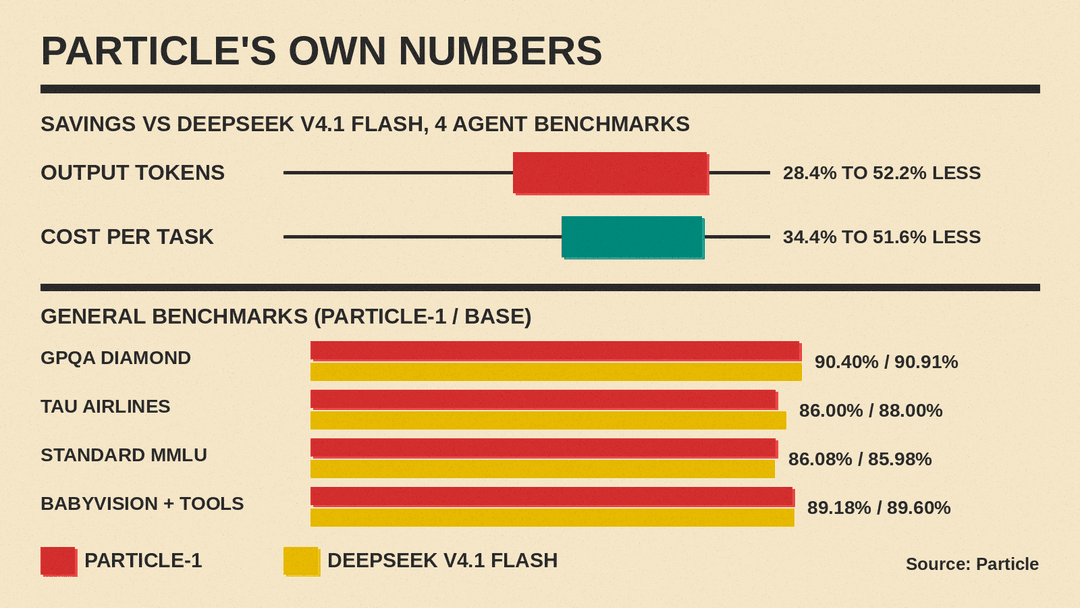
Across these four, Particle reports that Particle-1 uses 28.4% to 52.2% fewer output tokens and costs 34.4% to 51.6% less per task than DeepSeek V4.1 Flash. Pass@1 rates are within the confidence intervals of the base model, the company says.
Particle also checked whether the tuning hurt general skills. Its reported scores, with the base model in brackets:
- GPQA Diamond: 90.40% (90.91%)
- Tau Airlines: 86.00% (88.00%)
- Standard MMLU: 86.08% (85.98%)
- BabyVision with tools: 89.18% (89.60%)
These are the company's own numbers. No independent group has published a replication yet.
Why fewer tokens matters
Reasoning models and coding agents often think at length, repeat checks and write long final summaries. Every one of those tokens costs money and time. Particle's argument is that cutting them helps twice: the bill goes down, and tasks finish sooner.
The price comparison in the post makes the cost point concrete. Particle lists the same per-million-token prices for Particle-1 and DeepSeek V4.1 Flash: $0.30 for uncached input, $0.006 for cached input and $1.20 for output, including reasoning. So any cost saving comes from the model using fewer tokens, not from a lower price. For comparison, it lists GLM 5.3 Flash at $0.15, $0.03 and $0.50.
Where the savings come from
Particle compared runs where both the base model and Particle-1 passed the same task with the same seed. It found four patterns:
- Less reasoning before taking the same actions.
- Stopping once the task is verified, instead of rechecking or writing a long confirmation.
- Fewer rounds of trial and repair before a working solution.
- More focused exploration of alternatives and edge cases.
Reasoning tokens account for about 90% of the savings on Terminal-Bench 2.1, ReactBench and ADE Bench, the company says. On DeepSWE 1.1, tool-call text adds about 30% of the savings.
Particle is open about one caveat. In one ADE Bench example, Particle-1 reused an existing key macro while the base model built a different solution, so the savings there reflect a different answer, not only a shorter one.
How it was trained
The post gives an unusual amount of training detail for a commercial launch:
- Reinforcement learning in internal coding and data engineering environments, built in Harbor format by an in-house synthetic data system called Datamaker.
- A reward that pays for solving the task while using fewer tokens for reasoning and tool calls.
- Training in stages, following the Cascade RL approach. Stage 1 was coding; stage 2 shifted mainly to data engineering.
- Infrastructure built on Miles, RadixArk's open-source RL framework, with tuned SGLang rollout and Megatron training engines.
- Group Sequence Policy Optimization (GSPO), which weights and clips whole sequences instead of single tokens. Particle says a token-level loss oscillated and then diverged in its tests.
The company also says that after coding-only training in stage 1, the model already used about 20% fewer tokens on data engineering tasks, which it calls a first sign of generalization.
Early signs outside coding
Particle tried one legal task from Harvey LAB: reviewing an arbitration clause across four documents and writing a report. At the standard adapter strength, Particle-1 used 24.6% fewer output tokens than the base model, and all eight of its reports passed every criterion, against 62.5% accuracy for DeepSeek V4.1 Flash.
Particle also turned the adapter strength up. At 8 times strength, output fell by 78.7%, but only three of eight reports passed the strict check. The lesson the company draws is that pushing too hard cuts useful caveats along with waste.
What it means for open models
Particle-1 shows what open weights make possible. A small team can take a strong base model, train a small adapter on its own tasks, and change how the model behaves without training anything from scratch. The trade-off for users is that this tuned version, as described, is a hosted service, not a file you can run on your own hardware.
For developers already using DeepSeek V4.1 Flash in agents, the claim is easy to test: same prices, same base model, and a promise of shorter runs. Independent benchmarks will show whether the savings hold outside Particle's own test set.
