Full-parameter fine-tuning of modern foundation models requires substantial compute and memory infrastructure. Adapting an open-weight 70-billion-parameter model using standard 16-bit precision and first-order adaptive optimizers like AdamW demands well over 1 terabyte of GPU memory.
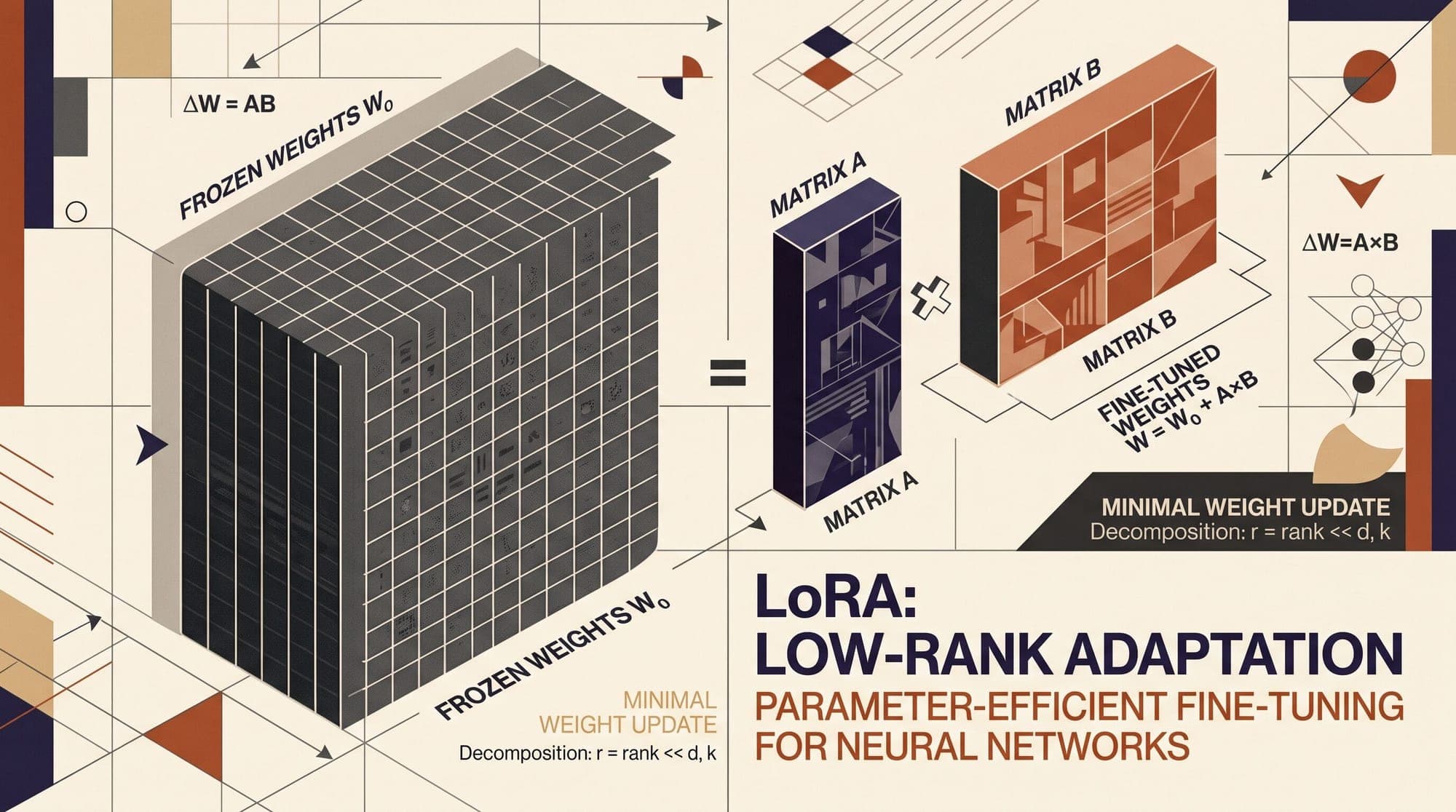
Low-Rank Adaptation (LoRA) bypassed this hardware bottleneck by framing task-specific weight updates as low-rank matrix decompositions. By freezing pre-trained weights and training small auxiliary rank decomposition matrices, LoRA reduces trainable parameter counts by up to 99.9%, cuts optimizer memory by over 75%, and allows zero-latency deployment through static weight merging.

The Memory Bottleneck in Full-Parameter Fine-Tuning
Training a large language model requires allocating memory across three distinct categories:
- Model Parameters: Storing weights in 16-bit floating point (BF16 or FP16) consumes 2 bytes per parameter.
- Gradients: Backpropagating loss requires allocating gradient tensors matching the parameter shapes, consuming another 2 bytes per parameter.
- Optimizer States: Standard 32-bit AdamW tracks both the first moment (running mean of gradients) and the second moment (running uncentered variance of gradients) in FP32, requiring 8 bytes per parameter, plus an FP32 master weight copy (4 bytes) and FP16 model weights, totalling 16 to 18 bytes per parameter across the training state.
For a 70B parameter model, optimizer states alone consume approximately 560 to 1,120 GB of VRAM before accounting for intermediate activation tensors during long-context forward passes.
The Intrinsic Dimensionality Hypothesis
In 2020, researchers at Facebook AI Research published Intrinsic Dimensionality Explains the Effectiveness of Language Model Fine-Tuning (Aghajanyan et al.). The study demonstrated that over-parameterized neural networks occupy a low intrinsic dimension. When adapting a model to a downstream task, parameter updates do not need to span the full ambient parameter space (). Instead, effective adaptation can occur within a significantly lower-dimensional subspace.
How LoRA Works: Low-Rank Factorization
Introduced by Edward Hu, Yelong Shen, Phillip Wallis, Zeyuan Allen-Zhu, Yuanzhi Li, Shean Wang, Lu Wang, and Weizhu Chen in LoRA: Low-Rank Adaptation of Large Language Models (2021), LoRA applies the intrinsic rank principle directly to weight matrices.
Mathematical Formulation
Given a pre-trained weight matrix , full-parameter fine-tuning updates the weight via a dense delta matrix :
LoRA constrains the update matrix by factorizing it into two low-rank matrices:
where , , and the rank .
During forward computation, input vector passes through both the frozen original weight and the parallel low-rank branch:
The scalar multiplier scales the adapter output, where is a fixed constant. Setting ensures that when experimenting with different values of rank , the magnitude of the adapter's contribution remains stable without requiring retuning of the base learning rate.
       Input x
       /     \
      /       \
[Frozen W0]  [Matrix A (r x k)]  <- Random Gaussian Init
 (d x k)          |
      |      [Matrix B (d x r)]  <- Zero Init
      |           |
      |      [* alpha / r]
      \       /
       \     /
       Output h = W0*x + (alpha/r)*B*A*x
Initialization Strategy
To preserve exact model behavior at the start of training:
- Matrix A is initialized using a random Gaussian distribution: .
- Matrix B is initialized to all zeros: .
Because at step zero, the product , ensuring that the model's forward outputs at the start of fine-tuning are identical to the original pre-trained network.
Parameter Reduction Example
Consider a hidden dimension of and . A standard linear layer contains:
With LoRA configured at rank :
- Matrix : parameters
- Matrix : parameters
- Total adapter parameters: parameters
This represents a 99.6% reduction in trainable parameters for that layer. Because gradients and optimizer states are computed exclusively for and , VRAM overhead drops precipitously.
Zero-Latency Serving via Weight Merging
Unlike adapter schemes that introduce sequential bottleneck layers or non-linearities (such as Houlsby adapters), LoRA updates are purely linear. For single-tenant production inference, the adapter weights can be permanently fused into the base model weights prior to serving:
has the identical shape and computational footprint of , adding zero floating-point operations (FLOPs) and zero latency overhead during inference.
For multi-tenant systems serving hundreds of customized fine-tunes concurrently, modern serving engines (such as S-LoRA and Punica) keep the base model in GPU memory and batch adapter operations using specialized batched matrix multiplication kernels (BMM), avoiding the need to host separate base model instances.
Module Targeting and Rank Selection
Target Modules
The original LoRA paper applied adapters exclusively to multi-head self-attention projection matrices ( and ). Subsequent empirical studies, notably by Dettmers et al. in QLoRA, demonstrated that applying LoRA across all linear layers delivers superior performance at lower ranks:
- Attention Projections: Query (), Key (), Value (), and Output ().
- Feed-Forward Networks (MLP): Gate projection (), Up projection (), and Down projection ().
Targeting all linear layers with rank consistently outperforms targeting only attention weights with rank , while consuming comparable memory.
Rank and Scaling
Empirical benchmarks indicate that for domain adaptation, instruction tuning, and style alignment, small ranks () capture the vast majority of task variance. For complex mathematical reasoning or code generation tasks requiring substantial new knowledge injection, practitioners often scale to or .
Conventionally, is set to or , creating a stable scaling ratio of or .
QLoRA: 4-Bit Quantized Low-Rank Adaptation
In 2023, Tim Dettmers, Artidoro Pagnoni, Ari Holtzman, and Luke Zettlemoyer introduced QLoRA: Efficient Finetuning of Quantized LLMs, enabling 65B-parameter models to be fine-tuned on a single 48GB GPU.
QLoRA introduced three architectural innovations:
1. 4-bit NormalFloat (NF4)
Standard integer or floating-point quantization assumes uniform weight distributions. Pre-trained neural network weights, however, follow zero-centered normal distributions .
NF4 constructs an information-theoretically optimal quantile quantization grid where each bin contains an equal number of expected parameters:
This distribution-aware quantization preserves higher precision in the dense central mass of the distribution while avoiding the degradation common in standard FP4 or INT4 formats.
2. Double Quantization (DQ)
Quantization divides weights into blocks (for example, block size 64) and stores a 32-bit floating-point quantization constant (scale ) for each block. In 4-bit models, these constants consume roughly bits per parameter.
Double Quantization performs an additional 8-bit FP8 quantization on the first-stage quantization constants with a secondary block size of 256:
This step saves approximately bits per parameter, freeing roughly 3 GB of memory on a 65B model.
3. Paged Optimizers
During long-context training passes or activation peaks, temporary memory spikes can trigger out-of-memory (OOM) errors. QLoRA implements paged optimizers via CUDA Unified Memory, automatically paging optimizer states between GPU VRAM and CPU system memory during allocation spikes without crashing the training run.
Modern Extensions: DoRA and LoRA+
Several subsequent methods address specific geometric and optimization constraints in standard LoRA:
DoRA: Weight-Decomposed Low-Rank Adaptation
Introduced by Shih-Yang Liu et al. in DoRA (2024), Weight-Decomposed Low-Rank Adaptation decomposes weights into directional and magnitude components:
where is a learnable magnitude vector and denotes the column-wise vector norm.
Liu et al. identified that while full fine-tuning simultaneously alters both magnitude and direction with subtle negative correlation, standard LoRA exhibits proportional coupling between magnitude and directional updates. By isolating magnitude from directional learning, DoRA bridges the performance gap between parameter-efficient fine-tuning and full-parameter fine-tuning without increasing inference latency.
LoRA+
Soufiane Hayou et al. analyzed gradient flow in low-rank architectures, noting that initializing leads to suboptimal feature learning dynamics if both matrices share the same learning rate. LoRA+ establishes an asymmetric learning rate schedule:
By training matrix with a higher learning rate than matrix , LoRA+ accelerates convergence and improves final validation loss on downstream benchmarks.
Summary
Low-Rank Adaptation resolved the parameter-space memory scaling dilemma by exploiting the low intrinsic dimensionality of pre-trained models. By confining parameter updates to factorized matrices , LoRA and its quantized successor QLoRA enable practitioners to fine-tune state-of-the-art models on consumer-grade hardware while preserving zero-latency serving through weight merging.
Sources
- LoRA: Low-Rank Adaptation of Large Language Models (Hu et al., 2021)
- QLoRA: Efficient Finetuning of Quantized LLMs (Dettmers et al., 2023)
- Intrinsic Dimensionality Explains the Effectiveness of Language Model Fine-Tuning (Aghajanyan et al., 2020)
- DoRA: Weight-Decomposed Low-Rank Adaptation (Liu et al., 2024)
- LoRA+: Efficient Low Rank Adaptation of Large Models (Hayou et al., 2024)