
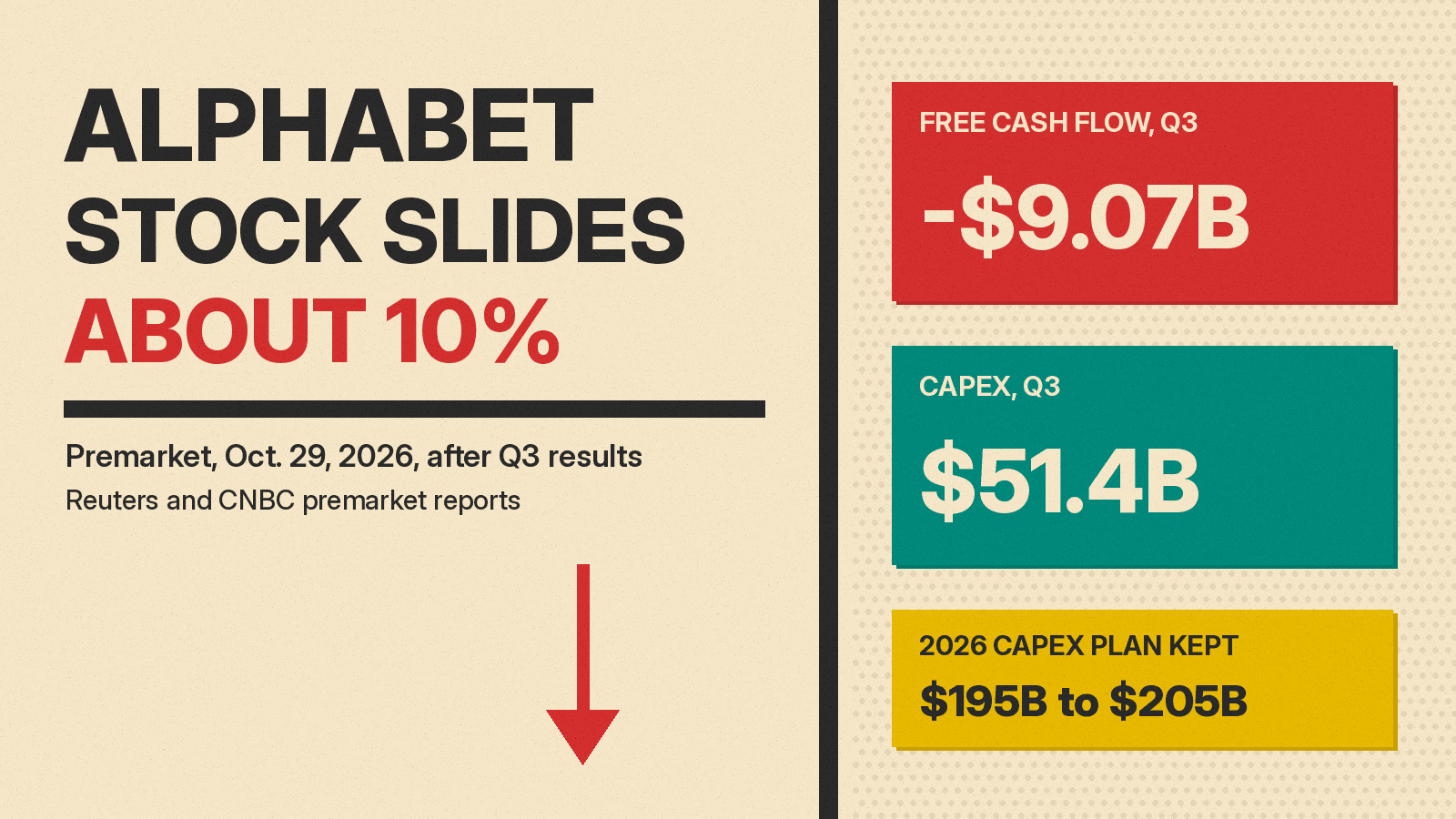
Alphabet shares fell about 10% in premarket trading on Thursday, October 29, the morning after the Google parent reported third-quarter results that missed on earnings and search revenue and showed a much deeper cash burn from AI spending than Wall Street expected. Microsoft, which reported the same evening, rose in premarket trading.
Reuters reported that Alphabet shares slid 10.4% before the open, which would put the company "on track to lose more than $400 billion in market value if losses hold." Nasdaq futures fell about 1%, and at 7:02 a.m. ET (4:02 a.m. PT) Nasdaq 100 futures were down 0.93%, Reuters said. CNBC reported that a close more than 9.77% lower would be Alphabet's worst post-earnings reaction since it went public in 2004. These are premarket moves, so the final number for the day can be different.
What spooked investors
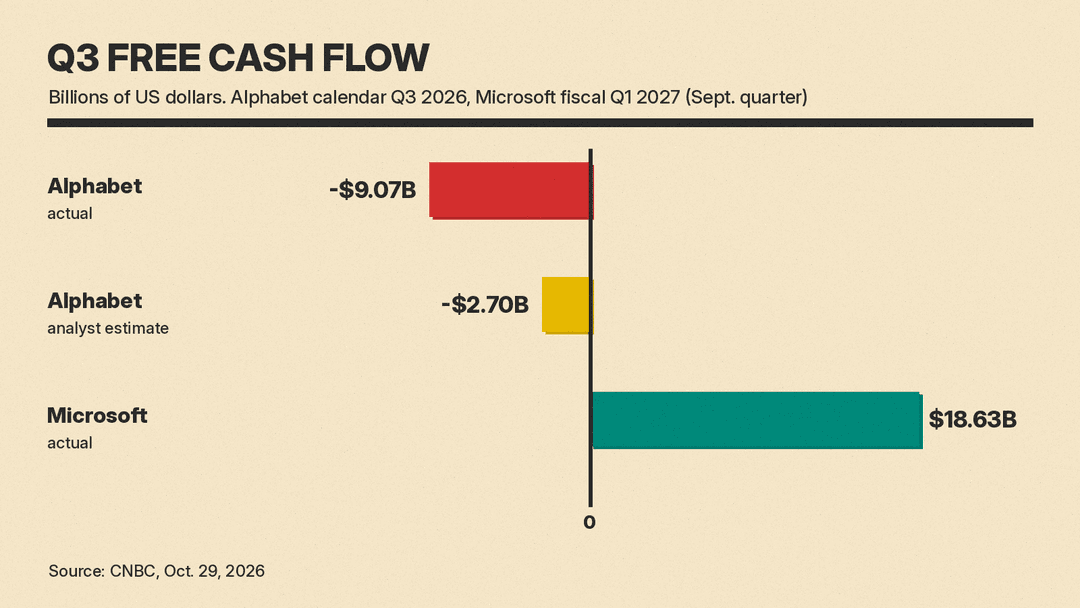
The sharpest number was cash. Alphabet reported negative free cash flow of $9.07 billion for the quarter. According to CNBC, analysts had expected a deficit of $2.70 billion. Investing.com noted that a year earlier, the same figure was a positive $24.46 billion. CNBC said in a separate analysis that free cash flow first turned negative in the second quarter, at $5.9 billion, for the first time in Alphabet's history as a public company.
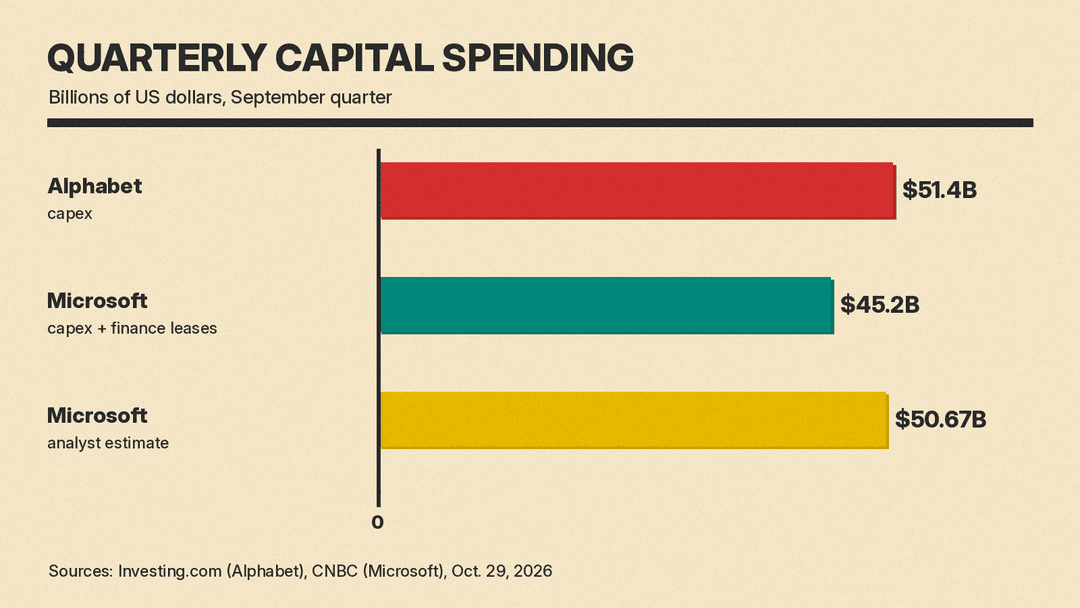
The cause is capital spending. Investing.com reported quarterly capital expenditure of $51.4 billion, more than double the prior-year level. Alphabet kept its full-year 2026 capex guidance of $195 billion to $205 billion, and Investing.com reported that management "signaled that spending would rise significantly again in 2027." Our earlier post on the Alphabet Q3 results has the full filing numbers.
Profit also missed. Alphabet's release shows diluted earnings per share of $2.12, against a consensus of about $3.02 cited by Investing.com, and net income available to common stockholders down 25% from a year earlier to $26.17 billion. Other income and expense swung to a net loss of $8.2 billion, from a $12.76 billion gain a year earlier. CFO Anat Ashkenazi said on the earnings call that this was "due primarily to unrealized loss from our investment in SpaceX from a decline in its stock price in the third quarter."
Search growth slows as AI Mode lags on ads
Search advertising, Alphabet's biggest source of revenue, grew 12% to $63.35 billion but missed analyst expectations, CNBC reported. In its analysis piece, CNBC said search revenue growth "slid from 19% in the first quarter to 17% in the second, before falling to 12% in the third," and that search revenue came in below estimates for the second straight quarter.
Google gave two explanations. On the call, chief business officer Philipp Schindler said foreign exchange was "the single largest driver of Search deceleration relative to Q2." Ashkenazi said that at current exchange rates Alphabet expects "a slightly larger FX headwind" to total revenue in the fourth quarter. Schindler also said "the strong growth in AI Mode queries had an impact because of the lower monetization we were seeing in AI Mode," and that Alphabet is now "scaling ads within both AI Overviews and AI Mode to more users and more queries," including in international markets. Google expanded AI Mode ads to 10 more countries this week.
At the same time, CNBC reported that Google said search query growth was the strongest it has been in five years. So usage is growing faster than search revenue, and Alphabet itself pointed to lower monetization in AI Mode. Our opinion column looks at why Google has not put a size on that gap.
Cloud is the part that worked
Google Cloud more than doubled its revenue to $30.71 billion, according to Investing.com. Jefferies analyst Brent Thill said Cloud was "the only business that beat," while "everything else missed," Investing.com reported. Ashkenazi said on the call that the cloud backlog was $561 billion and that Alphabet expects to recognize "just over 55%" of it as revenue over the next 24 months.
That backlog is part of why Alphabet keeps spending. CNBC reported that some of the capex goes to tensor processing units (TPUs), Google's own AI chips, which Alphabet started selling to outside customers in the second quarter. Ashkenazi explained the timing: TPU systems that are not yet sold show up as inventory, "so you see cash going out, and we're building up the inventory base. As we start delivering and billing customers for these TPU systems, then you see cash coming in."
Why Microsoft went the other way
Microsoft was nearly 4% higher in premarket trading, CNBC reported. A later Reuters update had it up 2.1%. It spent $45.2 billion on capital expenditures and finance leases in its fiscal first quarter, 30% more than a year earlier but below analyst projections of $50.67 billion. Its free cash flow fell 27% to $18.63 billion but stayed positive. CNBC also reported Azure revenue up 48% to $33.2 billion. We covered Microsoft's $10 billion of OpenAI revenue from the same report.
Ben Barringer, global head of technology research at Quilter Cheviot, said on Thursday, according to CNBC: "Microsoft is building out its architecture in a measured way and as such contains fewer surprises." He added: "Alphabet, by contrast, saw its share price hit after hours as a result of a fairly messy set of results and a poorly handled earnings call." Barringer also said, "The problem for Google is it faces an innovator's dilemma and doesn't know whether to protect its core business or look to join the disruption. As such, Google has lost its edge with Gemini and is behind peers on agentic AI."
What the market is asking
Some investors framed the drop as a question about AI returns, not only about one quarter. "Investors are starting to scrutinize monetization timelines versus the capital expenditure burn rates. Some investors are no longer giving all hyperscalers a 'free pass' to spend without limit," Jeremy Saltzberg, VP and senior investment officer at Check Capital Management, said, according to Reuters.
Alphabet did not cut its spending plan, and Ashkenazi said capex will "increase significantly in 2027." Its executives pointed to two sources of future revenue: ads that Alphabet is now scaling inside AI Mode and AI Overviews, and TPU systems that bring cash in once they are delivered and billed.
This post reports market moves and is not investment advice.
Sources
- Reuters via Investing.com: Nasdaq futures slide as Alphabet results intensify AI spending fears
- CNBC: Alphabet falls 10% in premarket, putting it on course for its biggest ever post-earnings drop
- CNBC: Alphabet earnings miss first sign AI is taking a bite out of search
- Investing.com: Why is Alphabet stock plunging today?
- Alphabet Q3 2026 earnings release (SEC)
- Alphabet Q3 2026 earnings call transcript (Stock Analysis)
