
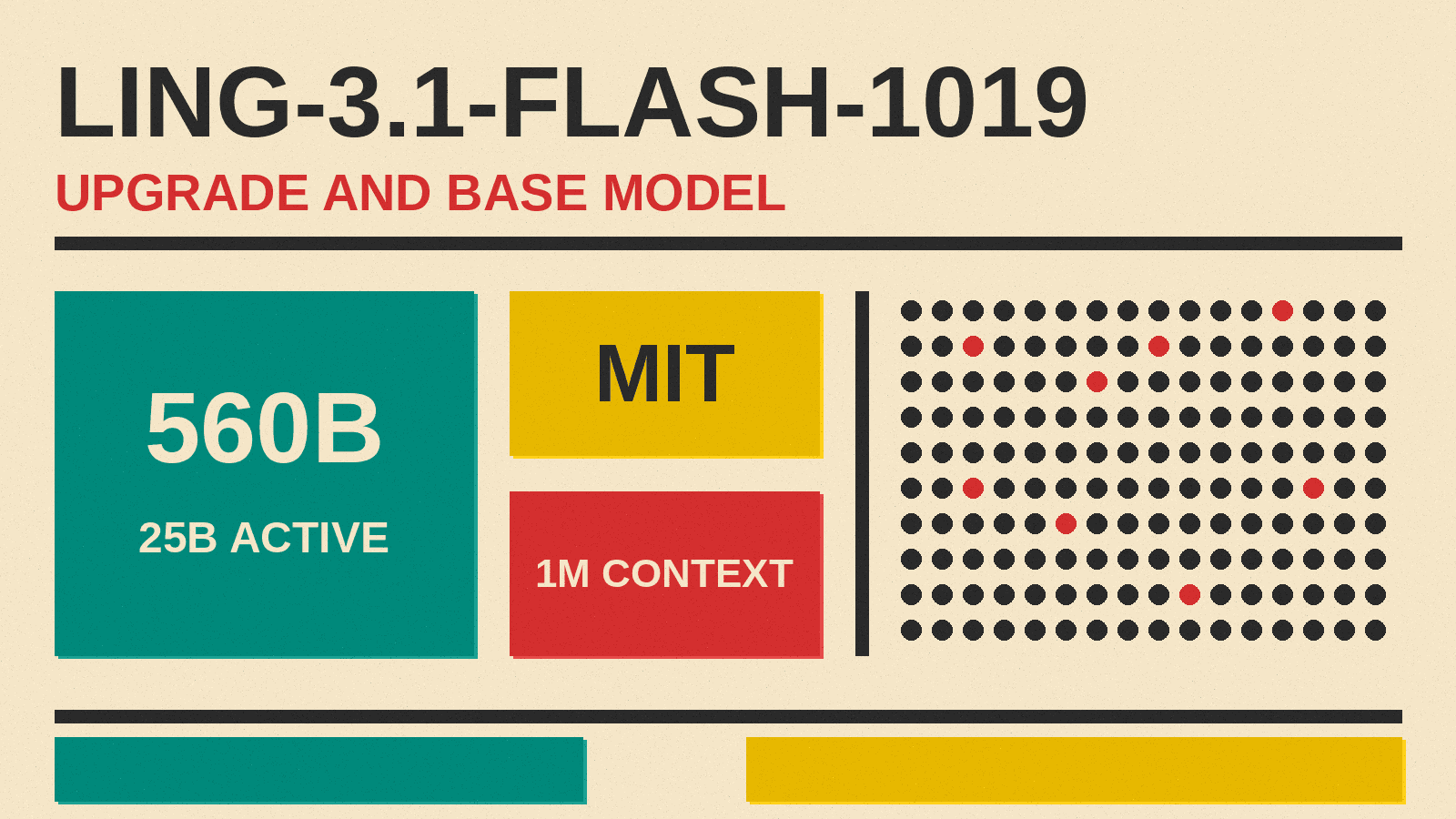
Ant Group's inclusionAI team has posted two new checkpoints of its largest open model. Ling-3.1-flash-1019 is an upgraded chat and agent model, and Ling-3.1-flash-base is the raw pretrained model that sits under it. Both are on Hugging Face under the MIT License.
We covered the first release in Ling-3.1-flash Explained. This post covers what is new: the post-training upgrade, the base model, and what each is for.
What was released
The Hugging Face listing shows the Ling-3.1-flash-1019 repository was created on October 26 at 10:46 PM PT. The base model repository went up on October 24 at 7:15 PM PT. A r/LocalLLaMA thread flagged both releases on Tuesday morning.
According to the model card, the 1019 model keeps the same size and design as the original:
- 560B total parameters, with 25B active for each token
- A 1M-token context window
- A hybrid-linear mixture-of-experts design: 63 KDA (linear attention) layers and 9 Gated MLA layers, a 7:1 ratio
- 512 routed experts plus 1 shared expert, with 8 routed experts active per token
The change is in post-training. inclusionAI says "further post-training optimizations" improved reasoning and agent work. It did not publish a list of what changed in the training recipe.
What the new scores say
All figures below come from inclusionAI's model card. Most are Artificial Analysis benchmarks, but the card reports them. We have not seen an independent run of the 1019 checkpoint yet.
- AA-Briefcase, an agent benchmark scored in Elo: from about 1400 to 1524
- AutomationBench-AA: from 62% to 68%
- CritPt, a science reasoning test: from 18% to 26%
- SciCode: from 54% to 57%
- Artificial Analysis Intelligence Index v4.3.2: 44, up from 41 for the first release
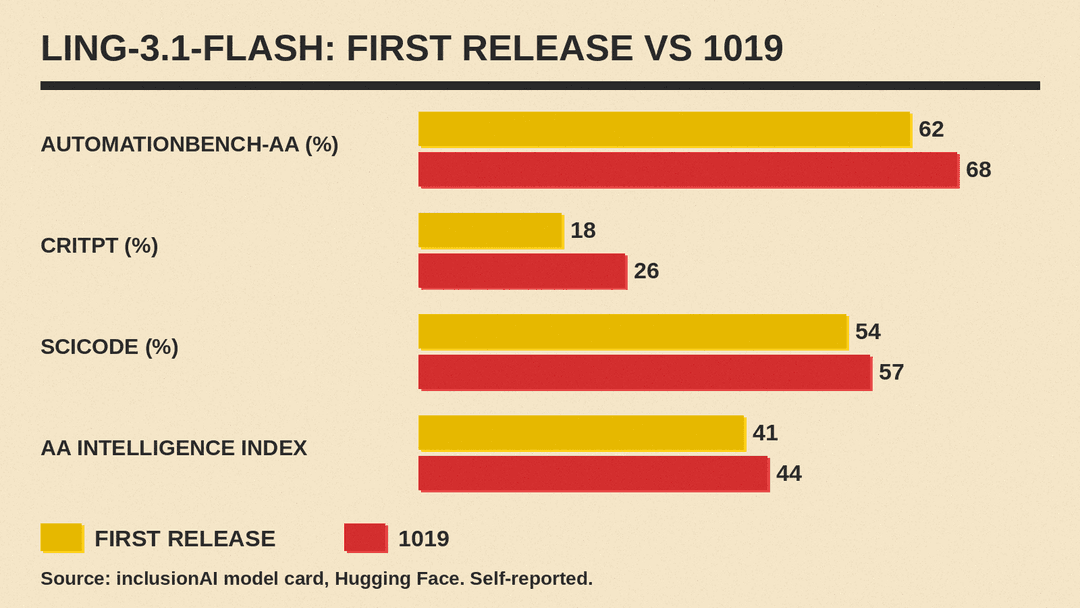
The largest gains are on agent tasks and science reasoning. That fits the model card's claim that the update targets "multi-step task execution, and agentic workflows". A three-point rise on a composite index is a modest step. Treat it as a refresh of the same model, not a new generation.
Why the base model matters
Most labs that publish open weights release only the tuned chat model. A base model is the checkpoint before instruction tuning and reinforcement learning. It does not follow chat instructions well, but it is the right starting point for teams that want to train their own version.
The base model card lists the uses inclusionAI has in mind: continued pretraining, supervised fine-tuning for a domain, preference optimization and reinforcement learning, distillation research, and long-context and MoE systems research. It says the model is not recommended for direct end-user chat, for safety-critical uses without more alignment and evaluation, or for production without post-training and task-specific checks.
Some training details are also new. inclusionAI says the model was trained in FP8, and the released BF16 weights were produced after "Warmup-Stable and Merge (WSM) checkpoint merging".
The card compares the base model on 47 benchmarks with two larger base models: DeepSeek-V4-Pro-Base (1.6T total, 49B active) and MiMo-V2.5-Pro-Base (1.02T total, 42B active). A few rows show the mixed picture:
- MMLU-Pro: Ling 76.71, DeepSeek 75.28, MiMo 71.26
- MATH500: Ling 79.40, DeepSeek 68.20, MiMo 57.20
- BigCodeBench: Ling 53.60, DeepSeek 51.49, MiMo 66.75
- AA-Omniscience (knowledge): Ling 37.67, DeepSeek 48.16, MiMo 36.45
- RULER at 256K tokens: Ling 86.64, DeepSeek 94.37, MiMo 86.00
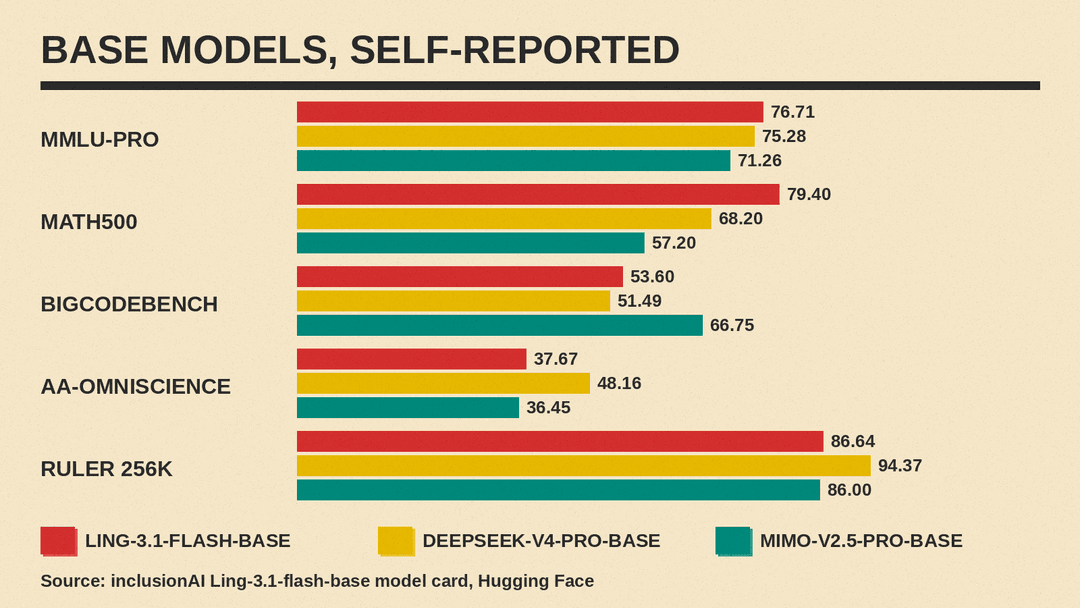
So Ling leads on many math and reasoning rows with fewer total and active parameters. DeepSeek's much larger base model still leads on some knowledge and very long context rows, and MiMo leads on some code rows. These are vendor-run numbers with vendor-chosen shot settings.
What it takes to run
This is not a laptop model. The Hugging Face file listing for Ling-3.1-flash-1019 totals about 574 GB, and the page shows almost all weights stored in FP8.
The model card's recommended path is SGLang. Its example server runs on 8 H200 GPUs with tensor and expert parallelism set to 8, and it says 4 GB300 GPUs also work. A vLLM recipe uses a tensor-parallel size of 8. inclusionAI recommends temperature 1.0, top_p 0.95, top_k 20 and thinking mode on for best results.
For most people, the practical way to try it is a hosted API. The model card links to an OpenRouter listing for the Ling-3.1-flash family.
Why it matters
Three points stand out.
First, the license. The MIT License lets anyone use, copy, modify and sell the software, as long as the copyright and license notice stay with it. Compare that with custom licenses such as MiniMax's community license, which add conditions for larger companies.
Second, the base model. A 560B MIT base model gives fine-tuning teams and researchers a large, permissive starting point. That is less common than another chat checkpoint.
Third, the pace. inclusionAI shipped the first Ling-3.1-flash weights earlier this month and has now pushed a post-training update. For teams building on it, that means the checkpoint to test against can change within weeks.
The caveat is the same as always: every number here is self-reported. Independent tests on agent tasks will show whether the 1019 gains hold up.
