
Amazon started early access to Alexa+ in Japan on Thursday, October 29, 2026. Alexa+ is the generative AI version of Amazon's voice assistant: it holds a natural conversation, remembers what you tell it, and can carry out tasks such as ordering a gift or sending an email for you. In Japan it is free during early access. After that it becomes part of Prime, or a standalone plan at 3,000 yen a month, according to Amazon's Japanese press release.
Amazon says customers in Japan used Alexa nearly 30 billion times over the past three years, and ran more than 2.6 billion smart home actions through it in the past 12 months. The launch lands three days after Apple made its own Siri AI beta available in Japanese with the 27.2 software updates.
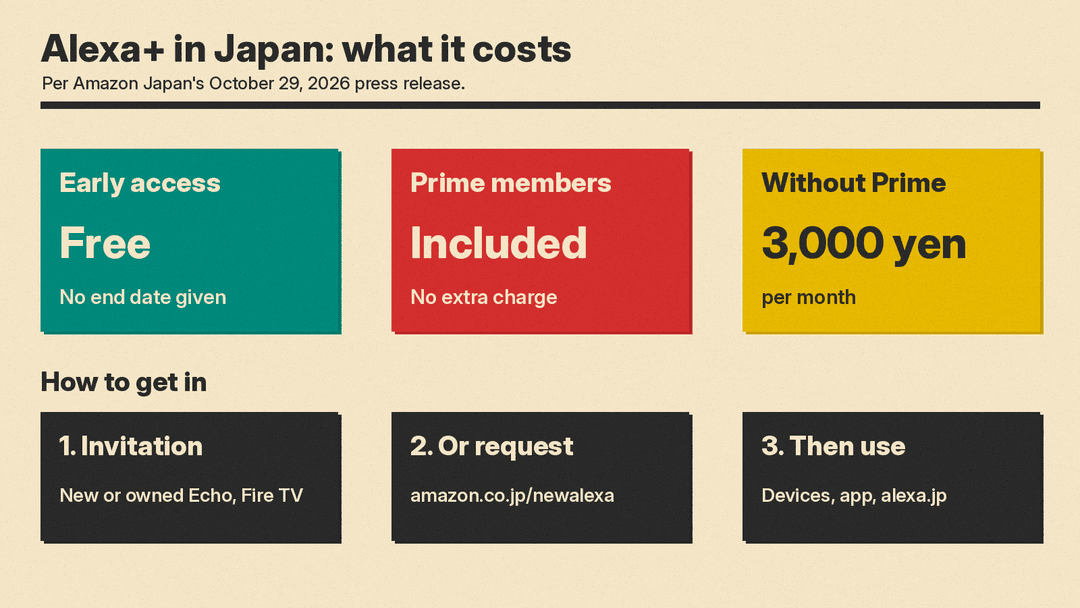
What it costs
- During early access: free.
- After early access, Prime members: included with Prime at no extra charge.
- After early access, everyone else: a standalone subscription at 3,000 yen a month.
Amazon did not give an end date for early access. Its Alexa+ page says non-Prime users are not moved onto the paid plan automatically when early access ends. Some content Alexa+ plays or recommends still depends on your own subscriptions, and Amazon notes that some services need a separate sign-up or fee.
How to get it
Amazon is sending early access invitations in stages. They go to people who buy a new Alexa+ compatible Echo, Fire TV, or Fire TV smart TV from Panasonic or JVC, and to people who already own a compatible device. You can also request an invitation at amazon.co.jp/newalexa, which lists the devices that qualify. Amazon says some models are excluded: the page names older Echo models such as the first-generation Echo Dot and Echo Show, the A80B and YS20 Fire TV smart TVs, and, for now, Fire tablets. In Japan, Alexa+ works only in Japanese, with the device language set to Japanese.
Once you are in, Alexa+ works on every compatible device, in the Alexa app, and in a web browser at alexa.jp. Amazon says a conversation follows you between them: you can look up a recipe on a kitchen Echo Show and keep talking about it on your phone on the way to the shop.
What Alexa+ does differently
Amazon's companion post of things to try first and its launch release list the main changes:
- Keep talking. Say the wake word once, then ask follow-up questions or change the topic without repeating it.
- Memory. Tell it an anniversary, a favorite restaurant, or that someone in the family is on a diet, and it uses that in later answers. Amazon's example is remembering that a mother is vegetarian and a child will not eat broccoli when it suggests recipes or restaurants.
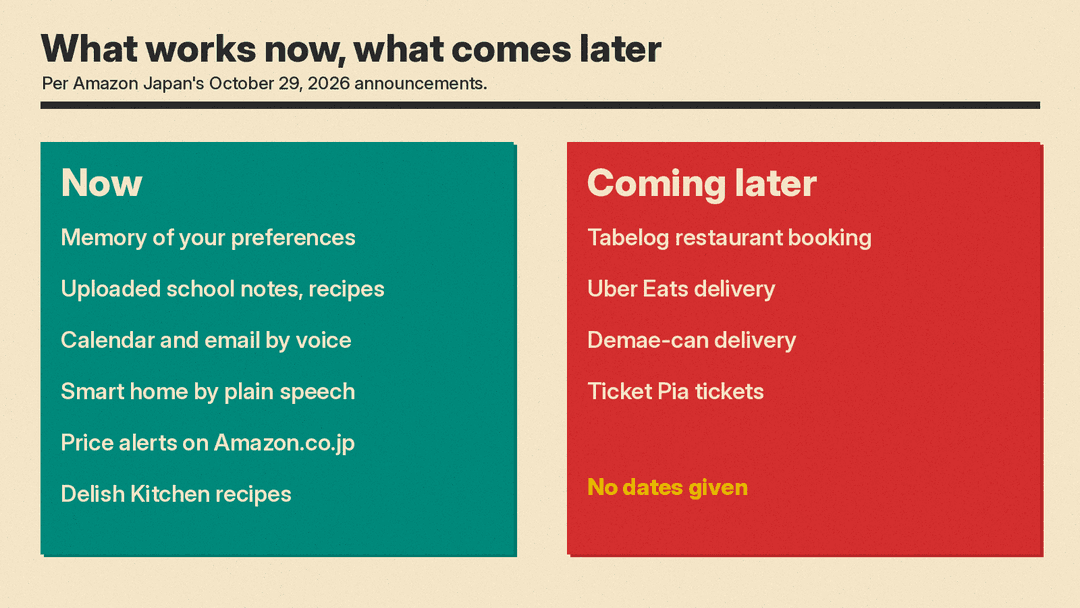
- Your documents. You can upload school schedules, appliance manuals, photos of handwritten recipes, or study notes from the Alexa app, or send them by email. Then you can ask questions such as when a school trip starts, and Alexa+ can check whether school events clash with your calendar.
- Calendar and email. It summarizes and adds calendar events. After setup, it can write and send an email by voice, and you can ask it to change the tone, for example to make it more formal.
- News. It pulls current news from sources including Kyodo News.
- Family recognition. Voice ID and visual ID let it tell family members apart and answer each person differently.
Smart home without exact commands
Alexa+ is meant to act on what you mean, not only on what you say. Amazon's examples: say "it's dark" and it turns on the lights in the room you are in, say "it's a bit cold" and it adjusts the air conditioner's heating. You can also build a routine by voice, such as turning on the TV at 7:30 each morning, checking if you need an umbrella, and playing the news.
Amazon names Daikin, LIXIL, Nature, Panasonic, Ring, and SwitchBot as smart home partners. These features need Alexa compatible devices, sold separately, plus setup. Appliances that do not support Alexa need a compatible smart remote. Amazon also plans to offer device makers a Smart Home AI Toolkit so they can connect their products' own features to Alexa+. Amazon has not said when the toolkit will be available in Japan.
Shopping, food, and tickets
Alexa+ shows product suggestions from Amazon.co.jp, answers questions about a product (battery life, whether it is waterproof, whether it is made in Japan), summarizes reviews, tracks prices, and alerts you when something drops in price. Amazon says it checks with you before it places an order.
Some partner services are live and some are not yet. Recipe suggestions from Delish Kitchen work now. Restaurant booking through Tabelog, delivery through Uber Eats and Demae-can, and ticket purchases through Ticket Pia are listed as coming later. Amazon did not give dates for those.
Built for Japanese conversation
Amazon's release gives language its own section. It cites the Japanese idea of "reading the air," where context matters as much as the words. One example it gives: "daijoubu" can mean "no problem," "yes, please," or "no, thank you," depending on the situation. Amazon says Alexa+ is designed to understand these differences, that it was developed with input from a Japanese team that knows Japanese customers' needs, and that it can talk about seasonal events like New Year and cherry blossom viewing, local news, and Japanese music and food.
Gianmaria Visconti, Amazon's Alexa regional manager for Japan and Australia, said in the release that his family had been using Alexa+ at home for the past few months, and that it turned them into sumo fans.
Privacy and kids
Amazon says Alexa+ interactions can be reviewed in one place in the Alexa Privacy dashboard. From the Alexa app or online, you can see what Alexa heard, check attachments you shared, and change how long voice recordings are kept.
That matters more with Alexa+ than with the old Alexa, because the new assistant is designed to hold on to personal details, family members' voices and faces, and documents like school letters. If you join early access, it is worth opening the privacy dashboard and setting the recording retention you want before you start uploading files.
For children, Amazon says a parent must give consent in advance and set up a child profile, and children can use only some Alexa services.
Why it matters
In Japan, Amazon ties Alexa+ to Prime: Prime households will pay nothing extra, and everyone else pays a standalone price. Amazon makes the same Prime link in the US, where it says Alexa+ is included with Prime and runs on its new Echo devices. For non-Prime users in Japan, 3,000 yen a month is a real cost for a voice assistant, so the free early access period is the time to decide if the memory, document, and smart home features are worth it.
The most useful parts for everyday users look like the school schedule uploads, the natural smart home control, and the price alerts, none of which Amazon marks as coming later. The restaurant, delivery, and ticket features are still listed as coming later.
Sources
- Amazon Japan press release: Alexa+ launch in Japan (October 29, 2026)
- Amazon Japan: what to try first with Alexa+ (October 29, 2026)
- Amazon.co.jp: Alexa+ early access and compatible devices
- Amazon Alexa developer blog: Smart Home AI Toolkit (Japan)
- Apple: Siri AI is available in more languages (October 26, 2026)
