
Google is widening its health work in Singapore. In a post on Google's blog dated October 29, 2026, Ben King, Country Managing Director for Google Singapore, said the company announced "a new Google Research hub and initiatives to support frontline clinicians, advance research, and help Singaporeans live healthier lives" at the Google for Health Summit in Singapore.
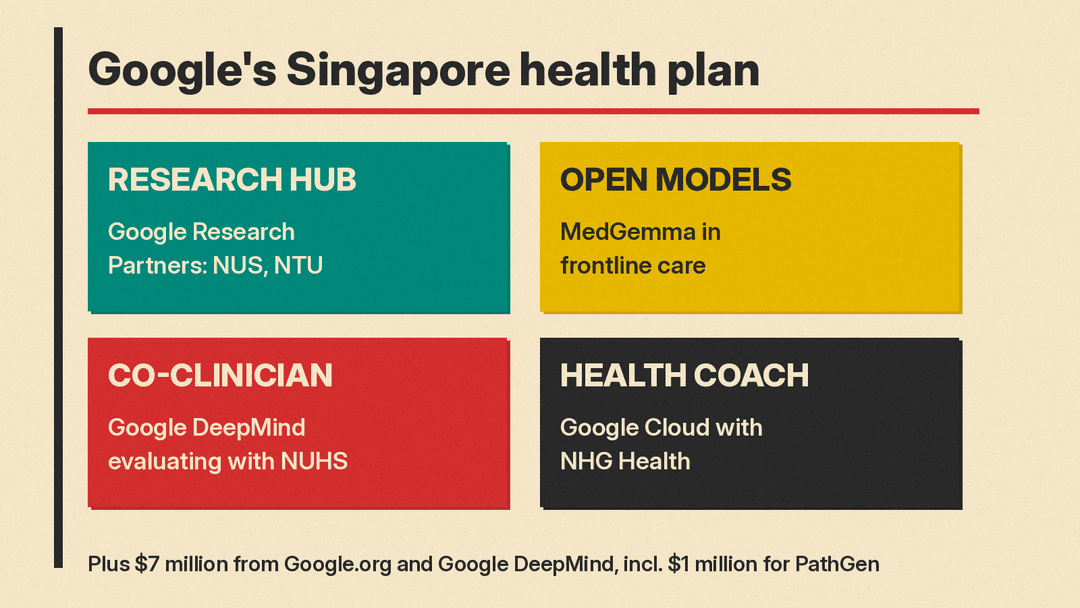
Google says it is partnering with the Singapore Ministry of Health, and the stated goal is to "deploy frontier AI across the nation's healthcare system." The announcement has four parts: a research hub, open medical models in clinics, a clinician assistant trial with a public hospital group, and an AI health coach for residents. It also restates a $7 million philanthropic grant.
A new Google Research hub
Google says it is "establishing a Google Research hub in Singapore composed of local research scientists and software engineers." The group will work on "advancements in foundational AI models to accelerate scientific breakthroughs." Google names the National University of Singapore and Nanyang Technological University as academic partners, to "help nurture future scientific leaders and provide targeted research support."
The post does not give a headcount, a budget or an opening date for the hub.
MedGemma in frontline care
Google Research also says it will scale its existing health research in Singapore. That includes "bringing open models like MedGemma to frontline care settings to enable the development of secure, customized solutions while maintaining full data sovereignty."
Google's MedGemma documentation describes it as "Google's collection of open models for medical text and image comprehension, built on Gemma 3." The same page says MedGemma "requires validation for specific use cases" and can be adapted "through prompt engineering, fine-tuning, or agentic orchestration." Open models matter here because of the "data sovereignty" line: Google is pitching tools that local teams can customize for their own care settings. The post does not name which clinics or which tasks will use MedGemma first.
An AI co-clinician trial at NUHS
Google DeepMind is "working with the National University Health System to evaluate our AI co-clinician tool." Google describes the tool as one that "helps clinicians quickly synthesize information from medical guidelines and literature, and assist doctors with clinical queries as they care for patients."
The word to note is "evaluate." This is a test with a public hospital group, not a rollout to every doctor in Singapore. It follows earlier groundwork. In a May 20, 2026 Google DeepMind post on its national partnership with Singapore, the lab said it was "exploring a collaboration with public health clusters as part of our global AI co-clinician research initiative." That post framed the work as a move toward "triadic care," where AI agents support patients "under the clinical authority of their physician." The October post turns "exploring" into a named partner.
An AI health coach on NHG HealthBot
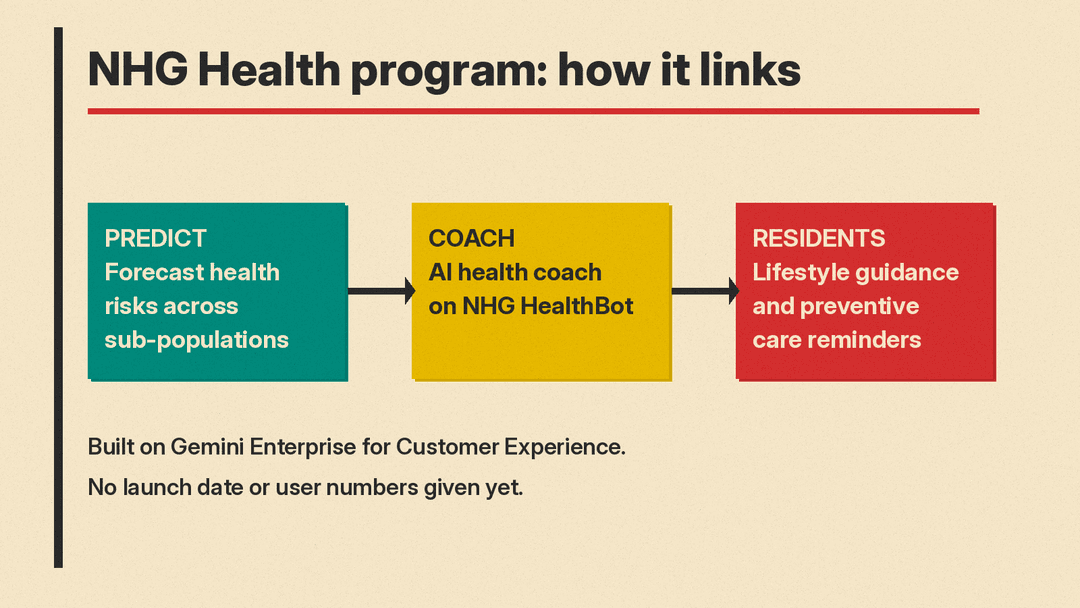
The consumer-facing part comes from Google Cloud. It is partnering with NHG Health on a population health program that "uses AI-driven predictive insights to forecast health risks, such as chronic conditions, across sub-populations."
Those forecasts feed "an AI health coach on the NHG HealthBot," built on Google's Gemini Enterprise for Customer Experience platform. Google says the coach will "deliver personalized lifestyle guidance and preventative care reminders to residents." The post does not say when residents can use it or how many people it will reach.
The $7 million grant and PathGen
Google says Google.org and Google DeepMind "are contributing $7 million to the Philanthropy Asia Alliance's Health for Human Potential Coalition." Of that, $1 million goes to PathGen, which Google describes as "an AI platform that uses Google technology to help countries detect disease threats faster and share data for public health intelligence while protecting in-country data sovereignty."
The $7 million figure is not new. The May DeepMind post already described "Google.org's $7 million funding contribution" to the same coalition, tied to infectious disease research and pandemic preparedness in Southeast Asia. What the October post adds is the $1 million figure for PathGen.
PathGen's own site says it "unifies genomic, epidemiological, and field context on one map" while "raw sequence data remains under institutional custody." In plain terms: countries can compare outbreak data without handing over their raw genome files.
Why it matters
Three things stand out.
First, the design stresses keeping data local. Google ties MedGemma to "full data sovereignty," and PathGen says raw sequence data stays with each institution. Google uses the phrase "data sovereignty" twice in one post. That matters for health systems that want to keep patient data in the country.
Second, Singapore is a test bed. Google says pairing its work with Singapore's health institutions "will help build a future-ready system that serves as a blueprint for scaling AI safely for public good." The blueprint wording suggests Google sees the Singapore work as a model it could repeat in other countries. The May post places the Singapore work under Google DeepMind's National Partnerships for AI initiative, and it cites a Public First estimate that faster AI-enabled R&D could add S$3.3 billion (US$2.5 billion) in economic value in Singapore by 2040.
Third, most of the clinical pieces are still at the test stage. The co-clinician is under evaluation, MedGemma is being brought to care settings, and the health coach has no launch date. The post gives no results, accuracy figures or patient numbers yet. Those are the details to watch for.
For a wider view of where AI is already used in care, see our guide to AI in healthcare: 12 real uses today. For DeepMind's earlier science tools, see our post on DeepMind's Co-Scientist moving into lab workflows.
