
Radical Numerics said on October 20, 2026 that phages designed by its genome language model Omnii-1 were given to a human patient with an antibiotic-resistant bacterial infection. The company calls it the world's first clinical use of AI-generated phages. The company is not saying what happened to the patient.
This post describes a company announcement and reporting about it. It is not medical advice. Nothing here should be used to evaluate a treatment for yourself or anyone else.
What the company disclosed
Phages, short for bacteriophages, are viruses that infect bacteria. Most of the uses in our 12 real uses of AI in healthcare are paperwork, imaging, alerts and operations, so a designed therapeutic is a different category of claim. Radical Numerics says it trained Omnii-1, a multimodal genome language model, on genomic sequences and multiomics data and then on phage genomes, and used it to generate phage variants, rank them by predicted activity against particular bacterial strains, and predict which phages can infect which hosts.
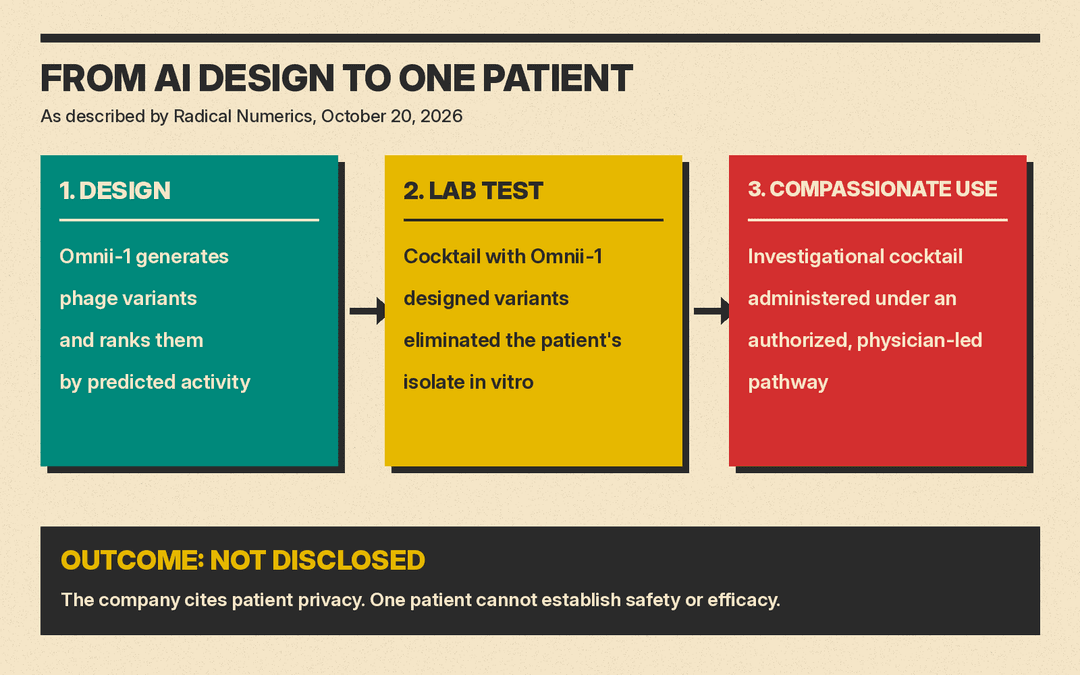
According to the company's technical report, a cocktail containing Omnii-1-designed phage variants eliminated the patient's antibiotic-resistant isolate in laboratory (in vitro) testing. The investigational cocktail was then administered to the patient "under an authorized, physician-led compassionate-use pathway."
The report also sets out what the company will not say. It states that it is not disclosing details of the patient's clinical course or outcomes, because even limited clinical information could make the patient identifiable. It adds that the therapies "have not been approved by regulatory bodies for broader clinical use, and observations from a single patient cannot establish general safety or efficacy." No outcome of any kind has been claimed.
What the New York Times added
A New York Times story by Carl Zimmer, read here in a syndicated copy at GV Wire, fills in some context the technical report does not.
Per the New York Times: the report has not been peer reviewed or published in a scientific journal. Company officials said the trial was authorized by the Food and Drug Administration. The company declined to provide information about the patient or the doctors running the trial, citing confidentiality requirements. Chief executive Eric Nguyen told the paper, "We take our responsibility to protect patient confidentiality and maintain the trust of our clinical partners extremely seriously," and said the company intends to publish its scientific findings through peer-reviewed research.
Per the New York Times, the phage the team modified is T7, which infects E. coli. Omnii generated new viral genes altering the shape of the protein structures T7 uses to attach to a bacterial surface, and the patient's E. coli infection had resisted both antibiotics and the available phages. The paper notes that phage therapy can run for days or weeks and that doctors typically monitor patients for months in case an infection rebounds, so it will take a while to know whether the phages succeed.
Outside experts greeted the news "with curiosity, and a wait-and-see attitude," per the New York Times. Michael Baym, a Harvard microbiologist not involved in the work, said "If it works, that's incredible," and also said he would reserve judgment until the treatment is finished and the novelty of the company's viruses can be examined: "My impulse is to be skeptical." Dr. Marisa Azad, an infectious disease clinician at the Ottawa Hospital who is working on a collaboration with Radical Numerics, described the underlying bottleneck the company is aiming at: "Hunting for phages is remarkably time-consuming."
How the design step works
The company's framing is that AI does not need to write a phage genome from scratch. It edits selected regions tied to a specific function. In the T7 work described in the report, the target was gp17, the receptor-binding tail fiber protein that helps determine which bacterial strains the phage can recognize, with the model generating DNA using context on both sides of the design region so the rest of the genome stays intact.
The report gives in-house numbers for that loop. At 11 to 15 amino acid changes from wild type, the company says 69.9% of designed variants were recovered after rebooting, against 4.8% of random controls. Of 6,694 variants with measurable activity, it says 2,161 exceeded wild type, some with up to 28 amino acid changes, while random controls that beat wild type had at most five. These are the company's own unreviewed figures.
The compassionate-use pathway
Compassionate use, as the company describes it, lets patients with serious conditions receive an investigational therapy outside a clinical trial when satisfactory alternatives are not available, subject to regulatory oversight and safety requirements. It is a route for an individual patient, not an approval and not an efficacy finding.
Why one case proves nothing
A single compassionate-use administration, with no disclosed outcome, cannot show that a treatment works or that it is safe. The company says so itself.
Background
Phage therapy is more than a century old and has had a renaissance as antibiotic resistance has spread, the New York Times notes. The AI thread is newer. In 2025, researchers at the Arc Institute built a model called Evo 2, trained on millions of DNA sequences including phage genes, and prompted it to produce new genomes; per the New York Times, it generated 700,000 virus genomes, the team synthesized DNA from 285 of them, and 16 gave rise to viable viruses. Three members of the Evo team, including Nguyen, left to found Radical Numerics, which unveiled Omnii in June 2026.
For other places AI is already used in medicine, see our overview of AI in healthcare: 12 real uses today. For another case where an AI-assisted scientific claim still awaits independent confirmation, see our post on hobbyists who used Claude Code to find possible exoplanets in NASA TESS data.
The things to watch next: the peer-reviewed paper Nguyen says the company intends to publish, the look at how novel the designed phages are that Baym is waiting for, and clinical data from more than one patient. For one test of unreviewed AI-generated science in another field, see the 135 follow-up papers AI agents wrote for Department of Energy lab scientists; none met the bar the lab scientists set.
