
AI in healthcare is easiest to judge by looking at where it is already running. This list covers 12 uses with a named tool, a named hospital, health plan or trial, and a link to a primary or reputable source for each. It describes how organizations use these systems. It is not medical advice, and none of the tools below replaces a clinician's judgment. Tool status is as reported in each source, checked as of October 2026.
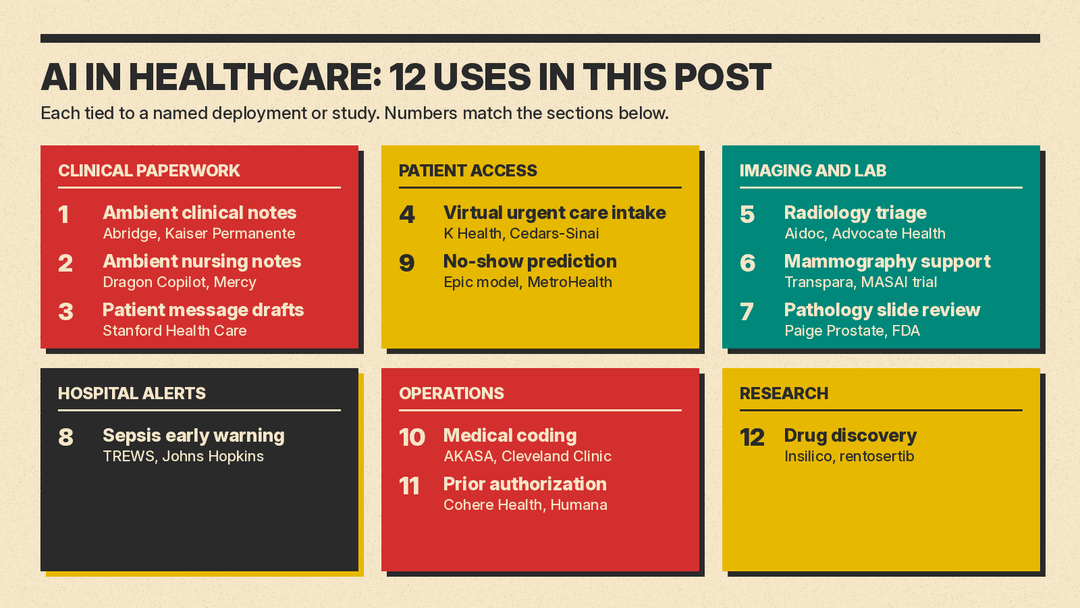
The uses fall into six groups: clinical paperwork, patient access, imaging and lab, hospital alerts, operations, and research. In most of them, a clinician or staff member reviews the output.
1. Ambient clinical notes: Abridge at Kaiser Permanente
Ambient documentation tools listen to a visit, with consent, and draft the clinical note. On August 14, 2024, Kaiser Permanente announced that a documentation tool powered by ambient listening technology from Abridge was available to doctors and other clinicians at its 40 hospitals and more than 600 medical offices in eight states and the District of Columbia. Kaiser said the tool requires patient consent and that clinicians review the notes before they enter the medical record. A Kaiser spokesperson told Healthcare Dive that testing included assessments by more than a thousand clinicians across its markets.
Why it matters: Kaiser says the tool is meant to cut the time doctors spend on administrative tasks, and this was a systemwide deployment rather than a pilot. Kaiser described it as the largest implementation to date of ambient listening technology in the United States.
2. Ambient nursing notes: Microsoft Dragon Copilot at Mercy
The same idea is now moving to nurses. Mercy said on November 4, 2025 that the ambient nursing capability in Microsoft Dragon Copilot was in use on inpatient units at Mercy hospitals in St. Louis and Springfield, Missouri, and Fort Smith, Arkansas. Nurses narrate care, and the tool turns that narration into flowsheet documentation that they review, edit and file into the electronic health record. Mercy said it was one of nine health systems working with Microsoft on the product.
Mercy published metrics that it attributed to Microsoft, including a 21% reduction in documentation latency and 8 to 24 minutes saved per shift for high-use nurses. These are vendor-provided figures, not a peer-reviewed study.
3. Patient message drafts: Stanford Health Care
Answering patient portal messages adds to clinician workload. Stanford Health Care tested a large language model, integrated into the electronic health record, that drafts replies for clinicians to review and edit before sending. The JAMA Network Open study ran for five weeks from July 10 to August 13, 2023, in primary care and gastroenterology and hepatology, and included 162 clinicians in the analysis.
The mean draft utilization rate was 20%. The study found no change in reply, write or read time, but it did find statistically significant reductions in task load and work exhaustion scores. Stanford Medicine's summary put it plainly: clinicians reported less burden despite objective findings that the drafts did not save time. That gap between perceived and measured benefit is worth keeping in mind for every tool on this list.
4. Virtual urgent care intake: K Health at Cedars-Sinai Connect
Cedars-Sinai Connect is a virtual primary and urgent care program that uses AI from K Health. According to Cedars-Sinai, patients start a visit in a mobile app where an AI model runs a structured interview, about 25 questions in five minutes on average, before the patient can start a video visit with a physician. The system also suggests management options that the treating physician can view.
A retrospective study in the Annals of Internal Medicine compared initial AI recommendations with final physician decisions in 461 visits from June 12 to July 14, 2024. They agreed in 56.8% of visits. Adjudicators rated AI recommendations optimal more often than physician decisions (77.1% vs 67.1%). The authors list clear limits: a single center, adjudicators who were not blinded, and no way to know whether physicians viewed the AI recommendations. K Health funded the work.
5. Radiology triage: Aidoc at Advocate Health
Triage tools flag imaging studies that may show an urgent finding so radiologists can read them sooner. Advocate Health announced on July 16, 2025 that it would expand its use of Aidoc's aiOS platform, which embeds FDA-cleared algorithms in imaging workflows. In a pilot that began in October 2024 at 22 sites in Wisconsin and North Carolina, Advocate used three Aidoc algorithms that help radiologists flag pulmonary embolisms, incidental pulmonary embolisms and intracranial hemorrhages.
Advocate said the expansion would add conditions including cervical spine fractures, rib fractures, pneumothorax and aortic dissection. Its estimate that nearly 63,000 patients a year will benefit comes from internal modeling and early pilot outcomes, not a published trial.
6. Mammography support: Transpara in Sweden's MASAI trial
This entry rests on a randomized trial. MASAI, run within the Swedish national screening program at four sites in southwest Sweden, assigned 105,934 women to AI-supported screening or standard double reading by radiologists. The AI system was Transpara from ScreenPoint Medical, used to route exams to single or double reading and to highlight suspicious findings.
In results published in The Lancet Digital Health00267-X/fulltext) in February 2025, the AI-supported group had a cancer detection rate of 6.4 per 1,000 vs 5.0 per 1,000 in the control group, with no significant rise in false positives and a 44.2% lower screen-reading workload. A later analysis of the trial's primary outcome in The Lancet reported a non-inferior interval cancer rate and the same specificity, 98.5%, in both groups. In the AI arm, exams were still read by one or two radiologists, with the AI deciding which.
7. Pathology slide review: Paige Prostate
Digital pathology tools analyze scanned biopsy slides. On September 21, 2021, the FDA authorized marketing of Paige Prostate through the De Novo pathway and described it as the first AI-based software designed to identify an area on a prostate biopsy image with the highest likelihood of harboring cancer. In the study the FDA reviewed, 16 pathologists read 527 slide images with and without the software, and it improved detection of cancer on individual slide images by 7.3% on average.
The FDA authorization letter is explicit about limits. The software is adjunctive, runs after the pathologist's initial review, and its output should not be used as the primary diagnosis. The FDA also noted that the study did not evaluate the effect on final patient diagnosis.
8. Sepsis early warning: TREWS at Johns Hopkins
Sepsis alerts scan electronic health record data for signs that a patient may be developing sepsis. TREWS, the Targeted Real-time Early Warning System, was deployed from 2018 at five hospitals in the Maryland and DC area, including Johns Hopkins Hospital, Bayview Medical Center, Howard County General Hospital, Suburban Hospital and Sibley Memorial Hospital.
A prospective study in Nature Medicine covered 590,736 monitored patients. Among 6,877 sepsis patients flagged before antibiotics started, those whose alert a provider confirmed within three hours had an adjusted absolute in-hospital mortality reduction of 3.3% compared with those whose alert was not confirmed within three hours. A companion paper found that 89% of alerts were evaluated by a physician or advanced practice provider. Both papers measure associations with provider response, not a randomized comparison.
9. No-show prediction: Epic's model at MetroHealth
Missed appointments waste clinic time and delay care. MetroHealth, a safety-net system in Cleveland, used a no-show prediction model developed by Epic and localized to its own data. Schedulers called patients with a predicted no-show risk of 15% or higher, on top of standard automated reminders.
In a randomized quality improvement study published in the Journal of General Internal Medicine, the group that got calls had a no-show rate of 32.8% vs 36.2% for standard care. The largest improvement was among Black patients (35.8% vs 42.1%). The authors deliberately did not use the model for overbooking, which they warned could worsen access for the patients it flags.
10. Medical coding: AKASA at Cleveland Clinic
Coding turns clinical documentation into billing codes. Cleveland Clinic said on April 29, 2025 that it would deploy generative AI tools from AKASA in its mid-revenue cycle across its U.S. locations. Coders get an AI coding assistant, and a second tool for clinical documentation integrity was in a pilot.
Cleveland Clinic said its revenue cycle staff typically review more than 100 clinical documents per case and choose from more than 140,000 codes, which can take up to an hour per encounter. Oracle Health has added automated professional fee coding to its Clinical AI Agent; we covered that coding and chart review update in August.
11. Prior authorization: Cohere Health at Humana
Prior authorization is the insurer approval step before some services. Cohere Health's case study on Humana, published in August 2026, says the partnership started in January 2021 for musculoskeletal requests in 12 states and has since expanded to all 50 states and more than 5.1 million members. The platform lets physicians submit a projected care pathway and compares it against clinical standards. For musculoskeletal requests, it approves what it can instantly and flags the rest for manual review.
The case study reports an 89% auto-approval rate and 95% provider portal adoption. Cohere notes that the figures come from its internal engagement data for a single health plan and are not guaranteed. Treat them as vendor claims.
12. Drug discovery: Insilico Medicine's rentosertib
AI is also used before any patient sees a drug. Insilico Medicine used generative AI to identify a target, TNIK, and to design rentosertib (formerly ISM001-055) for idiopathic pulmonary fibrosis. A randomized, placebo-controlled phase 2a trial of 71 patients was published in Nature Medicine on June 3, 2025.
The primary endpoint was safety, and rates of treatment-emergent adverse events were similar across arms. The highest dose group showed a mean forced vital capacity change of +98.4 ml vs -20.3 ml for placebo over 12 weeks. The authors call for larger and longer trials. A phase 2a result is an early signal, not an approved treatment. Clinical trial design is another target for AI; see our post on QuantHealth's trial simulation funding.
Limits and caveats
- Most evidence is not randomized. MASAI and the MetroHealth study are randomized. The TREWS, Cedars-Sinai and Stanford results are observational or single-group, and the Mercy, Advocate and Humana figures come from health systems or vendors.
- Perceived benefit and measured benefit can differ. Stanford's clinicians reported less burnout while the measured reply time did not change.
- A human stays in the loop. Kaiser and Mercy clinicians review notes, Stanford clinicians edit drafts, Paige Prostate is adjunctive, and exams in MASAI's AI arm were still read by radiologists. The sources describe support tools, not replacements.
- Local results may not transfer. MetroHealth localized and validated Epic's model on its own data and checked performance by race before using it. A model that works in one system can drift in another.
- Equity needs active checking. The MetroHealth authors warned that no-show models could worsen access if used for overbooking.
- Funding and authorship matter. K Health funded the Cedars-Sinai study, and the Cohere and Microsoft figures are company data.
- Regulatory status varies by tool and country. An FDA clearance or De Novo authorization covers a specific intended use, as the Paige Prostate letter shows. The coding, scheduling and prior authorization tools here are not described as FDA-cleared in their sources.
If you are a patient, the practical takeaway is narrow: these tools mostly change paperwork, queues and alerts behind the scenes. Questions about your own care belong with your clinician.
Sources
- Kaiser Permanente: AI-enabled clinical documentation with Abridge (Aug 14, 2024)
- Healthcare Dive: Kaiser Permanente rolls out Abridge's AI documentation tool
- Mercy: AI tool for nursing with Microsoft Dragon Copilot (Nov 4, 2025)
- JAMA Network Open: AI-generated draft replies to patient inbox messages
- Stanford Medicine: AI assists clinicians in responding to patient messages
- Cedars-Sinai: AI has potential to aid physician decisions during virtual urgent care
- Annals of Internal Medicine: initial AI vs final physician recommendations in virtual urgent care
- Advocate Health: agreement with Aidoc (Jul 16, 2025)
- The Lancet Digital Health: MASAI screening performance00267-X/fulltext)
- The Lancet: MASAI interval cancer, sensitivity and specificity
- FDA press release via PR Newswire: FDA authorizes software that can help identify prostate cancer (Sep 21, 2021)
- FDA De Novo letter DEN200080, Paige Prostate
- Nature Medicine: TREWS prospective multi-site outcomes study
- Nature Medicine: TREWS provider adoption study
- Journal of General Internal Medicine: predictive model-driven appointment reminders at MetroHealth
- Cleveland Clinic: collaboration with AKASA on revenue cycle AI (Apr 29, 2025)
- Cohere Health: Humana prior authorization case study (Aug 2026)
- Nature Medicine: rentosertib phase 2a trial in idiopathic pulmonary fibrosis
