
OpenAI, the AI-native biotechnology company PerturbAI and Scripps Research say they used GPT-Rosalind agents to work through data from millions of mouse brain cells in 32 minutes. The OpenAI post and a PerturbAI press release came out on October 21, 2026, alongside a joint bioRxiv preprint. PerturbAI describes the goal as helping to "identify promising hypotheses for scientists to test." PerturbAI says the two companies will now apply the approach to look for new drug targets.
What the agents did
The dataset is a whole-brain CRISPR atlas. OpenAI describes it as "a dataset showing how gene disruptions affect different types of cells across the mouse brain." PerturbAI says its discovery engine launched in March 2026 with an "8-million-cell, brain-wide CRISPR atlas" that has been downloaded more than 40,000 times.
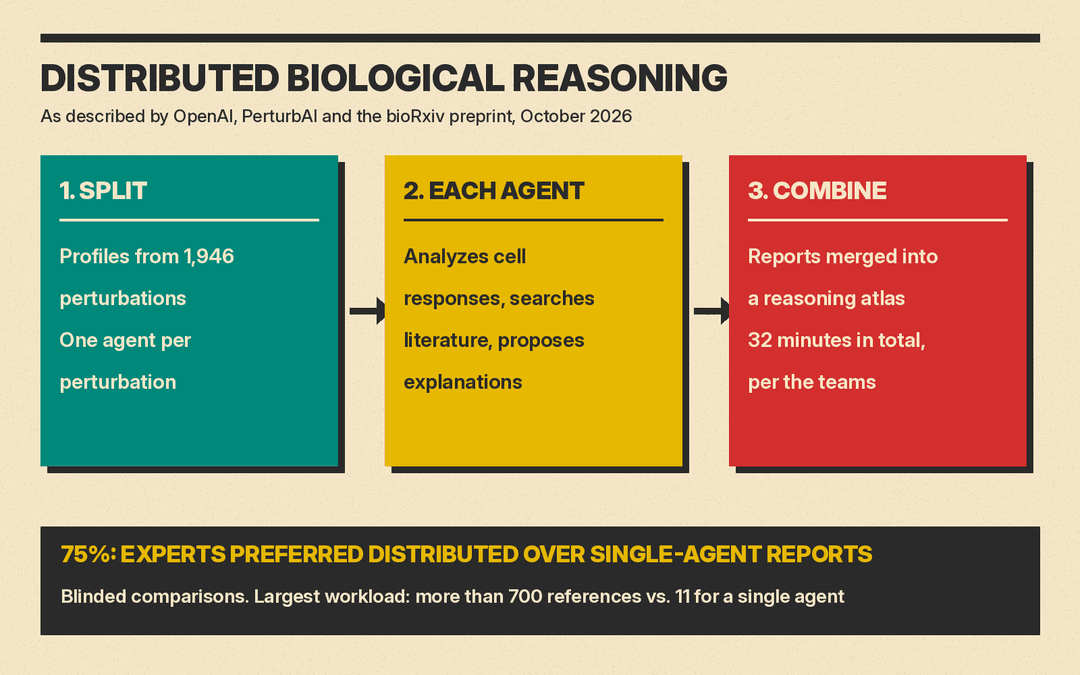
OpenAI calls the method "distributed biological reasoning." According to the preprint, the cell-type profiles from 1,946 perturbations were given to independent agents, one agent per perturbation. OpenAI says each agent "investigated a gene disruption, analyzed cellular responses, searched scientific literature, and proposed explanations for the results." The reports were then combined into a "reasoning atlas" that links genes, cellular effects, publications and possible mechanisms. OpenAI says the reasoning atlas is available for researchers to explore.
The preprint says the source manuscript and its conclusions were withheld from the agents.
The numbers the teams report
- 32 minutes for the analysis and synthesis, per OpenAI and PerturbAI. The research team estimated that comparable human analysis and literature review, "conducted one perturbation at a time," would take "months to a year."
- 75%: in blinded comparisons, human experts preferred the distributed-agent reports over single-agent reports 75% of the time, OpenAI says.
- More than 700 references vs. 11: OpenAI says it tested one agent on the whole dataset with the same model and resources. At the largest workload, the single agent cited 11 references and the distributed agents cited more than 700.
- 71 source-study findings: the preprint's Figure 1 sorts them into 35 matched, 13 refined, 9 partially recovered and 14 not covered.
Joy Jiao, Head of Life Sciences at OpenAI, said in the PerturbAI release: "Running nearly 2,000 agents in parallel shows how we can scale biological interpretation alongside high-throughput experimentation, helping researchers turn those findings into better medicines."
Two leads the agents surfaced
Tsc1 vs. Tsc2. These two genes work together to control mTOR, which OpenAI calls "a major regulator of cell growth, metabolism, and aging." Disrupting either gene had similar effects in several groups of neurons. In the cerebellum, Tsc2 disruption changed the activity of dozens of genes involved in neuronal communication, while Tsc1 disruption produced little change. OpenAI says that difference "may be relevant to human disease," because cerebellum abnormalities in people with tuberous sclerosis are strongly linked to TSC2 mutations.
DCTN1 and cholesterol. Mutations in DCTN1 cause Perry syndrome, a neurodegenerative disease with Parkinson-like symptoms. In the atlas, disrupting Dctn1 increased the expression of genes involved in making cholesterol. The agents connected this with research suggesting that problems with cholesterol transport may cause cells to make more cholesterol. OpenAI frames the next step as questions: "could DCTN1 disruption change how cholesterol is distributed within neurons, and could those changes contribute to neurodegeneration?" OpenAI says human experts also considered this hypothesis "novel, consequential and worth following up on."
Tomasz Nowakowski, an associate professor of neurological surgery at UCSF, said in the OpenAI post: "The possible link between neuronal function and cholesterol metabolism shows how those pieces, once brought together, can give us a new way to think about disease biology."
What the sources do not claim
- No lab test yet. OpenAI says the findings "help prioritize further experiments needed to test the proposed biological mechanisms." The Tsc and DCTN1 items are leads, not confirmed mechanisms.
- Mouse data. The atlas comes from mouse brain cells. For the Tsc result, OpenAI says only that the difference "may be relevant to human disease."
- Not full recovery. Of the 71 source-study findings in Figure 1, 14 were not covered.
- Time estimate. The "months to a year" figure is the research team's own estimate of serial human work.
OpenAI ends its post with: "Scientists remain at the center of discovery."
What comes next
PerturbAI says the work builds on a year-long collaboration with OpenAI that "is now expanding into joint drug-target discovery," using PerturbAI's "proprietary causal biological data." The company says it is pursuing multiple targets already surfaced through its engine, and that it closed a pre-seed round in Q3 2025.
For other AI-in-biology work on llms.blog, see our report on AI-designed phages given to a patient and our overview of AI in healthcare: 12 real uses today.
