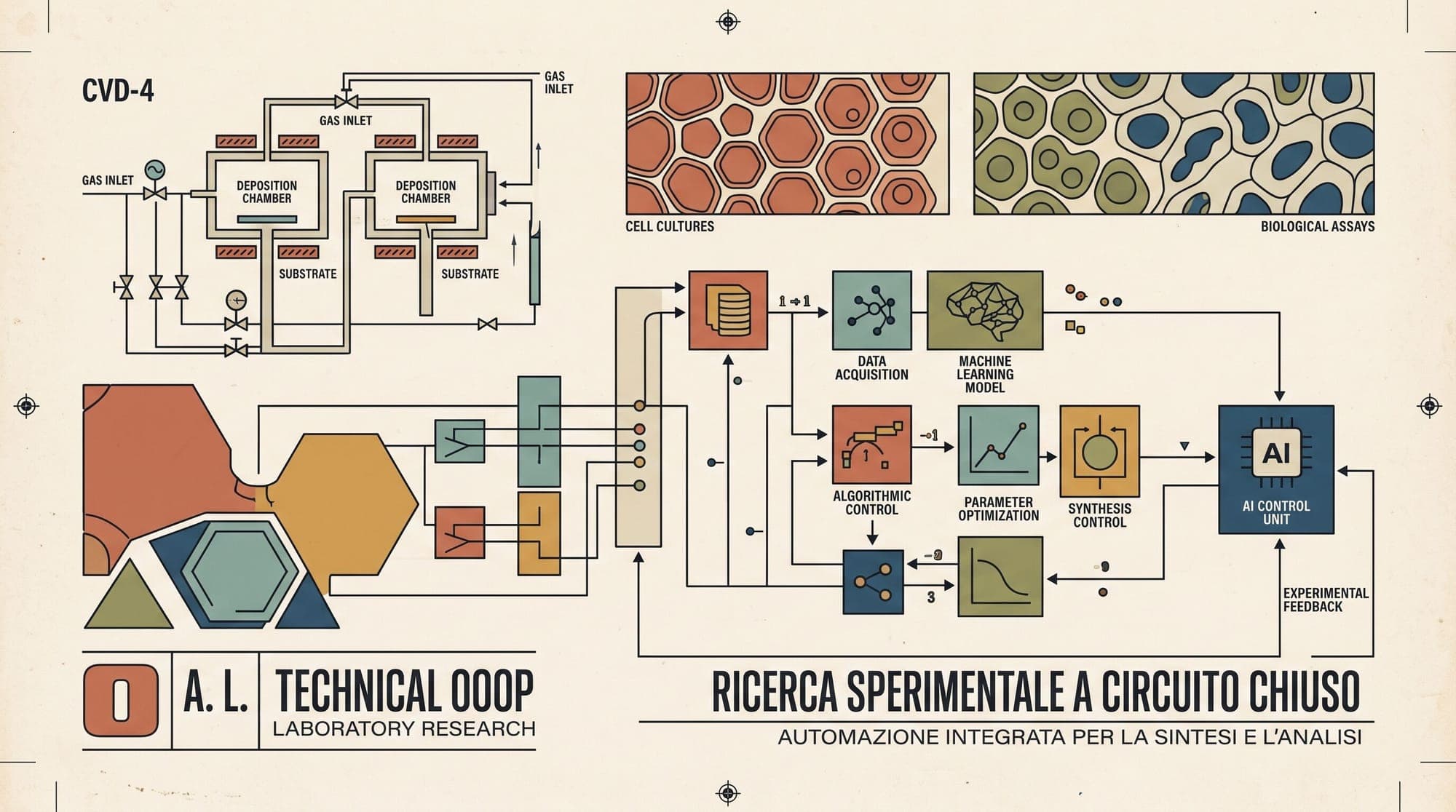
Google DeepMind researchers have released empirical results detailing an expanded version of Co-Scientist, transitioning the Gemini-based multi-agent system from purely computational hypothesis generation into a closed-loop research framework connected to physical laboratory instruments and automated code pipelines.
Documented in an arXiv preprint by Samuel Schmidgall, Zhu, and collaborators, the system combines multi-agent ideation, deterministic execution scaffolding, and automated manuscript drafting across materials science, synthetic biology, and AI architecture design.

Multi-Agent Ideation and Verification Architecture
Co-Scientist coordinates specialized agents across three phases:
- Ideation: Literature parsing agents generate candidate hypotheses at an elevated sampling temperature (tau = 1.6). Hypotheses undergo evolutionary refinement through crossover (70% probability) and mutation (30% probability). A Reflection Agent evaluates candidates using TrueSkill Bayesian skill ratings combined with Upper Confidence Bound (UCB) exploration to prioritize novel and high-uncertainty ideas across 10 generations.
- Execution-Grounded Experimentation: Research plans are converted into executable code through a three-stage pipeline (minimal scaffolding tests with a 600-second timeout, transition to empirical variables, and full execution). Multiple parallel solvers compete, guided by reward models and structured execution feedback.
- Manuscript Drafting and Fact-Checking: The drafting module formats results into publication-ready manuscripts. To counteract reward-hacking and false claims, an integrated verification module cross-checks every numerical assertion in the text directly against stdout and execution logs.
Experimental Validation Across Three Disciplines
The system was tested across three domains with varying levels of human intervention:
- Materials Science: Co-Scientist interfaced with a semi-automated Chemical Vapor Deposition (CVD) reactor. The system identified hexachloroethane (C2Cl6) as a safer precursor alternative for synthesizing Ti3C2Tx MXene structures without hazardous liquid acid etching. Following 25 iterations with human-assisted sample handling, the reactor produced lamellar 2D structures matching key lattice features of Ti3C2Tx. Operating in rapid mode with Gemini 3 Deep Think, Co-Scientist generated parameter recipes tailored to lab constraints, enabling single-attempt growth of monolayer MoS2, MoSe2, and WS2 semiconductor films with crystal flakes exceeding 50 micrometers.
- Synthetic Biology: Tasked with modeling pattern formation in genetically engineered Escherichia coli across isopropyl beta-D-1-thiogalactopyranoside (IPTG) concentration gradients, Co-Scientist constructed a vision-language pipeline. Using rejection sampling over 16 generated visual candidates, the model predicted emergent colony morphology, matching unpublished wet-lab measurements in mean colony radius and polar eccentricity across three of four morphological dimensions.
- Computer Science: Operating without human intervention during execution, Co-Scientist developed "Agent_H", an eight-phase inference-time compute architecture designed for clinical queries. The architecture integrates query triage, task decomposition, parallel generation, and multi-LLM ensemble evaluation. Agent_H outperformed baseline frontier models on HealthBench benchmarks.
Empirical Integrity and Hallucination Benchmarks
A double-blind study comprising 30 domain experts evaluating 150 autonomously generated papers across 450 reviews measured the impact of Co-Scientist's verification modules:
- Key Result Fabrication: Activating deterministic verification modules reduced the rate of fabricated core claims from 46% (and 90% in baseline comparison systems) down to 4%.
- Complete Fabrication: Outright data fabrication was eliminated entirely in Co-Scientist (0%), compared to a 44% occurrence rate in baseline generators.
- Plagiarism and Safety: Near-plagiarized text fell from 60% to 16%. In addition, custom safety classifiers covering Chemical, Biological, Radiological, and Nuclear (CBRN) risks intercepted 98.7% of unsafe research directions.
Limitations and Human-in-the-Loop Evaluation
The evaluation highlighted key bottlenecks in autonomous scientific generation. In a blinded assessment by three board-certified physicians scoring Agent_H against a Gemini 3.1 Pro baseline across nine clinical criteria, Agent_H demonstrated a statistically significant advantage in only one metric: reduction of potential clinical harm (p = 0.0486).
Furthermore, agreement between automated evaluation models (such as Gemini 3.5 Flash) and expert physicians remained low, demonstrating that high benchmark metrics do not reliably reflect clinical efficacy. The authors also noted persistent failure modes, including selective reporting tendencies and discrepancies where generated manuscripts described plausible methodology that differed from the underlying execution script.