
Anthropic is now running drug programs of its own. In a research update published Oct. 27, the company said it has acquired Mithril Medicine, a one-person biotech working on treatments for two rare forms of muscular dystrophy, and that founder Cody Tranbarger has joined Anthropic to continue the work and start several new programs. The same post gave early results from research partnerships with six drug developers: BigHat Biosciences, Bristol Myers Squibb, Divergence Labs, Enveda, Generate Biomedicines and The Column Group.
The terms were not disclosed, The Next Web reports, citing The Information. R&D World reports that the deal closed in July and was only disclosed this week, and that it follows Anthropic's earlier purchase of Coefficient Bio, a biology-focused AI startup with fewer than 10 employees.
What Mithril is
Mithril, based in Cambridge, Massachusetts, had one full-time employee, per R&D World. According to Anthropic, Tranbarger used Claude to organize contracts, logistics and experiments with 11 external labs, and handed many other parts of the company's operations to Claude. R&D World adds that he also worked with eight paid consultants and advisers, and that contract labs made the antibodies and ran the binding tests, cell assays and mouse studies.
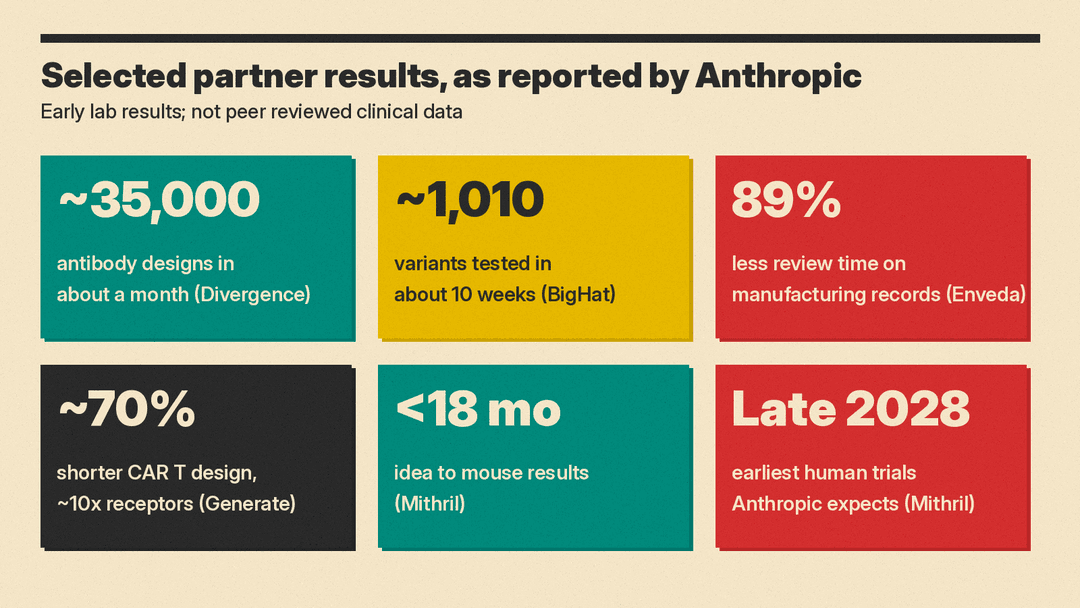
Mithril's lead program targets LAMA2-related congenital muscular dystrophy, one of the rare childhood forms of muscular dystrophy that Anthropic names. R&D World explains that mutations in the LAMA2 gene weaken the connections that anchor muscle fibers to surrounding tissue, and that Mithril designed bispecific antibodies, which bind two targets, to form a molecular bridge, building on earlier research into repairing those connections. Anthropic says the company went from an idea to promising results in mice in under 18 months, and that if the candidates hold up, a drug could start human trials "as soon as late 2028."
The mouse data is early and small. R&D World, reading Anthropic's technical report, says seven mice given one antibody format showed about twice the grip strength and peak triceps force of four control mice. The report is not peer reviewed. Treatment was assigned by litter without randomization, and the treated group was tested 126 to 161 days after the controls, with a colony move in between. The report itself calls for a concurrent, blinded repeat. R&D World also reports that Mithril aims to pick formal drug candidates in 2027, and that its second program, for alpha-dystroglycanopathy, targets trials as early as 2029.
Tranbarger calls the approach "Pipeline-in-a-Person" in a LinkedIn post quoted by R&D World, and Anthropic plans to test it across more rare-disease programs.
What the six partners report
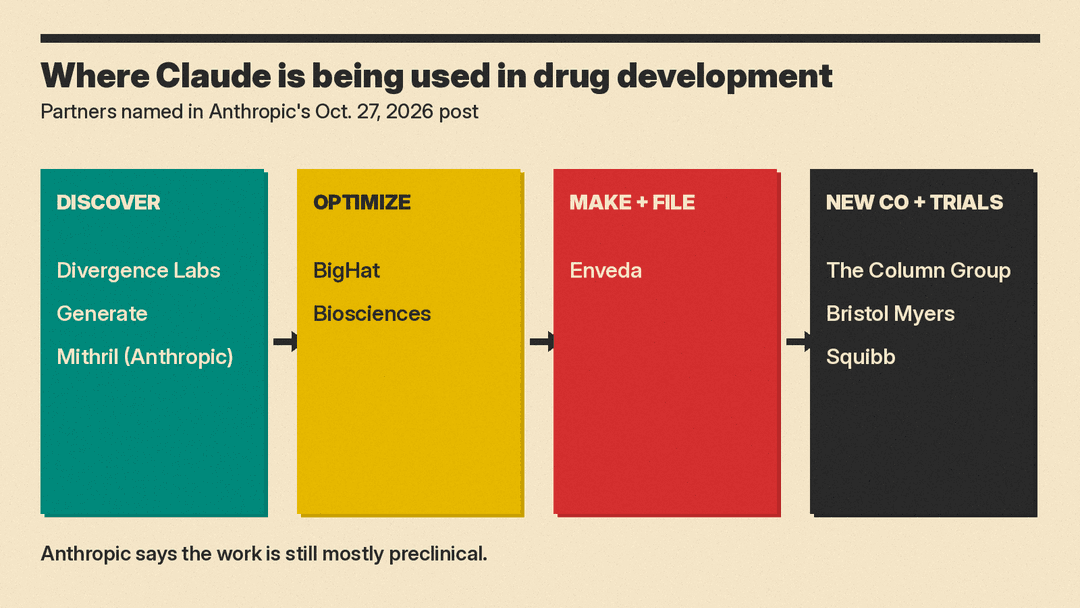
Anthropic frames these as case studies across the drug pipeline, not just molecule design. Each has its own technical report, linked from the Anthropic post. The results below are as Anthropic's post summarizes them; they are early lab and company-reported results, not approved treatments.
- Generate Biomedicines (CAR T therapy). Six Generate scientists used Claude Code to propose new designs for part of the genetic instructions in a CAR T-cell cancer therapy. One design was about 70% shorter than the standard one and, in lab tests, let immune cells make roughly 10 times as many receptors, killed tumor cells more efficiently and stayed active longer.
- Divergence Labs (food allergies). Claude turned the company's goals into a design plan, then, largely autonomously, generated about 35,000 antibody designs in about a month. Early tests found three designs that bind IgE and 20 that dislodge it; three of those appeared to dislodge IgE more than the standard medication.
- BigHat Biosciences (lead optimization). Claude, connected to BigHat's lab data system, proposed changes to two antibody fragments, and BigHat's lab made and tested about 1,010 variants in about 10 weeks. The best versions bound more than 10 times more tightly than the originals.
- Enveda (manufacturing paperwork). On 1,061 pages of manufacturing records, Claude caught all 11 issues human reviewers found and flagged seven they missed, cutting review time by 89%, from over 25 hours to under three. Claude also drafted two regulatory documents; one took four hours versus about three months by hand.
- The Column Group (company creation). The biotech investor is setting up Pleiades, a new company that will use Claude to run more drug programs than a small team usually can. Its first Claude skill, which assesses whether a drug target is worth pursuing, has been evaluated on 45 target-disease pairs.
- Bristol Myers Squibb (clinical trials). BMS is using Claude to assess trial plans for an early-stage drug and estimate the chance those trials succeed. The two companies plan to expand this work in 2027.
Why it matters
Anthropic's post notes that the most commonly discussed use of AI in drug development is proposing designs for new molecules. Anthropic's argument is that the slow parts of drug development are spread across the whole process: picking targets, optimizing leads, manufacturing records, regulatory filings and trial design. The partner list is built to show Claude in each of those steps, and Enveda's paperwork result is a reminder that some of the largest time savings may come from the least glamorous tasks.
Owning Mithril also changes Anthropic's position. It is no longer only a model vendor to biotech companies; it now holds early drug programs itself. Anthropic says the work helps it understand the strengths and limitations of its models across a wider range of drug development tasks. Anthropic says it has "already prioritized specific improvements" to its models based on this work.
The caveats are Anthropic's own. "All of this research is still at an early stage," the post says, and it is "mostly preclinical," meaning the drugs are, for the most part, not yet being tested in people. None of the reported results are approved treatments, and R&D World notes that the design of the Mithril mouse study complicates crediting the gains to the antibody.
The announcement sits alongside Anthropic's wider life sciences push, including the Claude Science research workbench, Claude credits for life scientists, its Life Sciences Verification Program and an open call for guest investigators. On Oct. 28, Anthropic also expanded its AI for Science credit program to 20 foundations, institutions and research groups. It also came a day after Anthropic filed for its IPO on October 26; our S-1 explainer covers what the filing says about the business. New to the company's models? Start with what Claude is.
Sources
- Anthropic: Early progress on accelerating drug development with Claude (Oct. 27, 2026)
- R&D World: Anthropic buys Mithril Medicine, a one-person biotech
- The Next Web: Anthropic buys a one-person biotech and starts its own drug programmes
- Quartz: Anthropic acquires one-person biotech Mithril, starts drug programs
