
India's national cyber agency has published guidelines for how AI systems should be audited. The Indian Computer Emergency Response Team (CERT-In) released its 107-page "Artificial Intelligence (AI) Security Auditing Guidelines" on November 4, 2026. The cover of the CERT-In PDF reads "Version 1.0" and "04 November 2026". We downloaded and read the full PDF. Page numbers below are its printed page numbers.
The document sets four risk tiers, a six-hour incident deadline, 180-day log retention and extra rules for AI agents. Outlets disagree on how binding it is and on whether it is final or "proposed". This post separates what the PDF says from what outlets report.
Four tiers from eight factors
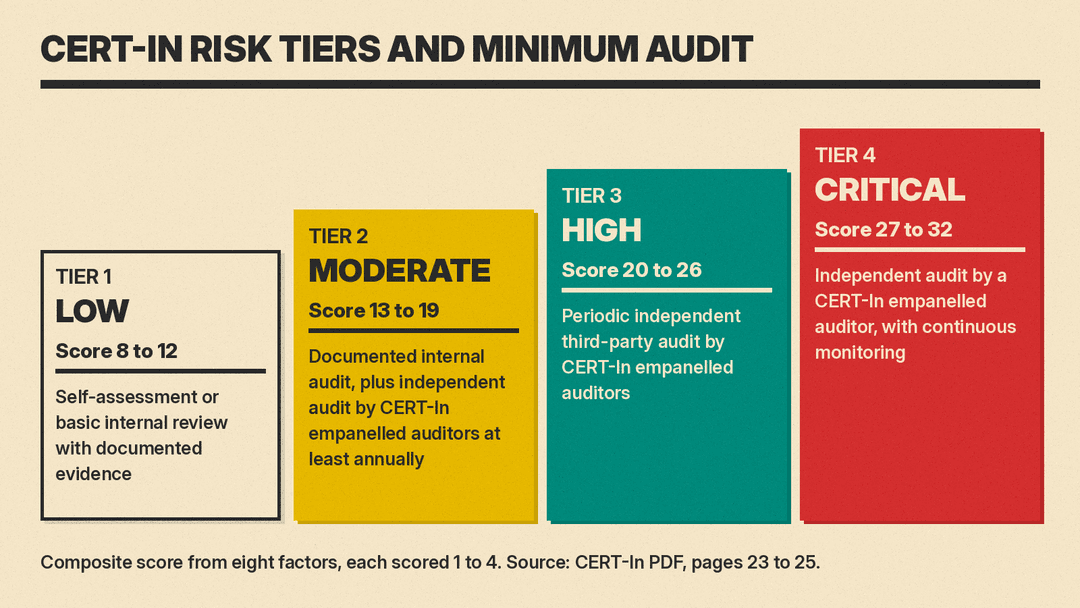
Section 5.3 (page 23) tells auditors to score each AI system against "eight inherent-risk factors". The factors are impact severity, autonomy and actionability, data sensitivity, scale and exposure, reversibility and recoverability, operational or sector criticality, adversarial exposure, and complexity and auditability. Each factor gets a score from 1 (Low) to 4 (Critical). The executive summary on page 4 names more factors in one sentence than Section 5.3 scores; this post follows Section 5.3.
The composite score sets the tier. Page 25 gives the minimum audit for each tier:
- Tier 1 (Low), score 8 to 12: "Self-assessment or basic internal review with documented evidence."
- Tier 2 (Moderate), score 13 to 19: a documented internal audit with evidence of control implementation and effectiveness, plus an independent audit by CERT-In empanelled auditing organisations at least annually.
- Tier 3 (High), score 20 to 26: a periodic independent third-party audit by CERT-In empanelled auditing organisations. Audits are more frequent where material changes, incidents or risk conditions warrant.
- Tier 4 (Critical), score 27 to 32: an independent audit by a CERT-In empanelled auditing organisation, with continuous monitoring.
The score "shall normally determine" the tier, the document says. The auditor or system owner must also check whether specific traits, such as autonomously performing safety-critical actions, warrant escalation.
Incident reports, logs and agents
The PDF says AI incidents "meeting CERT-In reportable criteria shall be reported within 6 hours" (page 76). Its security checklist also calls for log retention that "meets CERT-In 180-day minimum" (page 56).
The420 reports that the six-hour deadline "is not a newly introduced reporting obligation". It says CERT-In set the requirement under directions issued on April 28, 2022. Hindustan Times reports that the guidelines "extend Cert-In's existing rules" on six-hour flagging and 180-day logs to AI-related incidents, and "make compliance part of the audit".
For AI agents, page 66 says: "Agents shall operate under least privilege and shall not automatically inherit permissions from users, tools or other agents." Then: "High-risk agentic systems shall support emergency interruption, credential revocation, rollback and prevention of uncontrolled automatic restart." The checklist on page 65 asks auditors to verify "kill switch capability". CNBC TV18 reports that high-risk agentic AI systems "would also be required to have a 'kill switch' mechanism".
For generative AI, the PDF asks for "AI-generated content watermarking or labelling in compliance with emerging content provenance standards" (page 64).
Who is bound
The PDF says the framework "applies universally to all types and sizes of organisations operating AI systems within India or processing Indian citizens' data" (page 16). The words "legally binding" do not appear in the PDF text.
Outlets differ. Mint wrote that the guidelines are "legally binding only for cyber security auditors that are empanelled with Cert-In" and "not binding on companies building AI". An official with direct knowledge, quoted in Mint, said they "are for auditors to use whenever they are examining the AI systems being used by any large company". The same official said discussions on whether the guidelines should become law are "a completely separate matter, and are progressing with the right industry stakeholders inside Meity".
Hindustan Times reports that the document "does not say under which legal provision the guidelines were issued, when they apply, or what happens to organisations that do not follow them".
Jibu Elias of the Mozilla Foundation said, as quoted in Mint: "Typically, non-binding guidelines generally do not have a major impact on any industry."
Where sources differ
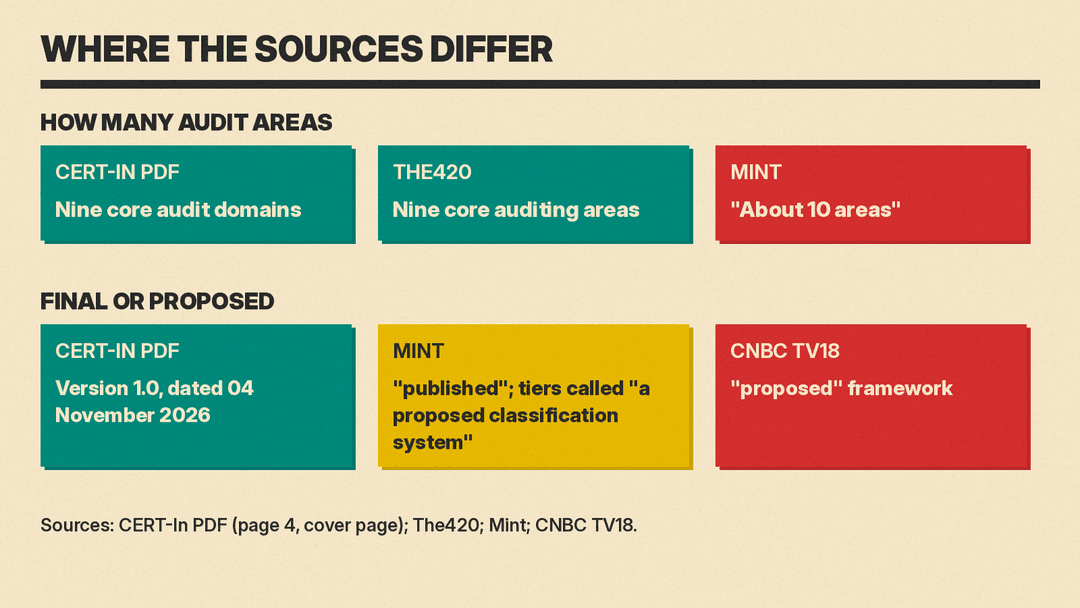
Mint writes that the framework identifies "about 10 areas". The PDF names nine core audit domains on page 4, and The420 also reports nine. CNBC TV18 calls the framework "proposed". Mint says the guidelines were "published" and calls the tier system "a proposed classification system". Hindustan Times says CERT-In "has issued" them. The PDF itself carries a version number and a date, and does not call itself a draft.
The EU comparison
Mint reported that "experts said its risk classification and audit structure appear to draw on the European Union's (EU) approach". The PDF's own reference table (page 97) states that "The EU AI Act's risk classification model informed the four-tier structure in Section 5." Mint added that, unlike the EU AI Act, India's guidelines are "not legally binding".
For other AI rules, see our earlier posts on the California SB 53 hearing on wider AI incident reporting and on a New York bill that would let the state limit AI compute.
What to watch
Hindustan Times reports that the document does not say when the guidelines apply. The law question sits inside the Ministry of Electronics and IT (MeitY), per Mint's source.
Sources
- CERT-In, Artificial Intelligence (AI) Security Auditing Guidelines, Version 1.0, 04 November 2026 (PDF)
- Mint, "Centre issues transparency, safety guidelines for AI", November 4, 2026
- Hindustan Times, "Cert-In issues AI security audit guidelines, sets 4-tier risk framework", November 5, 2026
- CNBC TV18, "India's new AI security audit rules could put OpenAI, Anthropic under greater scrutiny", November 5, 2026
- The420.in, "CERT-In Issues AI Security Audit Guidelines, Sets Four Risk Categories"
