
Artificial Analysis lists three releases between October 17 and October 23, 2026: DeepSeek V4.1 Flash 1017 on October 17, MiniMax-M3.1-Flash on October 19, and Kimi K3.1 Pro on October 23. All three accept text and image input, all three have a 1 million token context window, and all three are reasoning models, according to those pages.
They are not priced alike. On their Artificial Analysis pages, Kimi K3.1 Pro lists at $2.00 per million input tokens and $10.00 per million output tokens, DeepSeek V4.1 Flash 1017 at $0.30 and $1.20, and MiniMax-M3.1-Flash at $0.15 and $0.60. This guide compares the three on one independent benchmark, on price and cost per task, on speed, on license terms and on what each vendor claims for itself. Every page was checked on Nov 4, 2026.
For background on the Kimi release, see our post on the Kimi K3.1 Pro weights, license and benchmarks. For a wider price list that includes OpenAI, Anthropic and Google, see our LLM API pricing comparison.
Update, November 5, 2026: for a Chinese benchmark view, see our SuperCLUE November 2026 post. SuperCLUE ranks Kimi K3.1 Pro first among its ranked models at 61.46, 2.51 points above DeepSeek V4.1 Flash 1017.
The short answer
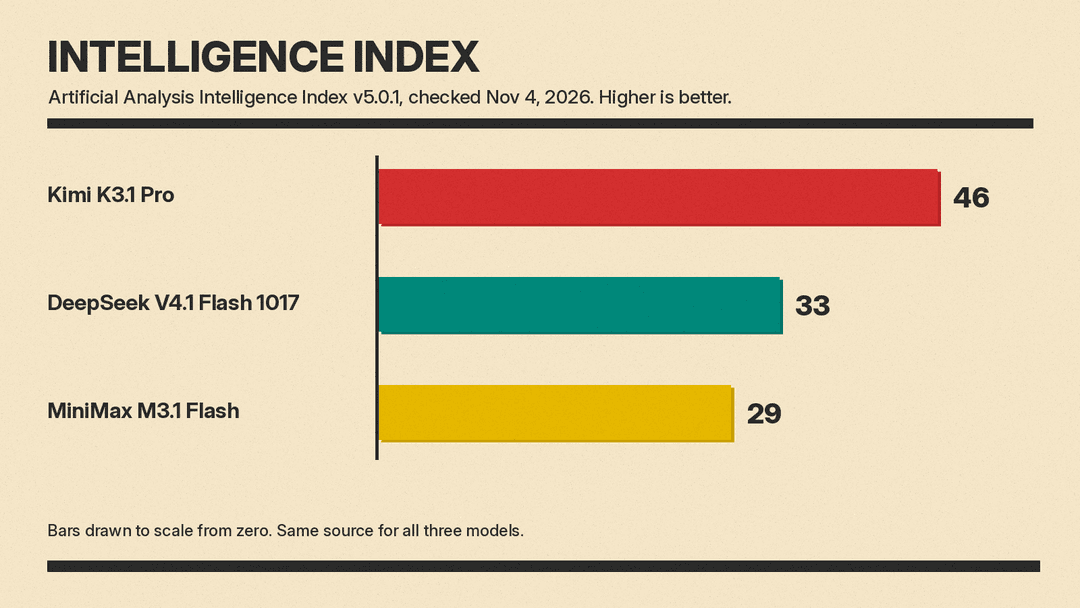
- Pick Kimi K3.1 Pro if output quality on hard agent and knowledge tasks comes first and you can accept a higher token price and slow responses. It has the highest Artificial Analysis Intelligence Index score of the three (46) as of Nov 4, 2026.
- Pick DeepSeek V4.1 Flash if you want a low price, an MIT license and the fastest task times of the three on Artificial Analysis. It scores 33 on the same index.
- Pick MiniMax M3.1 Flash if the lowest list price on Artificial Analysis and the lowest cost per task of the three matter most, and your use fits the MiniMax Community License. It scores 29.
The rest of this guide shows where those figures come from.
Specs at a glance
Each model is a Mixture-of-Experts design, which means only part of the model runs for each token. The total and active parameter counts below come from each model's own page.
Kimi K3.1 Pro (Moonshot AI). The Hugging Face model card lists 2.8T total parameters and 104B activated parameters, a context length of 1,048,576 tokens, and text and image as input modalities. Moonshot describes it on the card as "an open-weight, natively multimodal agentic model". The weights ship quantized: the card lists "MXFP4 weights / MXFP8 activations (quantization-aware training)". Reasoning effort is set with a reasoning_effort field that accepts low, high and max, with max as the default.
DeepSeek V4.1 Flash 1017 (DeepSeek). Artificial Analysis lists 552B total parameters and 16B active parameters. DeepSeek's pricing page lists a 1M context length, a maximum output of 384K tokens, and vision support. The API model name is deepseek-flash, which DeepSeek says is served by the DeepSeek-V4.1-Flash-1017 model. The model card calls the release "a minor update to DeepSeek-V4.1-Flash".
MiniMax M3.1 Flash (MiniMax). The model card lists "Approximately 428B total; 23B activated per token", a context window of up to 1,000,000 tokens, and text, image and video inputs with text output. Artificial Analysis lists text and image input only, so check video support with MiniMax before you build on it. Reasoning effort accepts low, medium, high, xhigh and max.
Intelligence: one index, same source for all three
Vendor benchmark tables use different harnesses and different rival lists, so they do not line up. For a single comparison, this guide uses the Artificial Analysis Intelligence Index v5.0.1, which the firm runs itself on every model. Its pages say the index includes nine evaluations: AA-Briefcase v1.1, AutomationBench-AA, Terminal-Bench 4.0, FrontierCode 2.0, AA-Omniscience v1.1, GDP.pdf, HLE-Diamond, CritPt v2 (Hard Subset) and Terminal-Bench-Science 0.1.
Scores as of Nov 4, 2026:
- Kimi K3.1 Pro: 46 (Artificial Analysis)
- DeepSeek V4.1 Flash 1017 (Max): 33 (Artificial Analysis)
- MiniMax-M3.1-Flash: 29 (Artificial Analysis)
Artificial Analysis does not put the three in one peer group. Its pages say open-weight models are compared with open-weight models of the same size class, and proprietary models with models in the same price range. It compares the DeepSeek and MiniMax models with large open-weight models, where it gives a median score of 23, and Kimi K3.1 Pro with models in a similar price tier, where it gives a median of 36. As of Nov 4, 2026, the Kimi page on Artificial Analysis still labels the model "Proprietary model" and says its weights are not publicly available, while the Hugging Face card describes an open-weight release.
Price per token
List prices per million tokens, as printed on each model's Artificial Analysis page (each based on the maker's own API):
- Kimi K3.1 Pro: $2.00 input, $10.00 output, with a cache discount of 90%.
- DeepSeek V4.1 Flash 1017: $0.30 input, $1.20 output, with a cache discount of 98%.
- MiniMax-M3.1-Flash: $0.15 input, $0.60 output, with a cache discount of 90%.
The vendors' own pages add detail.
DeepSeek charges two rates. Its pricing page lists $0.3 input (cache miss), $0.006 input (cache hit) and $1.2 output at peak, and $0.15, $0.003 and $0.6 off-peak. DeepSeek says "Off-peak rates are half of the peak rates." It gives peak hours as 01:00 to 04:00 and 06:00 to 10:00 UTC, Monday through Friday, excluding Chinese public holidays. In US Pacific time, now that standard time is in effect (PST, UTC-8), that is 5:00 PM to 8:00 PM PST and 10:00 PM to 2:00 AM PST, Sunday evening through early Friday morning. Weekends and Chinese public holidays are off-peak in full. The Artificial Analysis figures above match the peak rates.
MiniMax lists MiniMax-M3.1-Flash at $0.15 input, $0.60 output and $0.015 for a prompt caching read on its pricing page. The same page describes a Priority tier that it prices at "1.5x standard"; the page shows Priority rates for MiniMax-M3, so confirm whether Priority applies to M3.1 Flash before you plan for it.
Kimi's pricing page lists kimi-k3.1-pro at $2.00 per million input tokens, $10.00 per million output tokens and $0.20 per million cached input tokens, the same input and output prices that Artificial Analysis shows. It also lists a kimi-k3.1-pro-highspeed model at $4.00 and $20.00. The page says that kimi-k3.1-pro supports batch inference "billed at 60% of the standard price", and that the API turns on context caching billing for repeated prefixes automatically, with a default time-to-live of 5 minutes.
Cost and time per task
Token prices do not tell you what a job costs, because models use different numbers of tokens to finish the same work. Artificial Analysis publishes a cost per Intelligence Index task and a time per task for each model. These are the same-source figures to use when comparing what a finished task costs.
Cost per Intelligence Index task, as of Nov 4, 2026:
- Kimi K3.1 Pro: $3.68
- DeepSeek V4.1 Flash 1017: $0.60
- MiniMax-M3.1-Flash: $0.49
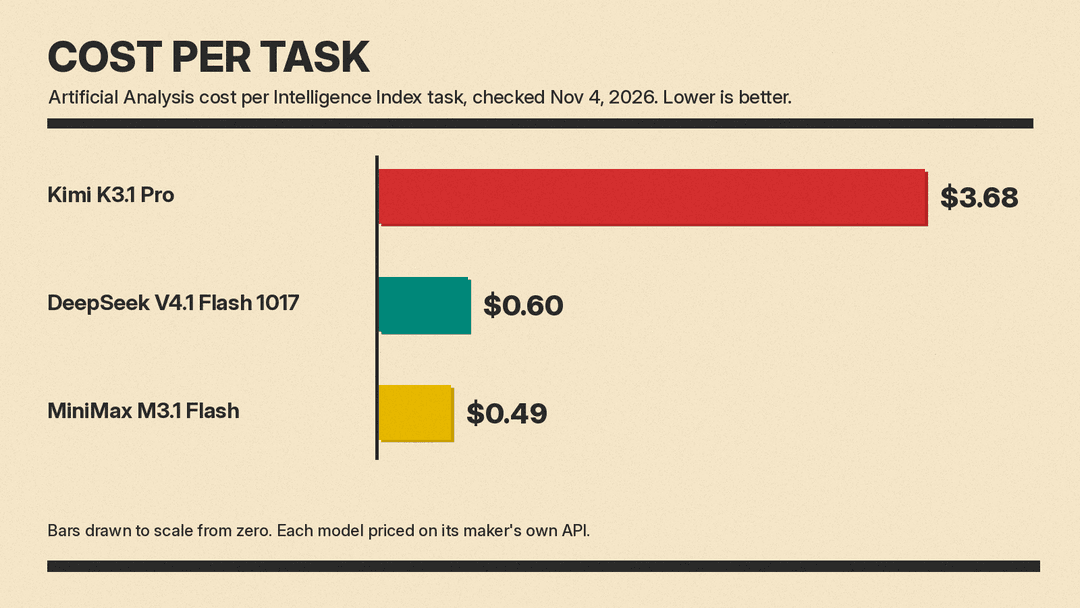
Per-task cost depends on how many tokens a model uses and how much of its input hits the cache. Artificial Analysis reports that Kimi K3.1 Pro generated 113M output tokens across the index, DeepSeek 174M and MiniMax 161M, and its cost formula includes input, cache hit, cache write, reasoning and answer token prices. The cache discounts it lists are 98% for DeepSeek and 90% for Kimi and MiniMax.
Speed figures from the same pages, each measured on the maker's own API:
- Kimi K3.1 Pro: 36.9 minutes per task, 33 output tokens per second, 147.52 seconds to the first answer token.
- DeepSeek V4.1 Flash 1017: 13.4 minutes per task, 173 output tokens per second, 48.04 seconds to the first answer token.
- MiniMax-M3.1-Flash: 19.9 minutes per task, 116 output tokens per second, 61.51 seconds to the first answer token.
Artificial Analysis calls Kimi K3.1 Pro "notably slow per task" on its page. If your users wait on each reply, test response times before you choose it. Artificial Analysis also notes that its speed figures "average each endpoint's runs over the past 5 days", so they move.
What each vendor claims
Each lab publishes its own benchmark table. These are vendor claims, run with different harnesses and settings, and they are not one comparable set. Read them as what each lab chose to show.
Moonshot (Kimi K3.1 Pro model card). The card reports 65.7 on Terminal-Bench 4.0 and 75.5 on DeepSWE v1.1, both run with the Claude Code harness. Its table includes DeepSeek-V4.1-Flash-1017 (42.3 on Terminal-Bench 4.0, which the card says comes from DeepSeek's release blog, and 77.0 on DeepSWE v1.1). It does not include MiniMax M3.1 Flash. The card also lists GPT-6 Astra, Claude Fable 5.1, Claude Opus 5.5 and GLM-5.3.
DeepSeek (V4.1 Flash 1017 model card). The card reports 42.3 on Terminal-Bench 4.0 with the Claude Code harness and 77.0 on DeepSWE v1.1 with the Mini-SWE-V2 harness. Its rival columns are DeepSeek-V4.1-Flash, a model labeled K3, GLM-5.3, GPT-5.6 Sol and Opus 5. Neither Kimi K3.1 Pro nor MiniMax M3.1 Flash appears.
MiniMax (M3.1 Flash model card). The card reports 38.1 on Terminal Bench 4.0 with Codex 0.149.1 and 73.7 on DeepSWE v1.1 with mini-SWE-agent 2.4.5 at 512K context. Its table lists DeepSeek V4.1 Flash-1017 at 42.3 and 77.0 on those two tests, and Kimi K3 rather than K3.1 Pro. MiniMax's highlights also cite 76.2 on BankerToolBench and 82.2 on CyberGym.
DeepSeek's DeepSWE v1.1 figure of 77.0 appears on all three cards. Kimi's card says its figure for DeepSeek comes from DeepSeek's technical report, so a matching number does not mean each lab ran the test itself.
Licenses
The three licenses set different terms for commercial use.
DeepSeek V4.1 Flash 1017: MIT. The model card says "This repository and the model weights are licensed under the MIT License." Artificial Analysis notes that this license allows commercial use.
Kimi K3.1 Pro: Kimi K3.1-Pro License. The license file grants broad rights to use, modify and distribute the model, subject to conditions. Two of them apply to larger businesses. A licensee that operates a "Model as a Service" business, with aggregate revenue above 20 million US dollars over any consecutive 12 months, must sign a separate agreement with Moonshot AI before commercial use. A commercial product with more than 100 million monthly active users, or more than 20 million US dollars in monthly revenue, must display "Kimi K3.1-Pro" on its user interface. The license says neither condition applies to internal use or to use through Moonshot AI's official products or certified inference partners.
MiniMax M3.1 Flash: MiniMax Community License. The license file grants rights "for non-commercial purposes" and sets conditions for commercial use. Commercial users must display "Built with MiniMax M3.1-Flash" on a related website, interface, blog post, about page or documentation. Products with more than 20 million US dollars in yearly revenue need prior written authorization from MiniMax; others send a one-time notice to MiniMax. An appendix lists prohibited uses, including any military purpose. Artificial Analysis summarizes this as "Commercial use is allowed with restrictions."
Running them yourself
Moonshot recommends vLLM, SGLang and TokenSpeed for Kimi K3.1 Pro. MiniMax recommends SGLang, vLLM and TokenSpeed, and says Transformers, KTransformers, unsloth and ATOM integrations are in progress. DeepSeek's card says the release "does not include a Jinja-format chat template" and points to a Python reference encoder and a set of Rust libraries called deepseek-recipe.
The cards also differ on sampling settings. DeepSeek recommends temperature 1.0 and top_p 1.0. MiniMax recommends temperature 1.0 and top_p 0.95. Kimi's evaluation runs use temperature 1.0 and top-p 0.95.
Total parameter counts differ: Kimi K3.1 Pro has 2.8T total parameters, against 552B for DeepSeek and about 428B for MiniMax, per the pages above. For a similar look at self-hosting large open models, see our Mistral Large 4 vs DeepSeek V4.1 Flash vs Qwen3.8 comparison.
Which one to choose
- Agent work where quality decides the outcome, such as long research or multi-step office tasks: Kimi K3.1 Pro, if the per-task cost of $3.68 and 36.9 minutes per task on Artificial Analysis fit your budget and latency limits.
- High-volume API work with batch-friendly timing: DeepSeek V4.1 Flash, run off-peak where you can. Its license is MIT, with no revenue thresholds or display rules.
- The lowest bill per task: MiniMax M3.1 Flash at $0.49 per Intelligence Index task, if you can meet the Community License attribution and notice terms.
- Video input: MiniMax's card lists video input; confirm it on MiniMax's API docs, since Artificial Analysis lists text and image only.
All figures above were checked on Nov 4, 2026. Recheck the linked pages before you commit.
Update, November 4, 2026: For day-one host praise, hardware jokes, license arguments and the R40 benchmark audit debate, see our Kimi K3.1 Pro weights reactions roundup.
Sources
- Artificial Analysis: Kimi K3.1 Pro (checked on Nov 4, 2026)
- Artificial Analysis: DeepSeek V4.1 Flash 1017 (Max) (checked on Nov 4, 2026)
- Artificial Analysis: MiniMax-M3.1-Flash (checked on Nov 4, 2026)
- Hugging Face: moonshotai/Kimi-K3.1-Pro model card
- Hugging Face: Kimi K3.1-Pro License
- Hugging Face: deepseek-ai/DeepSeek-V4.1-Flash-1017 model card
- Hugging Face: MiniMaxAI/MiniMax-M3.1-Flash model card
- Hugging Face: MiniMax Community License
- DeepSeek API Docs: Models & Pricing (checked on Nov 4, 2026)
- MiniMax: Pricing Overview (checked on Nov 4, 2026)
- Kimi API: Model Inference Pricing (checked on Nov 4, 2026)
