
Deepgram, which calls itself a voice AI infrastructure company, said on October 29, 2026 that it is acquiring Daily, the company that built Pipecat, an open-source framework for building voice agents. The companies did not disclose a price, TechCrunch reported. Pipecat is not becoming a closed Deepgram tool. It stays under its existing BSD license, and the companies are setting up an independent Pipecat Foundation.
Deepgram announced the deal on the day of its first Speak event in San Francisco, where it also introduced an open protocol for passing tone and other audio context between models, called the Real-Time Context Standard (RCS).
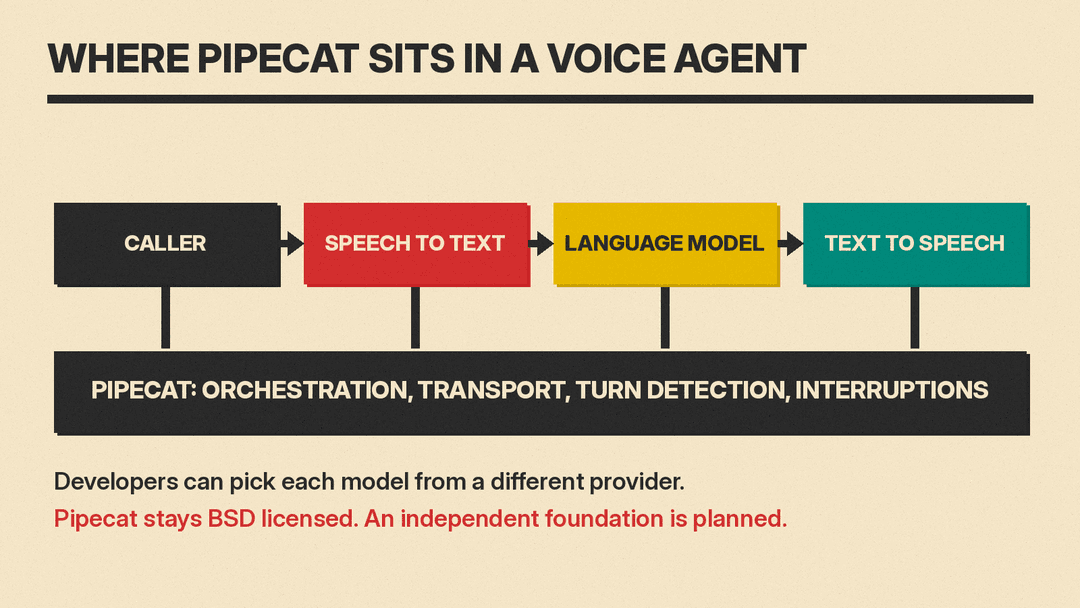
If you build or buy voice agents, this matters because Pipecat is the layer that connects the speech-to-text model, the language model and the text-to-speech voice. Who controls that layer decides how easy it is to swap one vendor for another.
What Deepgram is buying
Daily started as a company selling real-time audio and video infrastructure: WebRTC, telephony and cross-platform libraries that let developers embed live audio and video in web, desktop and mobile apps. In Deepgram's announcement, Daily runs "a global network of 75 points of presence" built for live AI traffic.
Pipecat came out of that work. Daily co-founder Kwindla Hultman Kramer wrote on Daily's blog that the team started building real-time voice agents in 2023 and open sourced all of Pipecat in 2024. He lists the problems it handles, including switching between models, low-latency network transport, turn detection, interruption handling, context management and async tool calling. According to Kramer, Pipecat now has more than 200 integrations and almost 400 contributors.
Both companies describe Pipecat as the most widely used framework of its kind. That is their claim; neither post gives usage figures, such as deployments or downloads, to back it.
The deal terms in plain terms:
- The Daily team joins Deepgram. Kramer becomes Deepgram's Head of Open Source.
- Deepgram will "sell, support, and develop all of Daily's current products and services," Kramer wrote. "For Daily's customers and the Pipecat ecosystem, nothing will change."
- Pipecat stays free and open source under its existing BSD license, per Deepgram.
- Deepgram is adopting Pipecat as the core of its new voice AI products, Kramer wrote.
TechCrunch, citing PitchBook data, reported that Daily has raised over $62 million. The two companies went through the same Y Combinator batch in 2016, and Kramer wrote that Deepgram has powered transcription inside Daily's audio and video APIs since 2019.
Why the foundation is the key part
Pipecat's selling point has been that it does not care whose models you use. A developer can take transcription from one company, a language model from another and a voice from a third. Deepgram sells speech-to-text and text-to-speech models, so owning the framework outright would give rival model makers a reason to worry.
The answer the companies gave is the Pipecat Foundation. Kramer wrote that it "will be managed by a steering committee that represents the entire realtime AI ecosystem, including companies that compete with Deepgram."
Deepgram CEO Scott Stephenson made the same pitch to TechCrunch: "It's great if you're using Deepgram models, but I want you to be using the best models for your use case."
Kramer also gave TechCrunch a commercial reason for staying open: "If you sit in the middle of an ecosystem that's growing very fast, and have many parts of that ecosystem that are genuinely the best from your company, then everything being as open as possible is like a commercial advantage."
What the announcements do not say yet: who sits on the steering committee, how it votes, or how the foundation is funded. Deepgram also now employs the engineers who built Pipecat and plans to build its own platform on top of it. The BSD license means anyone can fork the code if the project changes direction, which is the real backstop for developers.
The Real-Time Context Standard
The second announcement targets a weak spot in cascaded voice agents, the kind that turn speech into text, run a language model, then turn the reply back into speech. We covered that problem in Speech-to-Speech vs Cascaded Voice Agents. Deepgram describes it this way: "the words get passed from one model to the next, but the rich audio context around them, like tone, who's speaking and what's happening in the background, gets lost along the way."
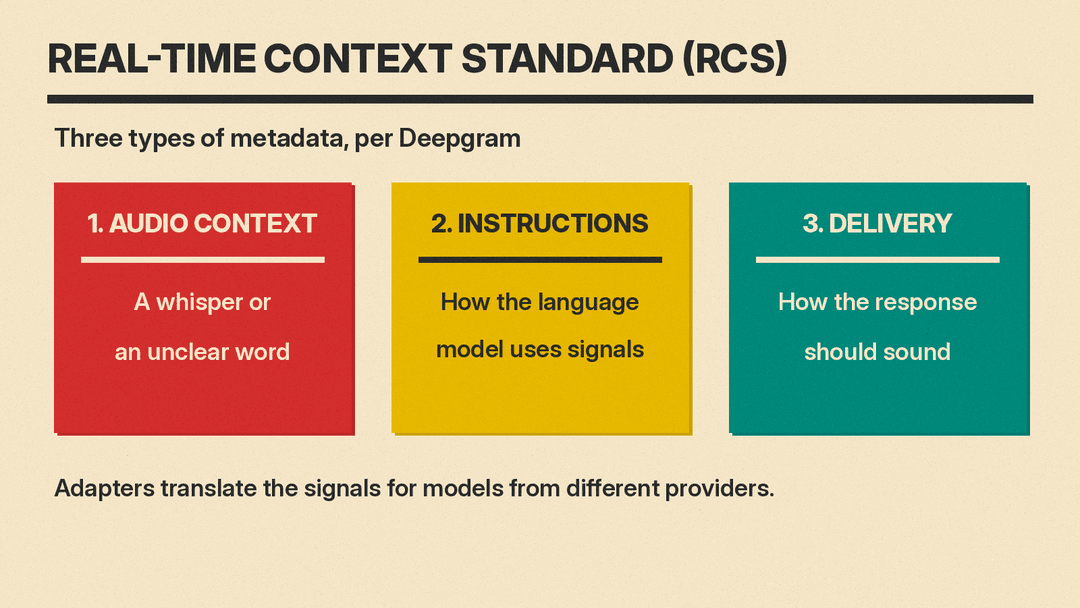
RCS, co-developed with the Pipecat team, defines three types of metadata:
- Context from the audio, such as a whisper or an unclear word.
- Instructions for how a language model should use those signals.
- Guidance for how the response should sound.
Deepgram's examples: an agent can ask for clarification when it did not hear clearly, or answer quietly when someone whispers. Adapters translate the signals for each model, so the same approach works with models from different providers. Deepgram calls RCS "open and extensible" and is asking developers and model providers to test it and contribute to the specification.
What else Deepgram announced
Deepgram said its Chief Product Officer, Ed Anuff, would preview a forthcoming Deepgram Voice Agent Platform at Speak. It combines Deepgram's models with Pipecat and Daily's infrastructure. Deepgram also said it would introduce two new models built for live conversation, expanded language support and a Global API meant to improve connection reliability and cut latency. Deepgram said full technical details and availability would be published later.
What it means for voice agent builders
This month brought new speech models such as Mistral's Voxtral 3, AssemblyAI-TTS-1 and Rime Prism. These are the parts a Pipecat developer plugs in. TechCrunch notes that other infrastructure companies, LiveKit and Vapi, raised funding this year as well.
For teams already on Pipecat, Daily's short-term answer is that nothing changes, and Deepgram says Pipecat stays free and open source. The things to watch are the foundation's committee members and governance rules, whether integrations for Deepgram's competitors keep getting the same attention, and whether RCS gets support from model makers outside Deepgram. If those land, a model vendor owning this framework could work out fine for developers. If not, the BSD license leaves the door open to a fork.
