
Google has open-sourced the Elephant-Goldfish Model plugin, a set of skills that has a coding agent draft a design document and then has fresh agent sessions review it before any code is written. Google's Open Source Blog announced the plugin on October 22, 2026, and Linux Today reported on it on November 5. The Google post says the plugin was developed internally for Google software engineers, that thousands of Googlers use it every day to ship production Google code, and that it is released under the Apache 2.0 license. The repository README says it is not an officially supported Google product.
The idea: an elephant, goldfish and you
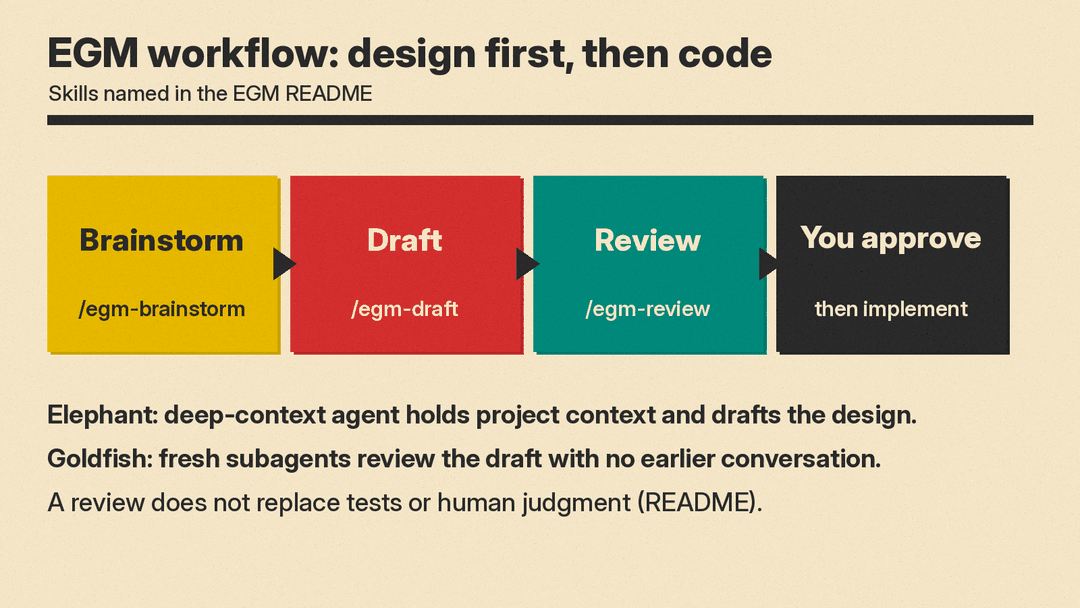
The Elephant-Goldfish Model, or EGM, splits design work into roles. The Google post describes the Elephant as a context-rich, long-horizon AI session that holds the architectural vision and project memory. No code is written in that session. It is for design, intent and small decisions, and the post says the AI interviews you there while you debate your choices.
Goldfish are the opposite. The post calls them stateless, zero-context sessions used strictly to validate specifications. Because they share no blind spots with the designer, they act as critics that look for gaps and edge cases. The README gives the human a third role: you resolve trade-offs, approve the design and decide what to build.
The method comes from an essay by Dave Rensin, Elephants, Goldfish, and the New Golden Age of Software Engineering. The Google post quotes him: "Design is the new code." The setup guide describes EGM as an implementation of Spec-Driven Development.
The three-step workflow
The README's first-use example is a feature request: add webhook delivery to a project. The skills run in this order.
/egm-brainstorm: you discuss requirements and trade-offs with the agent. Fresh reviewers challenge the proposal, and the agent saves the agreed direction inconcepts_brief.md. The setup guide says this step starts a six-lens Goldfish swarm./egm-draft: the agent turns the brief into a design document,design_draft.mdin the README example, and pauses after each section for your feedback. The Google post says the document covers the problem, the technical plan, alternatives considered, and an implementation plan that names the files to change./egm-review: fresh reviewers check the draft. The skill file lists five phases: an initial zoom-out review, a comprehension review, a design critique, an intermediate zoom-out review and an implementation readiness check.
The Google post says the last Goldfish runs a strict go or no-go check that file paths, data structures and function signatures are present and unambiguous. After you approve the design, the README says to ask your coding agent to implement it.
The plugin has more skills. egm-resolve works through review findings, egm-bootstrap creates or updates documentation for an existing codebase, egm-review-loop runs a configured group of reviewers, and egm-drift-report compares checked-in documents with the current source code. The setup guide recommends running the drift report about once a week and says a person decides whether to update the document or the code. The README says a small, clear bug fix does not need this process.
Which coding agents it runs in
The announcement says the plugin's core goal is to bring EGM into Antigravity, with other development environments upcoming. The repository's harness guide lists more. Its install table includes Antigravity CLI, the Antigravity App, Claude Code, Claude Cowork, Codex, ChatGPT, omp and Muse. Three of the install commands:
- Antigravity CLI:
agy plugin install https://github.com/google/elephant-goldfish-model - Claude Code:
claude plugin marketplace add google/elephant-goldfish-model, thenclaude plugin install egm@egm - Codex:
codex plugin marketplace add google/elephant-goldfish-model, thencodex plugin add egm@egm
The README says to install the whole plugin, because the skills read reviewer prompts and document standards at run time. Google's notice that it is shutting down Jules points users to Antigravity. For background on the other tools in the table, see llms.blog's explainer on coding agents such as Claude Code, Codex, Copilot and Cursor.
Limits that the repository states
Goldfish reviews need a fresh subagent context. The README says that if your agent cannot create one, EGM stops the review. The harness guide names the standalone Antigravity IDE, which it says does not expose the needed subagent tool, and ChatGPT modes without native fresh-context delegation. For Codex, it says named reviewer personas are not shipped, so a general-purpose subagent reads the persona file.
The guide also warns that a fresh conversation context does not mean the host leaves out its instruction files. Codex settings that isolate parent turns do not establish that project or user instructions are excluded. It tells users to state review assumptions that a Goldfish must challenge as explicit review criteria.
The README says a review does not replace tests or human judgment. The setup guide says to send the design to another human as a pull request before implementation. In Antigravity CLI and Claude Code the README says to add the /egm: prefix, for example /egm:egm-brainstorm, and in Codex you pick the matching skill from the skill picker.
A related VS Code preview
VS Code 1.145 previews nested chats on different harnesses, such as Claude inside a Copilot session, as described in llms.blog's VS Code 1.145 post.
Sources
- Introducing the Elephant-Goldfish Model plugin, Google Open Source Blog
- google/elephant-goldfish-model, GitHub repository and README
- EGM setup and workflow guide
- EGM harness guide
- egm-review skill file
- Elephants, Goldfish, and the New Golden Age of Software Engineering, Dave Rensin
- Linux Today, November 5, 2026
