
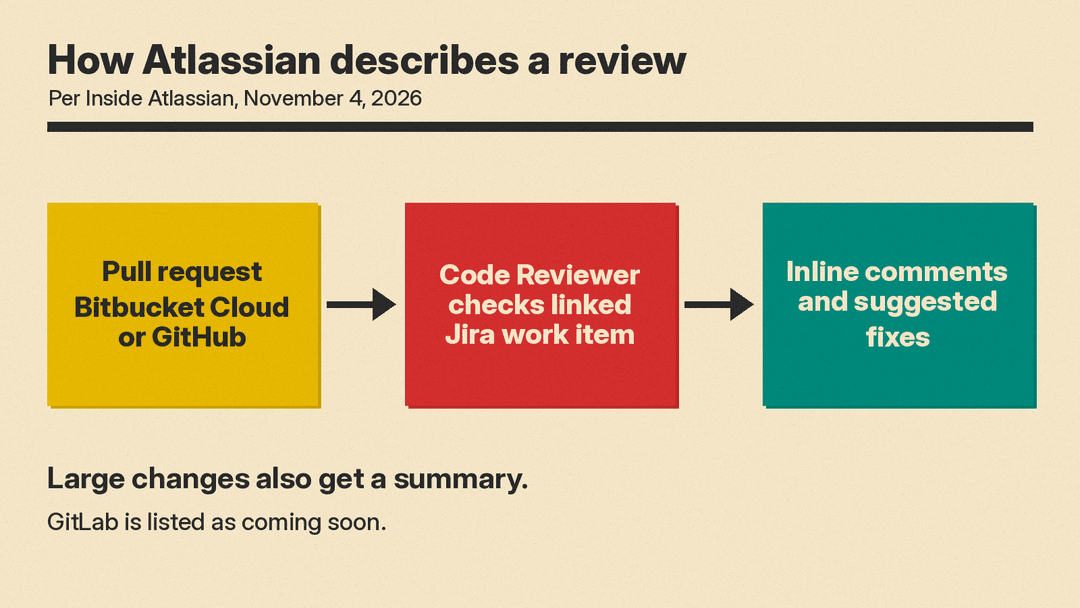
Atlassian says Code Reviewer is now generally available with paid Jira and Teamwork Collection licenses. Atlassian announced it on its Inside Atlassian blog on November 4, 2026. The post describes Code Reviewer as an AI agent that reviews pull requests in Bitbucket Cloud and GitHub, with GitLab coming soon. It runs on Rovo credits, and Atlassian's documentation says credit billing does not start until December 3, 2026.
What Code Reviewer does
According to Atlassian's post, each review is grounded in context from Jira and the Teamwork Graph. Code Reviewer leaves inline comments that flag issues and suggest fixes authors can apply in the pull request. Atlassian says it catches bugs, logic errors, security risks and maintainability issues. For large changes it also adds a summary to help reviewers get oriented.
The agent also checks a pull request against acceptance criteria in linked Jira work items. Atlassian says to put the work item key, for example PROJ-123, in the branch name or the pull request title so the agent can link them. It says specific criteria give the agent more to check. Its example is "Show an error message when the upload exceeds 10 MB", set against the vague "Handle errors".
Atlassian says a built-in quality filter removes low-value comments. It also describes Standards, a feature in beta, where an organization documents its coding standards, assigns them to repositories, and has Code Reviewer check each pull request against that repository's standards.
The numbers Atlassian cites
Atlassian's post cites its Q3 State of AI Impact in Engineering Report. Per that citation, teams that rely heavily on AI to write code wait more than twice as long for a human review on a pull request, 71 minutes up from 32. The post also says median pull request size has more than doubled in the past year, from 46 to 102 lines of code.
On its own code, Atlassian reports that median pull request cycle time dropped by 31% since it rolled out Code Reviewer internally. It also says 39% of Code Reviewer's comments led directly to a code change in the next commit. These are Atlassian's internal figures, and the post does not describe them as an independent test.
Privacy and admin controls
Atlassian says each review runs in a temporary, isolated environment that is deleted as soon as the review finishes. The post says code is not stored afterward and is never used to train models. Admins decide which workspaces and repositories get automatic reviews, and can switch any of them back to manual or turn Code Reviewer off.
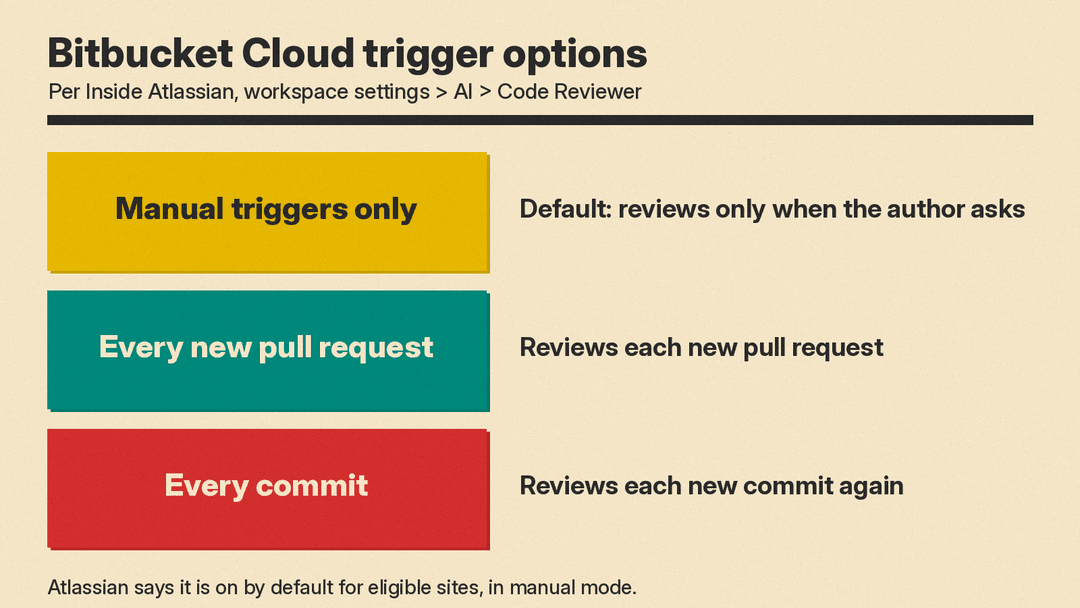
Atlassian says Code Reviewer is on by default for eligible sites, in manual mode, so it reviews a pull request only when the author asks. For automatic review, the post gives these paths:
- Bitbucket Cloud: a workspace admin goes to Workspace settings, then AI, then Code Reviewer. The trigger options are Manual triggers only, Every new pull request, and Every commit.
- GitHub: a Jira site admin goes to Jira site settings, then Developer AI, then Reviewer settings, and sets the trigger to When PR is created. The GitHub for Atlassian app must be installed first.
How billing works
The Code Reviewer credits page says Code Reviewer, previously Rovo Dev code reviews, is available with a paid Jira or Teamwork Collection subscription starting in early November 2026. No separate Rovo Dev subscription is needed. Credits come from the organization's shared allowance, the same pool used by Rovo Chat and Rovo agents.
With the default Manual trigger only, the page says Code Reviewer does not use credits in a repository until someone starts a review or sets an automated schedule. It says each review uses a variable number of credits. Four factors raise the cost: pull request size, how often reviews run, repository size, and custom instructions and Agent Skills, which are read on every review.
The Rovo credits page lists the included allowance, billed per user per month and pooled across the organization:
- Jira: 25 credits on Standard, 70 on Premium, 150 on Enterprise.
- Teamwork Collection: 250 on Standard, 700 on Premium, 1,500 on Enterprise.
That page says allowances reset monthly on the usage billing date and unused credits do not roll over. For extra usage beyond the allowance, it gives a list price at this time of $0.01 per Rovo credit, or $10 per 1,000 credits. Extra usage is on by default, and admins can set a spending cap or turn it off.
What to check
Some Atlassian help pages still use the older Rovo Dev wording. The Trigger a code review page says Atlassian is updating its pages to match, and it lists "Only when pull request is created" as the default. The credits page lists Manual trigger only as the default, and says a repository that already runs reviews automatically keeps its current option. Check each repository's setting before you rely on either default.
For related coverage, see the GitLab Orbit post on another vendor's context layer for coding agents, the OpenAI and Pierre post on OpenAI's plan to acquire the maker of Code Storage, and the coding agent guide on agents that write the code being reviewed.
