
Chinese outlets reported on November 3 and 4, 2026 that DeepSeek plans to train its next model, V5, on Huawei's Ascend 950 chips. Caiwen (财闻), in an exclusive on Tencent News dated November 3, cites people familiar with the supply chain. TechNode's Chinese edition carried the story on November 4, citing multiple industry sources. Neither article quotes a statement from DeepSeek or Huawei, and as of November 4 we found no DeepSeek announcement of V5.
This post sets out what the two reports say, what Huawei has published about DeepSeek models on Ascend hardware, and what remains open.
What Caiwen's sources say
Caiwen says DeepSeek V5 is planned to use Huawei Ascend 950 chips as its core training compute, with the project pace pointing to next year. These are the other claims in the report, all from its unnamed sources:
- In DeepSeek's previous model generation, Ascend chips handled inference only and were not used for training. V5 would be the first DeepSeek model trained natively on Ascend 950.
- DeepSeek's core research liaison team for Ascend is based in Hangzhou, and the two sides did a large amount of low-level operator adaptation during the V4 stage.
- Operator chains that were written for Nvidia's CUDA have been moved to an open-source Python operator ecosystem, so DeepSeek does not need to rewrite its low-level model code from scratch.
- DeepSeek plans a large computing center in Ulanqab with Ascend 950 chips. The sources say it is in early construction and expected to start operating next year, and that early V5 training will not necessarily run there. Caiwen says the cluster location has not been made public.
- The sources describe the choice as DeepSeek's own, driven by supply. They say Nvidia's newest high-end chips cannot be sold in China under US export controls, and that the H-series chips that were legally imported no longer meet the training needs of models such as V4 and V5.
- DeepSeek works mainly with Ascend on training compute and has not connected other Chinese chip vendors' products. Huawei holds no stake in DeepSeek, and the tie is limited to products, computing resources and technical adaptation.
- V5 training is still at the stage of choosing compute (选型阶段). Parameters, features and release timing are internal to DeepSeek. The sources expect a release most likely somewhere between the first and second half of next year.
What TechNode adds
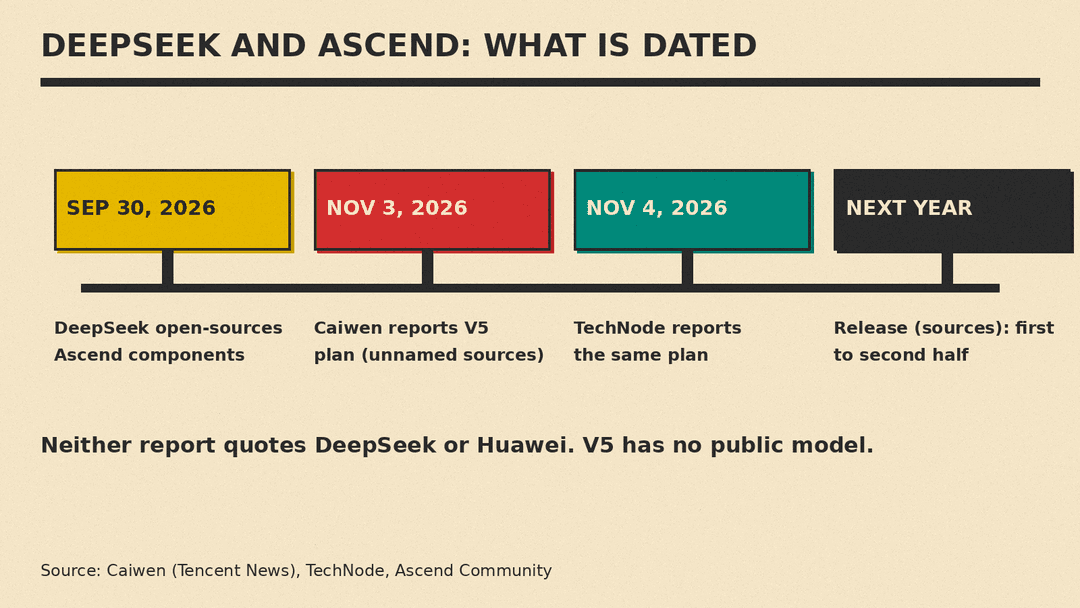
TechNode's Chinese edition says Ascend has so far mainly been used to run DeepSeek models, and that the V5 plan would extend the two companies' cooperation to the foundation training of a new model. It also points to two earlier steps. On September 30, 2026, DeepSeek open-sourced infrastructure components for the Ascend platform, including the TileLang compiler tool, the DeepGEMM and FlashMLA libraries and the DeepEP communication library. And a domestic research team recently finished full-parameter post-training of the 1.6 trillion parameter DeepSeek-V4-Pro on an Ascend 910C cluster, according to TechNode. TechNode says the V5 plan concerns the pre-training stage, which is a different step.
DeepSeek's GitHub account now lists Ascend versions of these tools. The DeepGEMM-Ascend page describes a "clean and efficient matrix multiplication kernel library for Huawei Ascend NPUs". The DeepEP-Ascend page calls it "A high-performance communication library for machine learning training and inference on Huawei Ascend NPUs."
What Huawei has published
The Ascend community site posted Huawei's account of the September 30 release. The figures below are Huawei's, from offline tests that exclude serving and load-balancing effects, and we have not verified them.
- Huawei says it provided a jointly defined SuperPoD Flex system and a UBL128 network design. It gives 128 cards with a 3.2Tbps single-layer scale-up network and a two-layer scale-out network for 256K cards.
- Huawei says DeepEP measured 375 GB/s for dispatch and 347 GB/s for combine.
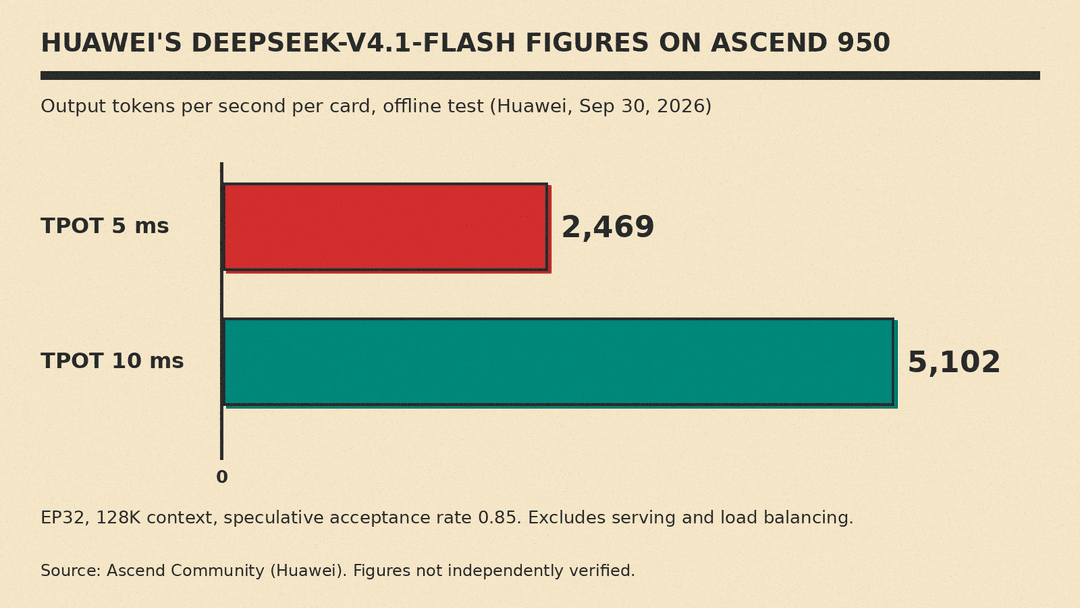
- Huawei says DeepSeek-V4.1-Flash reached 2,469 tokens per second per card at a TPOT (time per output token) of 5 ms and 5,102 tokens per second per card at a TPOT of 10 ms. Its note says the setup used EP32, a 128K context length and a speculative acceptance rate of 0.85.
Huawei's CANN project also lists a pre-training reference for Ascend 950 SuperPoDs. The document says it was validated end to end on DeepSeek-V4 and V4.1 models. It reports a model FLOPs utilization (MFU) above 35% for DeepSeek-V4-Flash training on an Ascend 950 SuperPoD, and says full-parameter CPT (continued pre-training) and SFT (supervised fine-tuning) of the 550B DeepSeek-V4.1-Flash needs only 64P. It also reports a pre-training validation at 1M sequence length on 128P. These are Huawei-side claims in an undated page, and the page does not say that DeepSeek ran them.
What is not known
- No DeepSeek or Huawei statement confirms the V5 plan. Both reports rest on unnamed sources.
- The two reports differ in wording. Caiwen says Ascend 950 is the core training compute. TechNode says Ascend would be used for pre-training. Neither gives a chip count or a start date.
- No V5 model exists in public yet. As of November 4, 2026, the newest model in DeepSeek's Hugging Face account was DeepSeek-V4.1-Flash-1017, created on October 17, 2026 (UTC).
- The plan sits beside other reports. We covered V5 names in DeepSeek Harness test code, which the code's own contents showed to be placeholders. Bloomberg reported on October 22 that DeepSeek raised about 100 billion yuan, as in our post on the funding round. Huawei's Ascend 950DT SuperPoD in Wuhan is a 1,024-card system that Huawei describes as a training and decode platform.
Why it matters
The reports describe a move that would tie a Chinese model lab to a Chinese chip platform for training, not only for inference. If it happens, a V5 release would show how Huawei's published Ascend 950 training figures hold up for a DeepSeek model. Meituan made a related claim on November 2: it says its LongCat-2.5 model was trained entirely on Chinese-made accelerators, but the pages we checked do not name the chip vendor. For background on the export rules in the sources' account, see our explainer on US AI chip export controls on China. For the other labs, see China's AI labs explained.
The next checkpoints are statements from DeepSeek or Huawei, a V5 model card, and details on the Ulanqab site. Until one of those appears, treat the V5 plan as reported, not confirmed.
On the software side, DeepSeek also published a research prototype of a coding agent with a Router and Worker design, covered in our post on the DeepSeek super-agent prototype.
Sources
- Caiwen (财闻) via Tencent News: DeepSeek V5明年有望基于昇腾950完成训练 (Nov 3, 2026)
- TechNode (动点科技): 消息称DeepSeek V5拟采用华为昇腾芯片预训练 (Nov 4, 2026)
- Ascend Community: DeepSeek官方开源昇腾基础组件 (Sep 30, 2026)
- CANN cann-recipes-train: Ascend 950 SuperPoD MoE pre-training reference
- GitHub: deepseek-ai/DeepGEMM-Ascend
- GitHub: deepseek-ai/DeepEP-Ascend
- Hugging Face: deepseek-ai
