
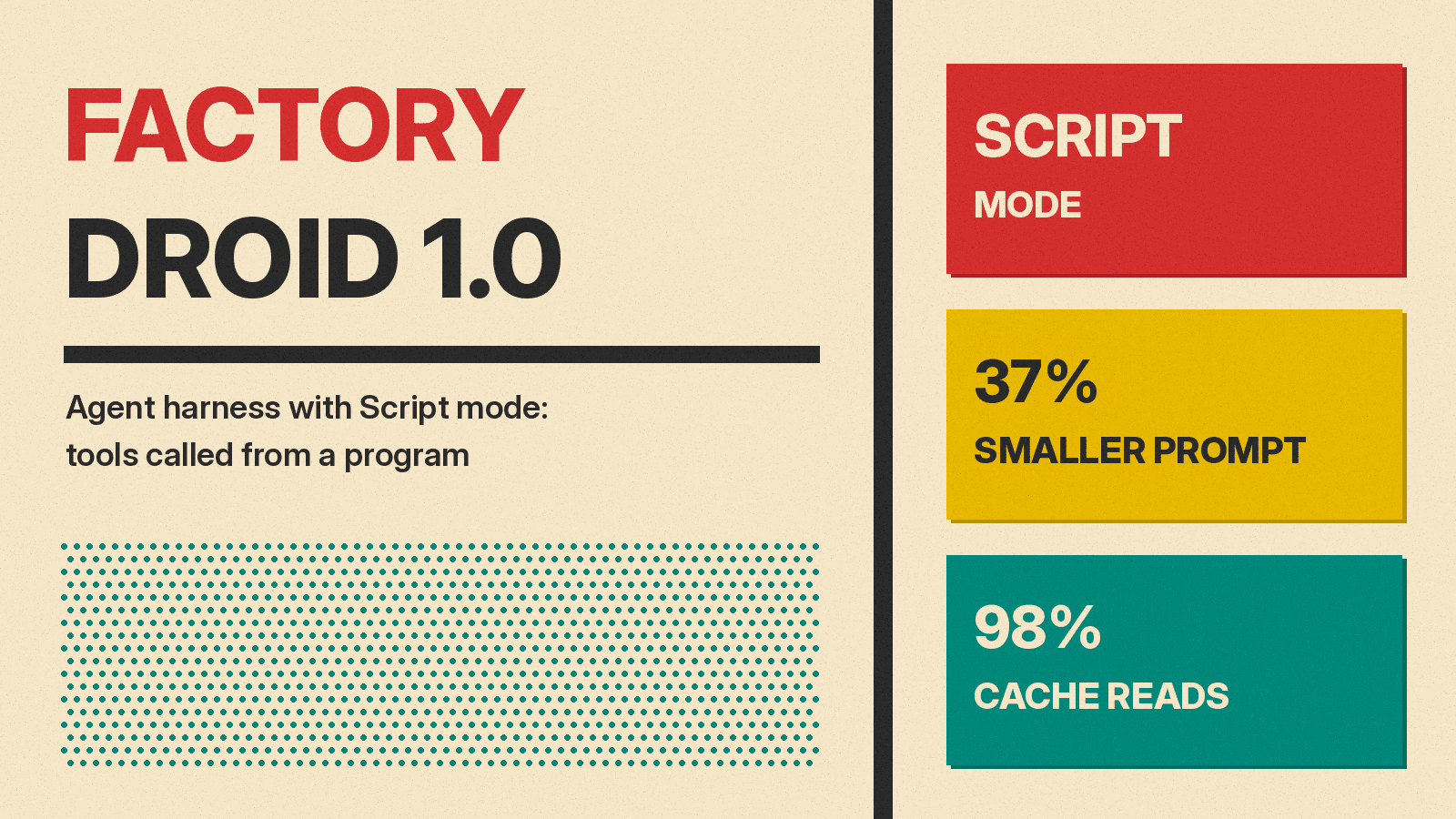
Factory has released Droid 1.0, which it calls the largest update yet to the agent harness behind its coding agent. In a launch post dated October 29, 2026, the company says the new Droid is "more accurate, efficient, and faster than ever before," and names one change as the largest behind its results: letting the model write a short program that calls its tools, instead of calling each tool one at a time.
Factory defines the term in the same post: "An agent harness is everything around the model: the prompts, the tools, how tool results come back, and the loop that runs it all." Droid works with models from several labs, and Factory says users can pick a model or let its auto model router, Factory Router, "choose the most efficient mix."
What Script mode changes
In a standard agent loop, the model asks for one tool call, reads the result, then asks for the next. Every result lands in the model's context, and every new request re-sends the instructions and history.
Droid 1.0 makes programmatic tool calling the default. Factory implements it as a Script tool: the model writes JavaScript that runs in a sandbox "with no file, network, or system access of its own." One Script can make many tool calls in a single model request. Raw files, search results and logs stay inside the program as variables, and the model reads only what the program prints.
Factory gives three reasons for the switch, per the launch post:
- It keeps the context window clean, because the agent receives only the output of its program.
- It cuts the number of model requests, because one program runs many calls.
- It makes loops and checks run "deterministically in code."
For a related idea, see our post on an agent that rewrites its own harness.
Factory's own examples
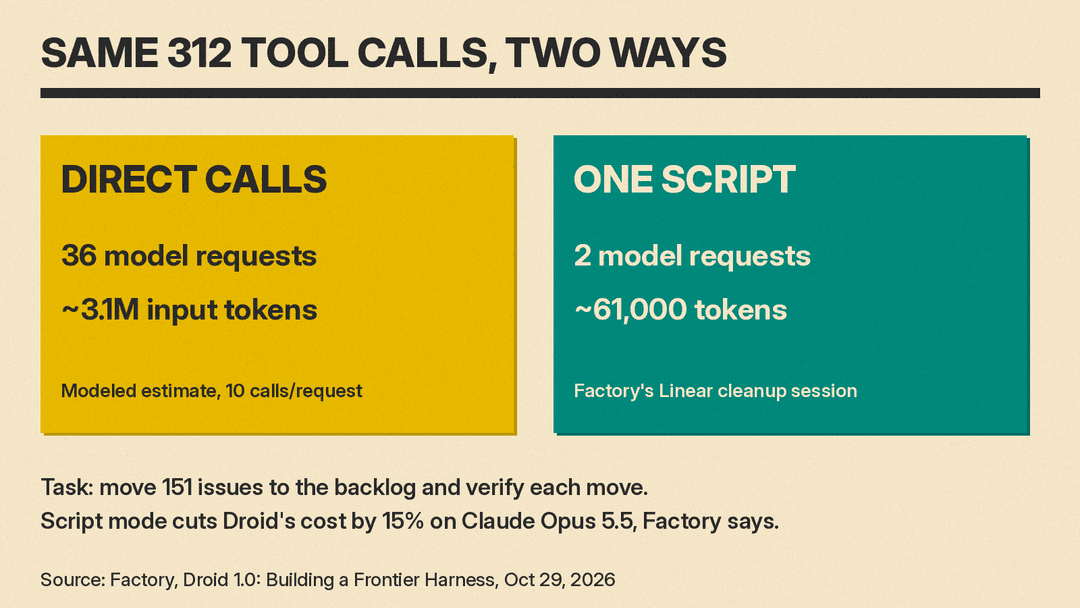
Factory says Script mode cuts Droid's cost by 15% on Claude Opus 5.5, compared with direct tool calls. It adds that most Scripts are small, and the savings concentrate in the 12.5% of Scripts that make six or more tool calls.
One example from Factory's own sessions is a Linear cleanup: the agent moved 151 issues between queues and checked each move, 312 tool calls in all. Factory says the Script took 2 model requests and about 61,000 tokens. Its modeled estimate for direct calls, at 10 calls per request, is 36 requests and about 3.1M input tokens.
Script mode is on by default for a list of models that includes GPT-6.1 Sol, GPT-6.1 Terra, GPT-6 Astra, Claude Opus 5.5, Claude Fable 5.1 and Kimi K3, according to the post.
Smaller prompts and a warmer cache
Factory also reports changes to what each request contains, in the same post:
- Base prompt. Between Droid 0.170.0 and 0.250.0, the first request of a session shrank from 20,887 input tokens to 13,055, a 37% cut. Droid now sends 2 tool definitions up front instead of 11, and loads rarely used tools on demand.
- Prompt cache. Newly found tools, such as MCP tools, are now added at the end of the request so the cached start stays intact. Factory says the typical production request reads 98% of its input from cache.
Benchmark claims
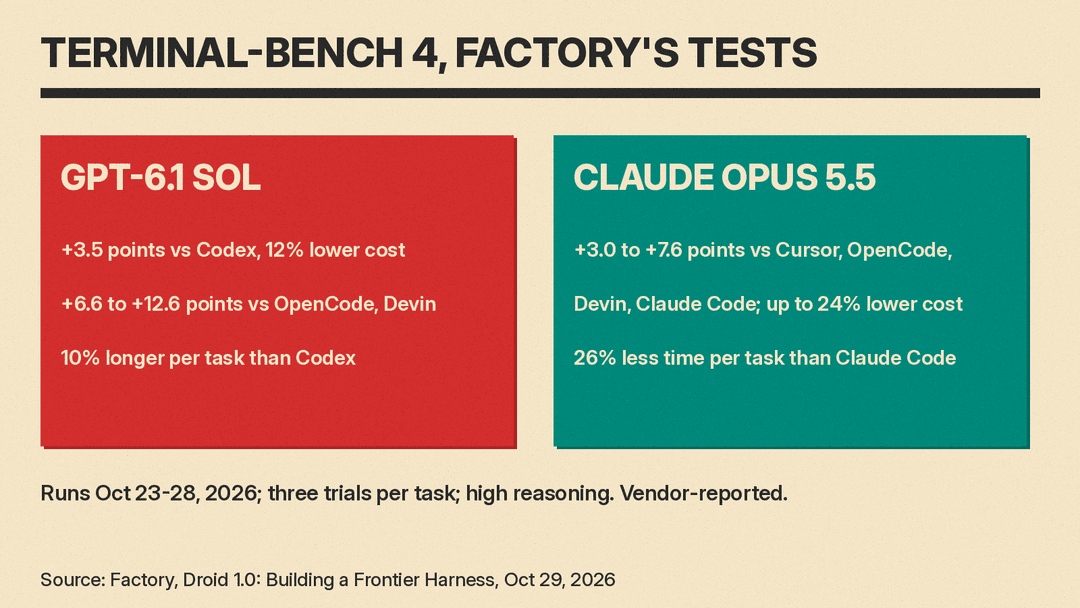
Factory ran Droid against other harnesses on Terminal-Bench 4, using the same model on both sides. Per the post's methodology section, the runs took place October 23 to 28, 2026, with three trials per task at high reasoning. The company reports:
- With GPT-6.1 Sol: Droid scores 3.5 points higher than Codex at 12% lower cost, and 6.6 to 12.6 points higher than OpenCode and Devin.
- With Claude Opus 5.5: Droid scores 3.0 to 7.6 points higher than Cursor, OpenCode, Devin and Claude Code, "at up to 24% lower cost."
- Time: On Opus 5.5, Factory says Droid takes 26% less time per passed task than Claude Code and uses 17% fewer tokens. On GPT-6.1 Sol, it uses 12% fewer tokens than Codex but takes 10% longer.
These are Factory's numbers, not an independent test. The methodology lists several choices that shape them. Cost and time count only tasks that both harnesses passed in all three trials. Some Claude Opus 5.5 trials blocked by Anthropic's content moderation were rerun on Claude Opus 5. Where Devin stopped to ask a question on GPT-6.1 Sol, Factory counted the task as passed if Codex passed it. Cursor does not appear in the GPT-6.1 Sol chart; Factory says it "has no access to OpenAI models."
Availability
Factory says Droid 1.0 "is available today" as a desktop app for macOS and Windows and as a terminal UI. Developers can build on the same harness with the Droid TypeScript SDK (@factory/droid-sdk). The launch post says the SDK "runs the same Droid as the CLI" and can give Droid custom tools over MCP. The launch post does not discuss pricing.
Droid 1.0 lands a day after GitHub made Copilot Fusion generally available, which also picks and orchestrates models for coding tasks. Microsoft has also put its own Copilot harness in public preview in Foundry.
