
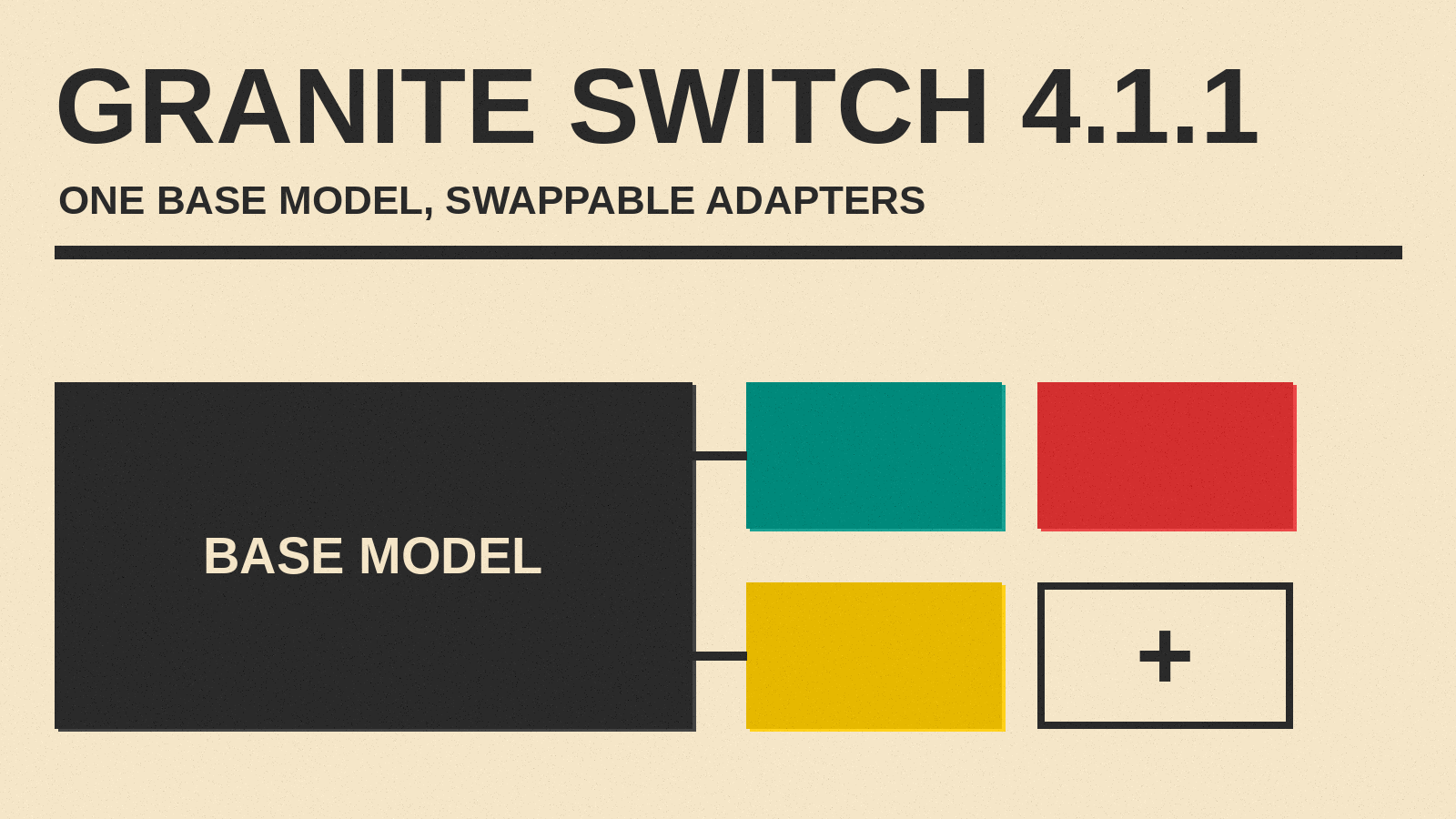
IBM has shipped Granite Switch 4.1.1, a patch release for its modular Granite Switch models. It comes two weeks after Granite Switch 4.1 launched on October 15. The update itself is small: an updated speech model inside the checkpoint and new weights for one adapter. The more interesting part is how IBM shipped it. The base model was not touched, and IBM says the version number should be read the way software developers read it.
What changed in 4.1.1
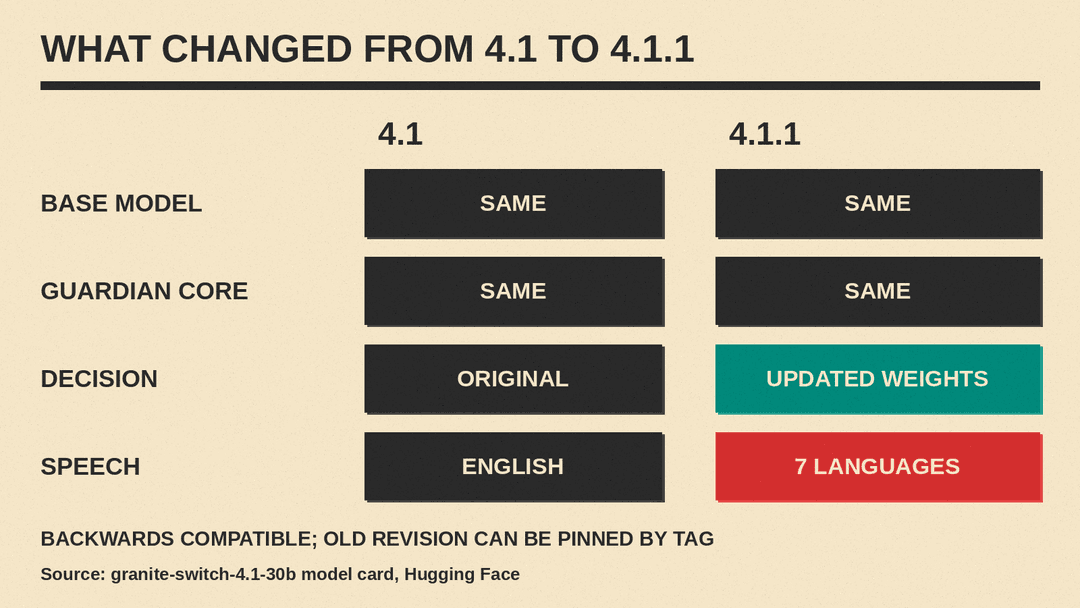
IBM's launch post lists two changes:
- An updated Granite Speech ASR model with multilingual speech-to-text and native punctuation and capitalization. ASR is automatic speech recognition. IBM says the point is that transcripts are "ready for downstream models without a formatting pass."
- An updated Decision adapter in granitelib-core, which IBM says has "improved overall performance on the Jev Decision Index test set."
The two sources disagree on the language count. The launch post says the speech model covers 10 languages. The Granite Switch 4.1 30B model card and the Granite Speech 5.0 TurboCTC model card list seven: English, French, German, Spanish, Portuguese, Italian and Japanese. Plan around the seven on the model cards until IBM says otherwise.
IBM calls 4.1.1 "fully backwards compatible with 4.1, no migration." The model card backs this up for the Decision adapter: its prompt format, invocation and readout are unchanged, "so existing integrations work as-is." The repository's main branch holds the newest revision, and every release is also tagged. If you depend on 4.1 behavior, you can pin the old revision in Transformers or vLLM.
What Granite Switch is
Granite Switch is IBM's approach to a modular language model. A checkpoint is a base model plus a set of small adapters plus a speech encoder, all composed into one model that runs on one endpoint. Per the model card, control tokens in the chat template turn adapters on when they are needed.
The 30B release is made of:
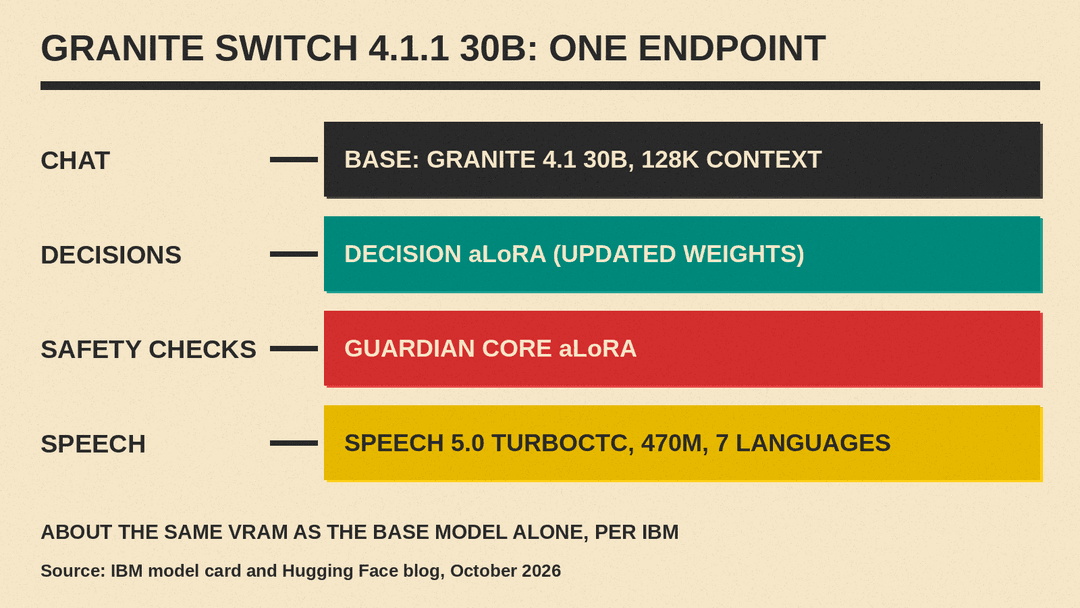
- Base model: Granite 4.1 30B, with a 128K token context.
- Decision adapter: given a state and a question with labeled options, it returns a probability for each option in one forward pass.
- Guardian Core adapter: detects safety risks such as harm, jailbreaking, profanity, violence, sexual content, social bias and unethical behavior.
- Granite Speech 5.0 TurboCTC: a 470M parameter speech encoder that transcribes audio on the same endpoint as chat.
There is also an 8B version with the same configuration. IBM says the parts together take up "approximately the same amount of VRAM on a GPU as the base model would by itself."
The adapters are Activated LoRAs (aLoRAs). A LoRA is a small set of extra weights that changes a model's behavior without retraining the whole model. IBM's 4.1 post explains that because these adapters are cache-efficient, the KV cache (the stored work from reading a prompt) that the base model builds can be reused for later adapter calls. In practice, the model can answer a chat request, then make a classification decision on the same context, without reading the prompt again.
The software-style update idea
IBM's main argument is about process. "Apart from training the new ASR model and Decision adapter, nothing was recomputed: the base model is untouched," the launch post says. "You compose the latest adapters you want and deploy."
The model card shows what that looks like. The 4.1.1 checkpoint is built with the granite-switch 0.1.1 composer, which takes the base model, the Guardian and Core adapter libraries, and the speech encoder, and writes out one checkpoint. Anyone can run the same composer with a different mix of adapters from IBM's Granite Libraries.
This matters for teams that run models in production. A typical model update means a new full checkpoint, new evaluations and often new prompts. If the base model stays frozen and only one adapter changes, the change is smaller and easier to test. IBM says it is working on tutorials and an Adapter SDK so that developers and third parties can build their own adapters and "ship updates the way you ship software." IBM has not given a date for the SDK.
Numbers and limits
The model card reports a Jev Decision Index v0.3 score of 51.33 overall for the 4.1.1 Decision adapter. That figure is a chance-corrected weighted aggregate, shown times 100. Category scores range from 25.9 (Arts) to 69.0 (Tools). The card does not print a 4.1 score next to it. The 4.1 revision of the card reported 50.1 overall, but that test used the Decision Index fast subset (1,068 rows) on a hosted endpoint, so the two figures may not be directly comparable. IBM has not stated the size of the improvement.
IBM's speech model card says the multilingual update improves average English word error rate on standard short-form English benchmarks over the earlier English-only release, from 5.78% to 5.51%. IBM also says it is the fastest ASR model on the Open ASR Leaderboard. The card notes that the leaderboard entry is still the English-only release.
The model card also lists a limit. The speech encoder and the language model "are not yet jointly trained." Audio is transcribed first, and the transcript is placed in the chat context in place of the audio.
Who should care
Granite Switch is released under Apache 2.0, which allows commercial use. It runs on Hugging Face Transformers and vLLM, and IBM's 4.1 post says it also has native support in llama.cpp. IBM pitches it as a way to serve chat, decisions, safety checks and speech-to-text from one hosted endpoint, which could suit teams that now run a separate model for each of those jobs.
For more open speech models, see our coverage of NVIDIA Nemotron 3.5 Transcribe and open speech models for Apple apps. For IBM's reasoning models, see our Granite 4.2 post.
