
Articul8, the enterprise AI company that Intel spun out in January 2024, launched Bivia on October 28, 2026. The company describes Bivia as "a compact, multimodal model that reads any input and hands you a calibrated decision," with "zero generated tokens." In its launch post on X, Articul8 said there is no subscription, users "pay only for input tokens," and "the first 10,000 users get up to 1B tokens free."
What a decision model is
Chatbots are generative models: they write answers word by word, and companies pay for the tokens those words are made of.
A decision model does not write. You give it material (a document, photo, video or table) and a question with a fixed shape, such as yes or no, or pick one of four options. It returns the choice plus a confidence number between 0 and 1. On its product page, Articul8 gives the example of a support ticket: instead of a chatty paragraph, Bivia returns "Infra" with a confidence of 0.94.
An AI agent working through a long task makes many small calls: Is this step done? Which tool runs next? Articul8 argues that sending each one to a large generative model is slow and expensive. Articul8 CEO Arun Subramaniyan said in the press release that "when an AI agent is working through a complex task, it doesn't need a powerful generative model to answer every question along the way."
What Articul8 says Bivia can do
These are company claims from the release and the product page:
- Many inputs, one model. Text, images, documents, code, signals, audio and video.
- Typed answers. The page lists nine decision types (Decide, Choice, Boolean, Score, Set, Span, Ground, Extract and Data science). The release describes eight "native decision primitives."
- Evidence. Answers can point to the image region, text passage or video timestamp that supports them, according to the release.
- Saying "not sure." With abstain turned on, Bivia returns "abstained" and a reason instead of a guess, so an app can send the case to a person.
- Three modes. The page lists Fast, Deep and Thinking. Deep mode "decides, then challenges the decision before committing."
- Tuning on a company's own policies, procedures and past decisions.
Bivia is offered through an API, SDKs for Python, Node.js, Go and Rust, an MCP server for coding tools such as Claude Code, Codex, Cursor and VS Code, a desktop app, a browser extension and Google Workspace functions, per the product page.
The numbers, and their limits
Articul8's benchmark figures come from its own testing. In Articul8's "internal workflow completion tests involving tool routing," the release says Bivia scored 0.91 against 0.84 for Jev, a rival decision model. The release says Bivia is designed to give the same decision "regardless of how answer options are presented," and that Jev and "other leading decision models changed their answers in approximately one in eight cases," while Bivia "returned the same answer every time."
The release says Bivia hit 100% accuracy on "selected energy and hardware design (Verilog) tasks" after training on domain data, and it adds its own caveat: these are "in-distribution results" that show it can be specialized, not "performance on previously unseen data." Readers should treat all of these as vendor claims until outside testers run them.
In a demo post, Articul8 said it asked Bivia "to find the cheapest way to cool a data centre without violating a single operational constraint," that Bivia "completed the optimisation in 15 seconds," and that the "Total cost" was $0.40. The product page labels several examples "illustrative."
Pricing and the free tokens
The launch offer, per the product page, reads "Launch offer · First 10,000 users," "Get 1 billion tokens free," "No subscription." The X post words it as "up to 1B tokens free." Neither page lists an end date or further terms.
Articul8's launch post says "No subscription. Pay only for input tokens." The product page shows no per-token rate card.
Who it is for
Bivia is pitched at developers and enterprises building agents, not at people chatting with an assistant. Articul8 describes itself as a provider of "domain-specific generative AI" for regulated industries including energy, manufacturing, aerospace and defense, financial services and semiconductors. The release names Hitachi Energy, CTC, AZing and Megazone as customers it says are seeing savings.
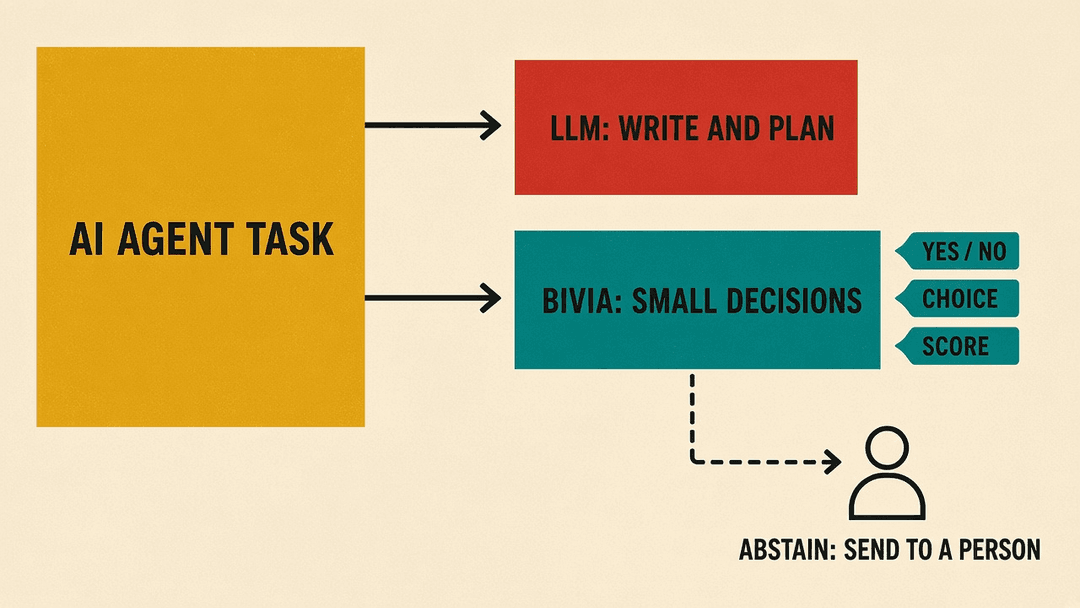
For non-developers, the effect would show up inside other software, such as an app that routes a support call to the right team and hands unclear cases to a person. If you are new to agents, our explainer on how AI agents work covers the basics.
For other tools that send agent requests to cheaper models, see our coverage of Bito Governor and GitHub Copilot Fusion.
Background: the Intel spinout
Intel and DigitalBridge announced Articul8 on January 3, 2024, as an independent company built on IP and technology developed at Intel. DigitalBridge Ventures led the investment, and Intel took an equity stake. Subramaniyan was previously a vice president and general manager in Intel's Data Center and AI Group. Articul8 says it closed a Series B in June 2026 at a $500 million pre-money valuation.
