
A hackathon gives you a deadline, a theme and a reason to finish a project. Organizers say you do not need to be a developer, have a team, or arrive with a finished idea. You do need to know where to look and what to set up before the clock starts.
This guide covers where beginners can find AI hackathons, which listings suit students and teens, and how to prepare, using each organizer's own pages as of November 2026.
What is a hackathon?
Devpost, a site for finding and running hackathons, defines a hackathon as "a time-boxed, focused competition where participants build a project, such as an app, tool, or prototype, and then submit it for judging." Its participant FAQ says hackathons "can run anywhere from a single day to several weeks online," and that many virtual hackathons stay open for 6 to 8 weeks, so you can build at your own pace.
An AI hackathon is the same format with an AI theme, such as building with machine learning, a large language model, or an AI agent. Devpost says the hackathons on its site are hosted by companies, universities and communities.
Do I need to know how to code?
No, according to Devpost. Its FAQ says everyone is welcome, "including students, professionals, and hobbyists of any skill level or background," and that you do not need to be a developer. It names designers, entrepreneurs and product managers as people who join and contribute skills like design, pitching and product strategy.
Major League Hacking (MLH) makes a similar point in its guide to preparing for a hackathon: "A person who has never written a line of code can still be the reason a team wins, because the demo is what judges see." The same guide closes with: "You don’t need to be “good enough” yet."
MLH also notes that AI has made much of the old setup work optional. If you have never built an app, read our explainer on what vibe coding is before your first event.
Where can I find AI hackathons?
Five places cover most of what a beginner needs.
Devpost
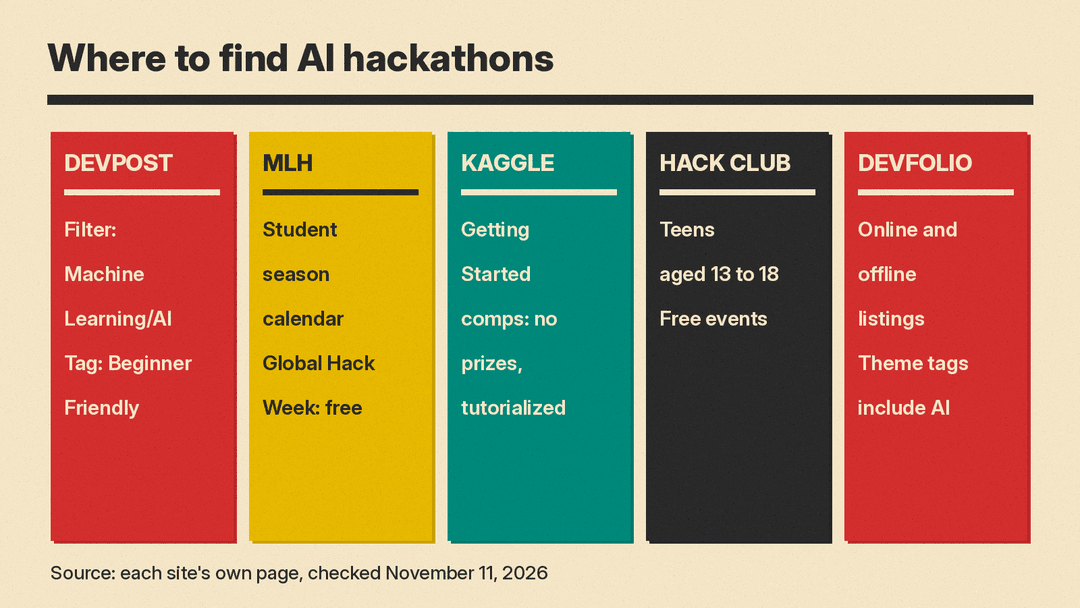
Devpost's hackathon listing showed about 180 open and upcoming hackathons on November 11, 2026, 57 of them open for entries. That count changes daily. Devpost's FAQ gives three filters that matter for beginners:
- The "Machine Learning/AI" interest tag, for AI hackathons.
- The "Beginner Friendly" theme tag, for events that welcome newcomers.
- The "in-person" filter, for events near you. Devpost says results are best when you are logged in and have added your location.
Devpost says joining a hackathon as a participant is free on its platform, and most of its hackathons do not require a team. Some set a team size in their rules, so check each event.
MLH season events
MLH describes itself as "the world's largest developer community" and a Public Benefit Corporation. Its site has moved from mlh.io to mlh.com. The MLH 2027 season calendar lists student hackathons around the world. As of November 11, 2026, upcoming events included:
- HackPrinceton Fall 2026, November 13 to 15, 2026, Princeton, New Jersey
- NASA's Space Apps Challenge NYC, November 13 to 15, 2026, Brooklyn, New York
- Hack Western 13, November 20 to 22, 2026, London, Ontario
- UofTHacks, January 15 to 17, 2027, Toronto, Ontario
Not every MLH event has an AI theme. Check each event page for its theme, tracks and eligibility.
MLH Global Hack Week
Global Hack Week runs each month. MLH calls it "a 100% free event for anyone, anywhere," with live challenges and a community Discord. Builders Week ran November 6 to 12, 2026, with what MLH calls "beginner-friendly content." The next listed week is Open Source Week, December 4 to 10, 2026.
Kaggle Getting Started competitions
Kaggle is a data science competition site, not a weekend hackathon. Our reading: it suits beginners who want to practice machine learning itself rather than build an app. Kaggle's competition docs call Getting Started competitions "the most approachable competitions" for new users and say: "They offer no prizes or points and are heavily tutorialized." Examples include Titanic: Machine Learning from Disaster, Digit Recognizer, and Housing Prices.
Kaggle says everyone competes as a team, even a team of one, and you must accept a competition's rules before you download its data. For free compute to run notebooks, see our guide to free GPUs for AI.
Devfolio
Devfolio's hackathon page is another listing site. On November 11, 2026 it showed both online and offline events, with theme tags that include AI. Check each event's page for eligibility and dates.
Are there hackathons for high school students?
Yes. Hack Club is a nonprofit for teenagers. Its homepage says it is for teens aged 13 to 18 and that "Hack Club is free for every teenager, forever." It also lists events it describes as free and open to any teen. Its Arcade program, a summer program for high schoolers or younger, has closed for now. Its page says you can still join the Hack Club Slack.
The MLH calendar also marks some events as high school events. For structured learning before an event, see our list of free AI courses for kids and teens.
Should my first hackathon be in person or online?
MLH says neither format is better. In its prep guide, it says in-person events have mentors nearby and a hard stop, while online events are easier to attend but "ask for more self-direction." It adds that a first-timer "often does well in person simply because help is easier to find."
MLH also says a first hackathon usually goes smoother when the theme is broad, because a narrow sponsor track adds a constraint before you know how the weekend flows.
Do I need a team?
No. MLH says going solo "is completely legitimate, especially for a first event," and that most MLH hackathons run team-formation sessions, an active Discord, and in-person mixers where solo builders find each other. It also notes there is no global rule on team size, so check the rules of your event.
On Devpost, you can mark yourself as looking for teammates on a hackathon's Participants page and send team-up requests, according to its FAQ. Our list of AI communities to join is another place to find people to build with.
How do I prepare for my first hackathon?
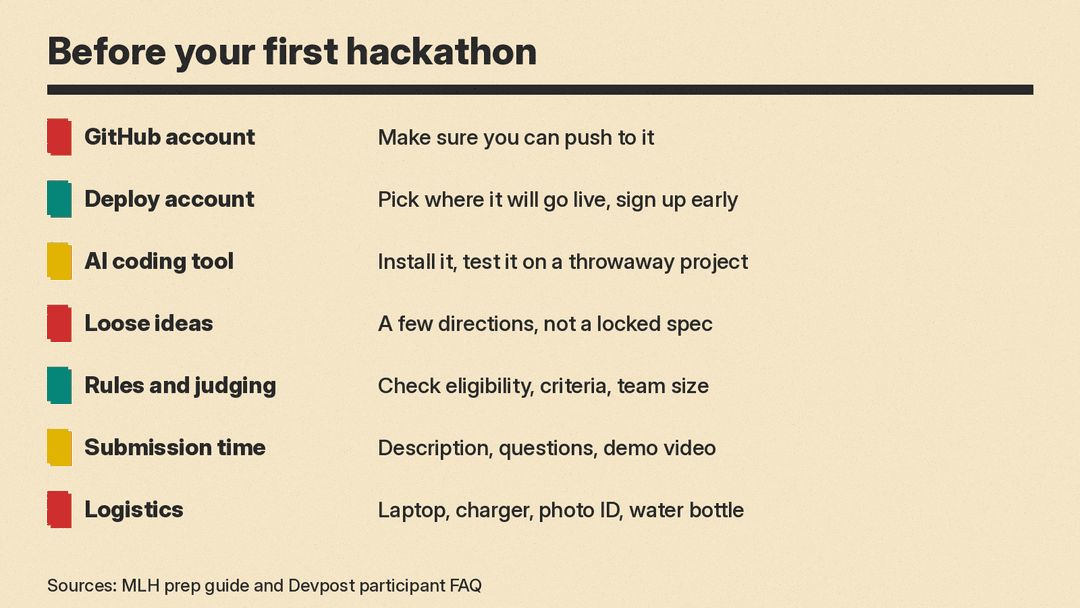
MLH calls environment setup "possibly the most consequential thing" in its guide. Its three setup steps:
- GitHub account: set one up and make sure you can push to it.
- Deploy account: pick where you will deploy and create the account ahead of time.
- AI coding tool: pick the tool you will lean on, install it, and test it on a throwaway project.
MLH also advises arriving with a few loose ideas, not a fully specced product, to avoid scope creep. For in-person events it lists a laptop, charger, any hardware your project needs, a photo ID and a water bottle. For online events it suggests setting up a workspace, turning off notifications and blocking the time on your calendar.
Devpost adds two points in its FAQ. First, check the hackathon's eligibility requirements, judging criteria and official rules before you plan your build. Second, set aside time to package the project: the description, the submission questions, and a demo video if one is required. Devpost calls these "the judges' first impression of your project."
How do I spot a hackathon worth joining?
Devpost suggests looking for the "Managed by Devpost" tag as a signal of legitimacy, which means its team plays a significant role in running the event. It also warns that if a hackathon asks you to pay a fee to judge, you should treat that as a red flag.
Before you sign up, a short check helps:
- Is it free for participants?
- Is it tagged Beginner Friendly, or does it have a broad theme?
- Who is eligible: students only, a set age range, certain countries?
- Does it set a team size?
- What does it ask you to submit, and when is the deadline?
What happens after the hackathon?
On Devpost, your project is listed in the public project gallery after the deadline, and you keep the IP rights to it. Devpost says some builders use that gallery page as a portfolio piece when job hunting.
That makes a hackathon project a natural fit for a portfolio. Our guide to building an AI portfolio that gets interviews covers how to present it. If you are also looking for structured experience, see where to find AI internships, and if you are starting from zero, our 12-week plan to learn AI from scratch.
Sources
- Devpost: Frequently asked questions for hackathon participants
- Devpost: hackathon listings
- MLH: About
- MLH: 2027 season events
- MLH: Global Hack Week
- MLH: How to prepare for a hackathon
- Kaggle: Competitions documentation
- Kaggle: Titanic, Machine Learning from Disaster
- Hack Club
- Hack Club Arcade
- Devfolio: hackathons
