
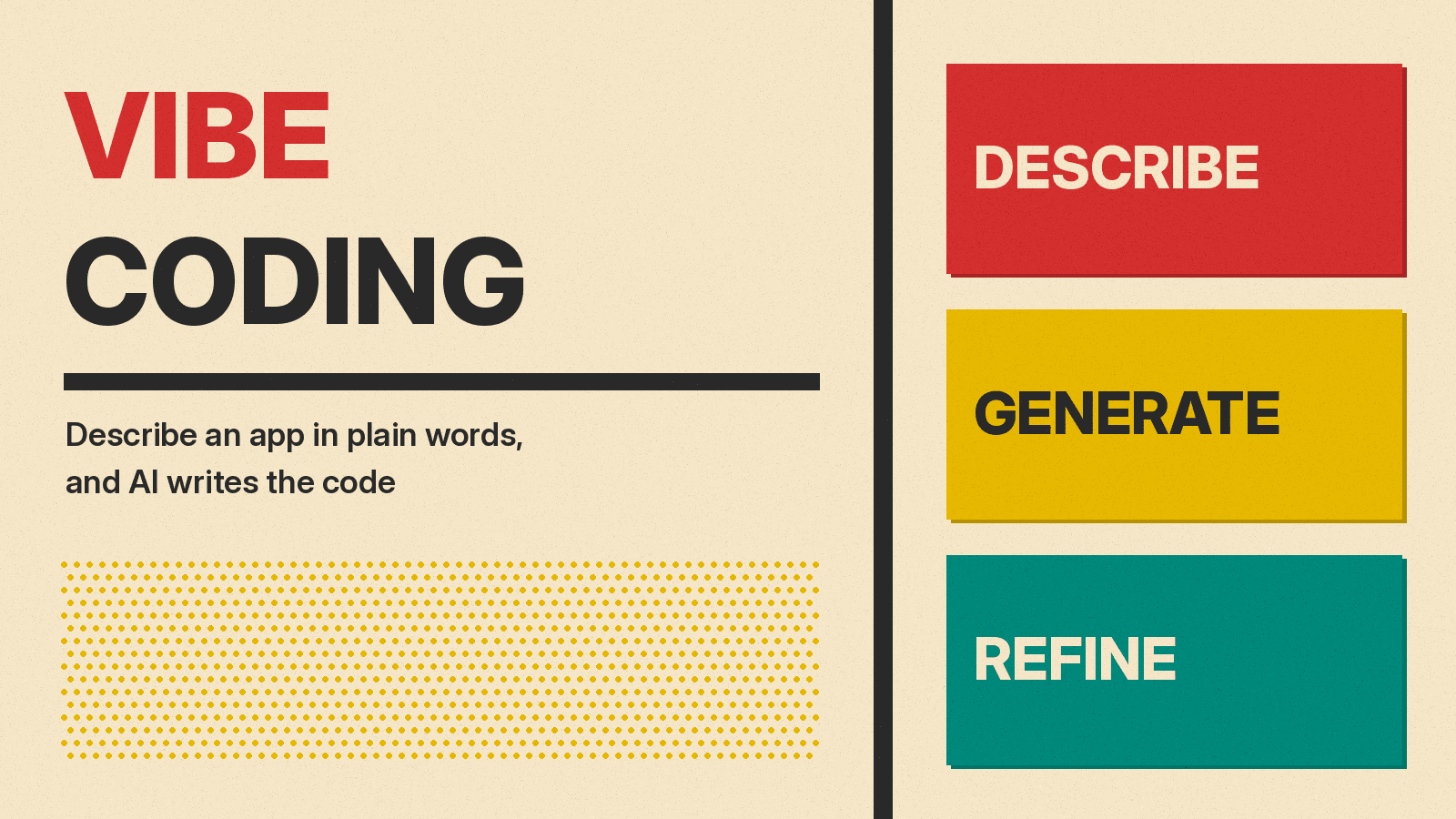
Vibe coding means building software by describing what you want to an AI tool in plain language and letting the AI write the code. You might ask for a page that tracks your reading list, the AI produces a working app, and you keep asking for changes until it does what you want. In the strictest sense, you never read the code at all.
This guide explains where the term came from, the two ways people use it, how the process works step by step, what it is good for, and the risks to know before you try it. No programming knowledge is needed to follow along.
Where the term came from
The phrase comes from a post on X by Andrej Karpathy in February 2025. Collins Dictionary calls him an "AI pioneer," and the BBC calls him an "OpenAI co-founder." In the original post, Karpathy wrote:
There's a new kind of coding I call "vibe coding", where you fully give in to the vibes, embrace exponentials, and forget that the code even exists.
He went on to describe his own habits. He talked to the AI tool by voice, asked for small changes like "decrease the padding on the sidebar by half," and wrote: "I 'Accept All' always, I don't read the diffs anymore." When he got an error message, he would "just copy paste them in with no comment, usually that fixes it." He also set limits on the idea: "It's not too bad for throwaway weekend projects, but still quite amusing."
Collins named "vibe coding" its Word of the Year for 2025, and the BBC reported that it was one of 10 words on a shortlist meant "to reflect the mood, language and preoccupations of 2025."
Two meanings: strict and broad
People use "vibe coding" in two different ways, and it helps to know which one someone means.
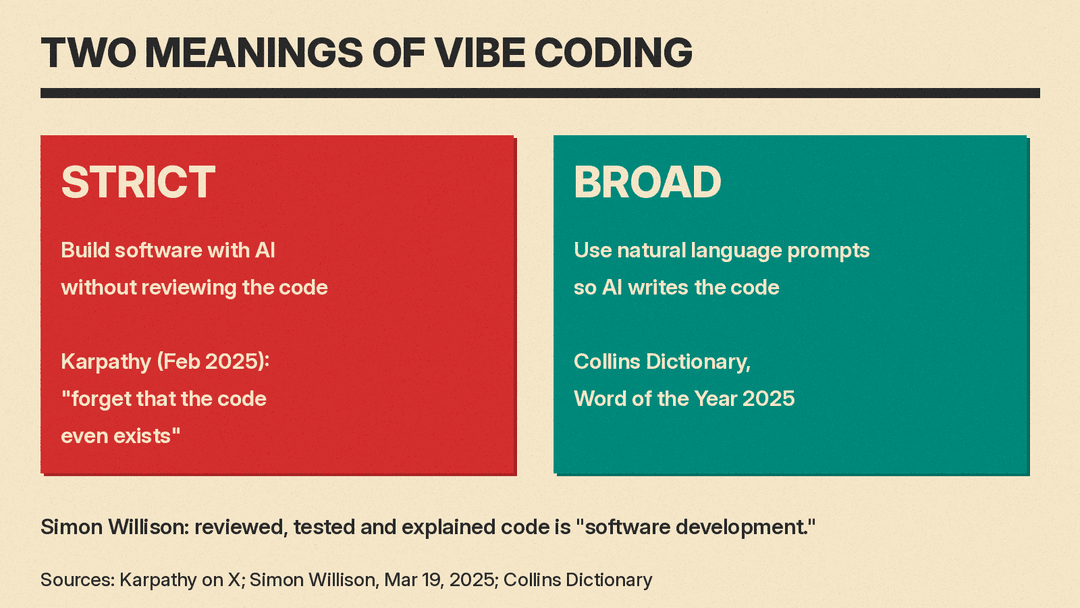
The strict meaning follows Karpathy's post: you do not look at the code. Developer Simon Willison put it this way in a March 2025 post: "When I talk about vibe coding I mean building software with an LLM without reviewing the code it writes." (An LLM, or large language model, is the type of AI behind tools like ChatGPT and Claude.)
Willison argues that this is different from careful AI-assisted programming. In the same post he writes: "If an LLM wrote the code for you, and you then reviewed it, tested it thoroughly and made sure you could explain how it works to someone else that's not vibe coding, it's software development."
The broad meaning covers almost any use of AI to write code from plain-language requests. Collins' American English definition reads: "the practice of writing computer programs by using natural language prompts to make a generative artificial intelligence program output the desired code." Its British English entry calls it "the use of artificial intelligence prompted by natural language to assist with the writing of computer code."
Willison wrote that applying the term to all AI-assisted code "dilutes the term."
How vibe coding works, step by step
The exact screens differ by tool, but the loop is the same. Here is how two popular app builders describe it in their own documentation.
Lovable's docs list four steps:
- Describe what you want to build.
- Review and iterate on your app.
- Publish it to a live URL.
- When you want the code in your own pipeline, sync it to GitHub, GitLab, or Bitbucket.
Replit's Agent docs describe a similar flow: you describe what you want in the chat, optionally pick a project type such as a web app or slides, and then "Agent writes code, sets up infrastructure, and tests the result." After that, you "chat with Agent to refine your project, then publish when you're ready."
Put together, a typical vibe coding session looks like this:
- Describe. You write or say what you want: what the app does, who uses it, how it should look.
- Generate. The AI writes the code and shows you a working preview.
- Try it. You click around the preview like a normal user.
- Ask for changes. You describe what is wrong or missing in plain words, for example asking for a bigger button or a search box.
- Fix errors. If something breaks, you paste the error message back to the AI, as Karpathy described.
- Repeat, then share. When it works well enough, you publish it or keep it for yourself.
Some of these tools, such as Replit Agent, run an AI agent: software that plans steps, takes actions and checks its own work rather than only answering questions. Replit's docs say: "Unlike a chatbot that only answers questions, Agent takes action: it sets up your project, creates applications, checks its work, and fixes problems along the way." For background on agents, see our explainer what is an AI agent.
What tools people use
Vibe coding tools fall into two rough groups.
App builders for non-programmers. These run in a web browser and handle hosting for you. Lovable calls itself "a full-stack AI development platform for building, iterating on, and deploying web applications using natural language." Replit's docs say of its Agent: "No code or technical knowledge required." In its FAQ, Replit answers the question "Do I need to know how to code?" with "No."
Coding tools for developers. Karpathy's original post named Cursor Composer, an editor feature in Cursor, used with Anthropic's Sonnet model. Willison notes that Cursor "was initially intended for professional developers" and has "far less safety rails" than some beginner tools. He also points to Claude Artifacts as "one of the first widely available vibe coding platforms," with code "restricted to running in a locked down" sandbox.
We compare specific options, with what each costs, in Best Vibe Coding Tools in 2026.
What vibe coding is good for
The sources above describe these uses:
- Personal tools. Willison writes: "I believe everyone deserves the ability to automate tedious tasks in their lives with computers. You shouldn't need a computer science degree or programming bootcamp in order to get computers to do extremely specific tasks for you."
- Prototypes. Lovable's docs list "working prototypes with real data and logic, so product, design, and sales teams can validate an idea before engineering builds it."
- Internal tools and simple sites. Lovable also lists landing pages, dashboards, and tools that replace spreadsheets for internal teams.
- Learning. Willison says vibe coding "shaves that initial barrier down to almost flat" for people who want to learn programming. He also calls it a way for experienced developers to build intuition "as to what LLMs can and cannot do for them."
- Throwaway projects. Karpathy's own scope was "throwaway weekend projects."
The BBC gives a simple example: a request such as "make me a program that schedules my weekly meals." The same article adds that "more complicated tools still require skill."
The risks
The sources above also flag these risks.
The code may not work. The BBC notes there is "no guarantee the code will actually work or be free of bugs." Karpathy himself wrote: "Sometimes the LLMs can't fix a bug so I just work around it or ask for random changes until it goes away."
Security flaws. Security firm Veracode tested more than 100 AI models on coding tasks for its 2025 GenAI Code Security Report. Veracode says "45% of code samples failed security tests and introduced OWASP Top 10 security vulnerabilities into the code." Veracode also found that newer models were better at writing working code but "no better at writing secure code."
Secrets and private data. Willison's post warns about secrets, meaning anything shaped like a password, such as the API key used to access an online tool. If your app handles them, "you need to take care not to accidentally expose them, which means you need to understand how the code works." He gives the same warning for private data.
Surprise bills. Willison writes that he has "seen horror stories about people who vibe coded a feature against some API without a billing limit and racked up thousands of dollars in charges." His advice: "Be very careful about using vibe coding against anything that's charged based on usage."
Harm to other people. Willison says thinking about harm is "particularly important if you plan to build software that will be used by other people." He asks: "Could somebody be harmed?" He lists damaged reputation and lost money among the possible harms.
How to try it safely
These tips come straight from the sources above:
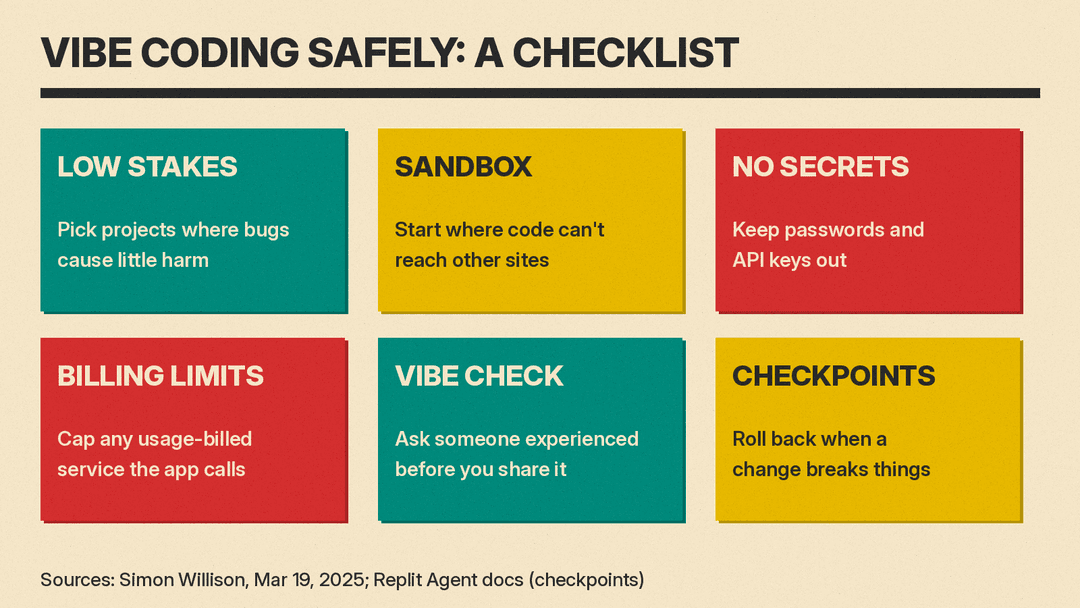
- Keep the stakes low. Willison: "Projects should be low stakes."
- Start in a sandbox. Willison writes: "Safe vibe coding for complete beginners starts with a sandbox." He cites Claude Artifacts, where code "can't make any network requests to other sites."
- Keep secrets out. Do not paste passwords or API keys into a project you do not understand.
- Set spending limits on any paid service your app connects to.
- Get a second opinion before you share it. Willison recommends "checking in with someone more experienced for a vibe check" before you release anything other people will use.
- Use checkpoints. Replit's docs say Agent "creates checkpoints as it works, so you can roll back to any previous state."
For a hands-on walkthrough with example prompts, see Vibe Coding With Claude: Prompts and a Step-by-Step Workflow. If you want structured lessons, we list options in Best Vibe Coding Courses for Beginners.
If you want to go from an idea to a published app without writing code, our guide How to Build an App With AI and No Code walks through it in seven steps.
Vibe coding vs other AI coding terms
- Vibe coding: you describe, the AI writes, and (in the strict sense) you do not review the code.
- AI-assisted programming: a developer uses AI to help but still reads, tests and understands the code. Willison's view is that this is "software development," not vibe coding.
- Coding agent: the software that does the work, such as Replit Agent. You can use a coding agent carefully or vibe code with it. The term describes the tool, not your habits.
Frequently asked questions
Do I need to know how to code to vibe code? Not according to Replit, whose docs say "No code or technical knowledge required." Willison adds a caveat: if your app handles secrets such as API keys, you "need to understand how the code works."
Is vibe coding the same as using ChatGPT to write code? Under the broad Collins definition, it can be. Under the strict meaning, it depends on whether you read and check the code.
Can I sell an app I vibe coded? The sources here do not cover selling apps. For anything other people will use, Willison recommends asking someone more experienced to check it before you share it.
Who coined the term? Andrej Karpathy, in a February 2025 post on X, per the BBC.
Sources
- Andrej Karpathy on X: the original "vibe coding" post
- Simon Willison: Not all AI-assisted programming is vibe coding (but vibe coding rocks)
- Collins Language Blog: Collins' Word of the Year 2025
- Collins Dictionary: vibe coding definition
- BBC: 'Vibe coding' named word of the year by Collins Dictionary
- Lovable docs: Welcome to Lovable
- Replit docs: Replit Agent
- Veracode: Insights from 2025 GenAI Code Security Report
