
This guide skips the job boards. A faster route into AI work as a student is to know the named programs, who each one is for, and when each one takes applications. Some windows are open now, and at least one closes this month.
It covers nine real programs, checked on each program's own page on November 11, 2026. Some are classic paid internships at AI labs and chip companies. Others are government research placements, open-source programs, and one fellowship. Where a program says it is not an internship, we say so.
Where to find AI internships
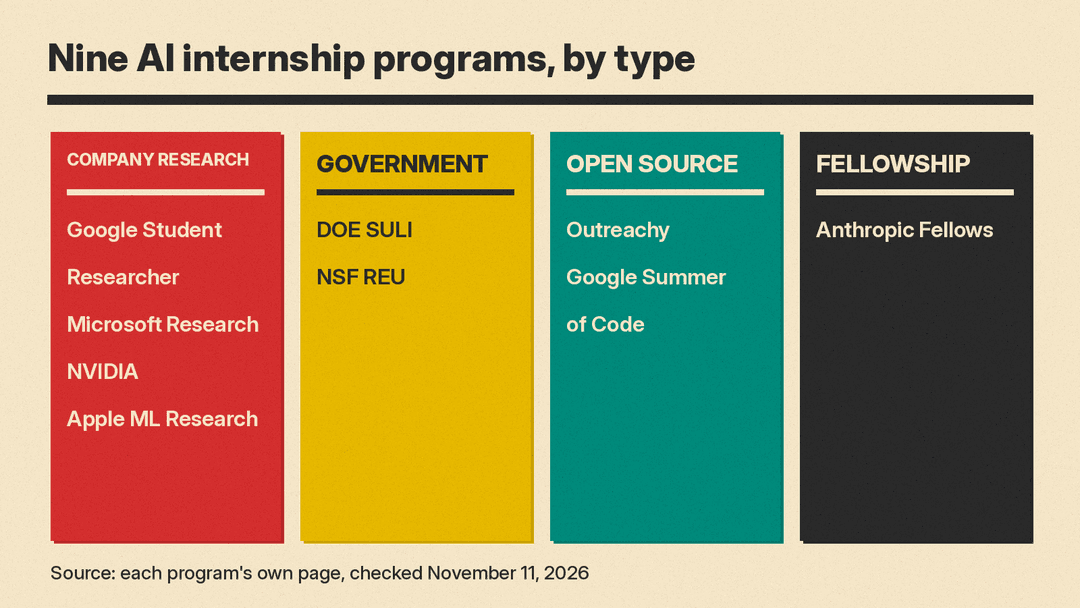
This guide groups the programs into four types:
- Company research career pages. Google, Microsoft Research, NVIDIA and Apple each run student programs and list roles on their own sites.
- Government research programs. The US Department of Energy and the National Science Foundation fund paid research placements for undergraduates.
- Open-source programs. Outreachy and Google Summer of Code pair contributors with mentors on open-source projects, fully online.
- Fellowships. Some AI labs run research fellowships that work like internships but are open to people who are not students.
Company AI internships
Google Student Researcher Program
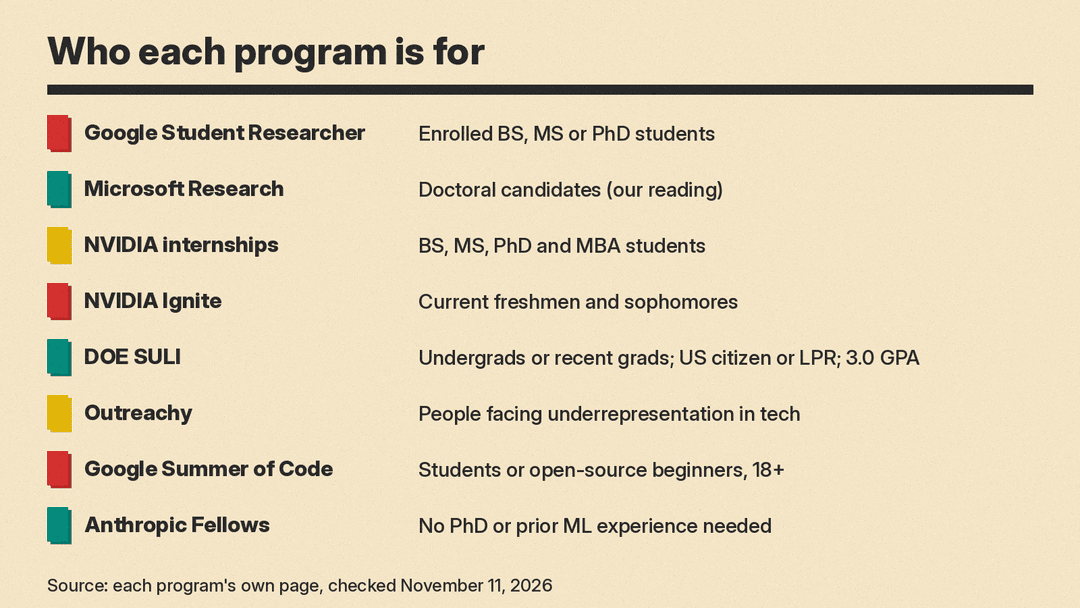
The Student Researcher Program offers paid internships in Google research, science and engineering teams. You must be enrolled in a Bachelor's, Master's or PhD program. The program page says placements run between 12 and 24 weeks, five days a week, in person at a Google office.
Applications are organized by degree level (BS, MS, PhD) and location. Google says it considers each applicant for relevant positions across its AI teams, including Google DeepMind and Google Research.
One current US posting, Student Researcher, BS/MS, Fall 2026, says the window is open until November 27, 2026 but may close earlier if projects fill. It lists a US base salary range of $98,000 to $131,000. That posting says time commitment, length and onsite or remote work vary by project, start dates are typically August through December, and you must be located in the United States for the whole engagement. It also says the program is "non-conversion eligible" and is best suited to students who will not seek full-time work after the role. To apply you need a CV or resume and a transcript in English.
Microsoft Research internships
Microsoft Research describes its research internships as a place for interns to work "alongside fellow doctoral candidates," so our reading is that the program is aimed at PhD students. Interns are paired with mentors for a 12-week internship. Microsoft says internships are available virtually and at its locations around the world, in all areas of research. They are offered year-round but typically begin in the summer. All are paid, and Microsoft says it helps with visa applications where needed.
On November 11, 2026, the same page listed a Research Intern role in AI and Human Systems, posted November 6, 2026, in Cambridge, Massachusetts and New York.
NVIDIA internships and Ignite
NVIDIA's university recruiting page says its interns are employees who work on real projects. It offers year-round internships for BS, MS, PhD and MBA students, for a minimum of 12 weeks. NVIDIA calls the internship its primary pipeline for new college grad hiring.
For students earlier in college, NVIDIA Ignite is a 12-week summer pre-internship program for current freshmen and sophomores.
Apple Machine Learning Research
Apple's Work with us page links to internships in machine learning and AI. Its pitch: "Come to Apple as a student, and your team will welcome you as a full contributor." The same page describes an AIML Residency Program, which invites experts in other fields to apply their domain expertise to machine learning products. That is worth a look if you are switching into AI from another field.
Government research internships
DOE Science Undergraduate Laboratory Internships (SULI)
SULI places undergraduates at Department of Energy national laboratories, with 17 participating labs and facilities. Summer is a paid 10-week internship. Applications for the Summer 2027 term are due January 6, 2027 at 5:00pm ET.
The eligibility page is strict. You must be a full-time undergraduate or a recent graduate (degree within two years of the start date), be 18 or older when the internship begins, and be a US citizen or lawful permanent resident. You also need a cumulative GPA of at least 3.0 and, by the deadline, at least 6 STEM credit hours and 12 total undergraduate credit hours.
NSF Research Experiences for Undergraduates (REU)
The NSF REU program funds research by undergraduates in any area NSF supports. Students apply directly to individual REU Sites. NSF says participants receive stipends and, in many cases, help with housing, meals and travel. Read each site's project list to find ones that involve AI or machine learning.
Open-source programs
Outreachy
Outreachy offers paid, remote internships in open source. The stipend is $7,000 USD in total, and internships last three months, running May to August or December to March. It is open to anyone who faces underrepresentation, systemic bias or discrimination in the tech industry where they live. Projects can include programming, research, data science and documentation, among other work.
Outreachy says its internships are not linked to jobs at its sponsors. For the May 2026 cohort, intern applications were accepted from February 6 to February 13, 2026, so watch the site early in the year.
Google Summer of Code
Google Summer of Code is often listed with internships, but Google says it is not one. Contributors are independent developers who receive a stipend after passing their evaluations, and the program is entirely online.
To be eligible you must be 18 or older at registration, be eligible to work in your country of residence, be a student or an open-source beginner, and not live in a US embargoed country. Projects are scoped at about 90, 175 or 350 hours. You can submit up to three proposals, but only one can be accepted.
AI fellowships for career switchers
Anthropic Fellows Program
The Anthropic Fellows Program is a fellowship, not an internship. Anthropic describes it as funding and mentorship for engineers and researchers. Fellows spend four months on empirical AI safety research with Anthropic mentors, with the aim of a public output such as a paper. Anthropic says fellows receive compute funding of about $15k per month, with stipend details in the job description.
Applications are rolling. Anthropic says: "You don't need a PhD, prior ML experience, or published papers." It also says over 35% of past fellows went on to join Anthropic full time to work on AI safety.
How to apply for an AI internship
The programs above run on different calendars and rules, so the main job is to match each one's process.
Apply early when the window is rolling. Google's Student Researcher posting says applications are reviewed on a rolling basis and may close before the stated date. Anthropic's fellowship also takes applications on a rolling basis.
Have your documents ready. Google asks for a current CV and a transcript in English, with your anticipated graduation date and coding languages on the resume. SULI asks for transcripts and letters of recommendation, and its site has an application checklist.
Talk to mentors before you propose. For Google Summer of Code, Google says prior interaction with the mentor is the most critical factor in a good proposal. It also warns that using AI to write your proposal could lead to automatic rejection, depending on the organization.
Check eligibility first. Citizenship, location, age, enrollment and GPA rules differ by program. SULI requires US citizenship or permanent residence and a 3.0 GPA, and Google's US Student Researcher posting requires you to be in the United States.
Check dates on each program's own page. Each program runs its own cycle. Every date in this guide comes from the program's site as of November 11, 2026.
Skills that help
None of these programs publishes a single skills list for every role. Google's Student Researcher posting asks for experience in one area of computer science, such as machine learning or natural language understanding, and prefers experience with a general-purpose language such as Python. If you are starting from zero, our list of free Python courses for AI beginners is a practical first step.
If you are still choosing a direction, see AI engineer vs ML engineer vs data scientist and our AI agent engineer roadmap. If you are not on a computer science track, read AI jobs without a CS degree.
Bottom line
AI internships are not only at the big labs. Company programs at Google, Microsoft Research, NVIDIA and Apple sit next to government placements (SULI, NSF REU), paid open-source work (Outreachy) and stipend programs (Google Summer of Code). Career switchers can look at fellowships like Anthropic's. Two dates to note now: Google's US BS/MS Student Researcher window is listed as open until November 27, 2026, and SULI's Summer 2027 applications are due January 6, 2027.
Sources
- Google DeepMind: Student Researcher Program
- Google Careers: Student Researcher, BS/MS, Fall 2026
- Microsoft Research: Careers in research
- NVIDIA: University Recruiting and Early-Talent Programs
- Apple Machine Learning Research: Work with us
- US DOE Office of Science: SULI
- US DOE Office of Science: SULI Eligibility
- NSF: Research Experiences for Undergraduates
- Outreachy
- Google for Developers: Google Summer of Code FAQ
- Anthropic: Anthropic Fellows Program for AI safety research
