
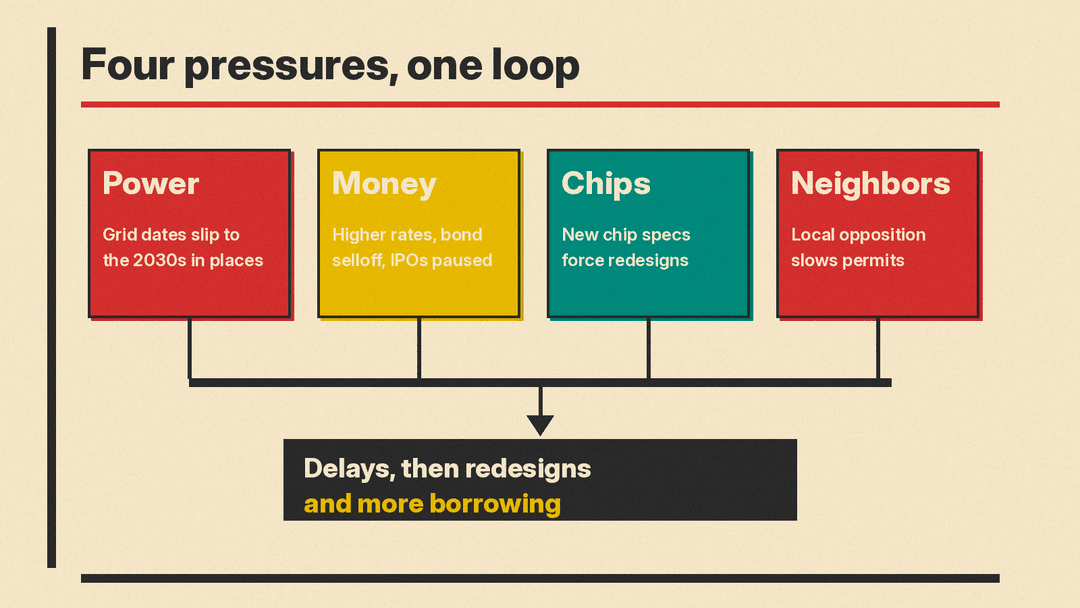
The AI data center boom has hit four limits at the same time: grid power, the cost of debt, chip designs that change mid-build, and local opposition. New figures published over the weekend put numbers on each one.
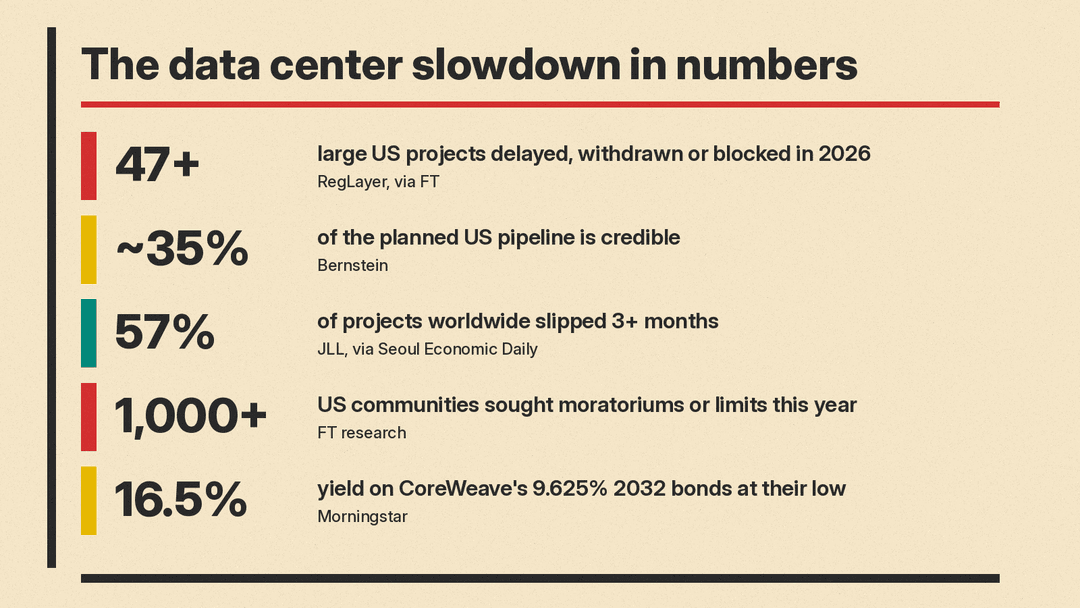
The headline count comes from RegLayer, a firm that tracks local permits, utility filings and grid records. It counted at least 47 large US data center projects that were delayed, withdrawn or blocked in 2026, the Financial Times reported on October 18. RegLayer called the figure a conservative estimate that covers only the largest projects. The FT also cited Bernstein's estimate that only about 35% of the planned US data center pipeline is credible, a figure The Asia Business Daily also reported. According to the Financial Times, that estimate takes into account grid connection times, transformer shortages and liquid cooling bottlenecks.
Power: the slowest input
Power is the constraint money cannot fix quickly. The clearest recent case is Microsoft's exit from Nscale's planned site in Loughton, Essex, which we covered on October 18. Grid officials reportedly told Nscale they did not expect to supply electricity until the 2030s. The site was planned for about 23,000 Nvidia chips, starting at 50 MW, according to a Yahoo Finance summary of the Reuters and Telegraph reports.
The same piece notes that Microsoft is paying for sites that come with a power date. On October 16, utility NiSource announced a 20-year agreement with Microsoft that adds about 1,100 MW of generation in Indiana, with service expected to begin in 2028. Buyers now rank sites by when power arrives, not only by price. Anthropic's recent 95 MW lease in Nova Scotia fits the same pattern: capacity tied to a dedicated energy plan.
Money: rates rose, and neocloud debt got expensive
The second limit is financing. CoreWeave, the largest neocloud operator, is the reference point. On October 14 its shares fell 15.5% and the yield on its 9.625% bonds due 2032 rose to about 14.8%, CNBC reported. Morningstar reported that the 2032 bonds fell as low as 75 cents on the dollar, a yield of about 16.5%, before recovering to 80 on October 15. S&P rates CoreWeave B+, which is junk territory.
CoreWeave CEO Mike Intrator dismissed the selloff in a memo obtained by CNBC: "We are confident in our backlog which more than supports all of our debt obligations." Reuters put CoreWeave's debt at about $50 billion, citing LSEG data, and said the cost of insuring that debt against default rose to about 1,200 basis points in the same week.
The pressure has spread to listings. In the past week, planned listings for a Blackstone-backed AirTrunk REIT, Nvidia-backed Firmus and SoftBank-backed SB Energy were pulled or paused, Reuters reported on October 18. Firmus had aimed to raise $5 billion while carrying about $30 billion of debt, according to Reuters. The trigger is rates: the 10-year US Treasury yield had its sharpest quarterly rise this century in the quarter that ended in September, Reuters reported.
Deals have not stopped. Reuters cited Dealogic data showing $21.3 billion of Asian data center M&A so far this year, more than double all of 2025. But investors now separate operators with long-term customer contracts from higher-risk neoclouds and campus builders.
Chips and cooling: the spec moves during construction
The third limit links back to the chips. A data center designed for one GPU generation may need new power and cooling layouts by the time the next generation ships. The Seoul Economic Daily, summarizing reporting from the New York Times and the FT, gives one example. At a Texas site that developer Cipher is building, design changes by tenants Fluidstack and Anthropic added $359.3 million in costs and moved completion from this year to the first quarter of next year, the paper reported.
This is why delays compound. A late project often needs a redesign, the redesign needs more money, and more money now costs more.
Neighbors: permits get harder
The fourth limit is local opposition. The FT said its own research found more than 1,000 US communities sought moratoriums or other restrictions on AI infrastructure this year. The Seoul Economic Daily also cites an Annenberg Public Policy Center survey in which 61% of Americans said they oppose a new data center in their own community. Common objections are electricity prices, water use, noise and tax breaks.
Why it matters
Most AI roadmaps assume compute capacity arrives on schedule. If Bernstein's 35% estimate is close, a large part of the announced US pipeline will not be built on the dates in press releases. Projects with power, permits and an investment-grade tenant will get built. The rest will wait, change hands or be cancelled. SemiAnalysis still forecasts +50GW in 2027, and we explain why both counts can be true.
For the chip side, the risk is concentrated. The Information, as summarized by Financial News, reported that some data center executives expect today's hundreds of neoclouds to shrink to around 7 to 10 within a few years. The same report said a failure at a company that builds its own facilities would weigh more on Nvidia than a failure at one that leases them. Demand for GPUs at hyperscalers is still high. Demand that depends on smaller, debt-funded buyers is now the less certain part. Our report on Google's TPU v9 schedule shows that silicon timelines can slip too.
What to watch
- Microsoft's fiscal first-quarter results on October 28. Compare capital spending including finance leases with the $50 billion guide.
- CoreWeave's quarterly results, expected in November, and whether its bond yields stay near 15%.
- Whether paused listings such as Firmus and SB Energy return, and at what valuation.
- New RegLayer and FT tallies of blocked or withdrawn projects.
Sources
- Financial Times: report on US data center delays (RegLayer, Bernstein)
- Reuters via Lee Enterprises: Market selloff, rising rates test AI data center deal boom
- CNBC: CoreWeave shares tumble as bond yields near 15%
- Morningstar: CoreWeave and data center bonds slide
- Reuters via Investing.com: CoreWeave's debt stress tests private credit
- Seoul Economic Daily: Four bottlenecks shake AI data center boom
- Financial News: 47 US data center projects hit snags
- Yahoo Finance: Microsoft walks away from Nscale's UK data center
- The Asia Business Daily: US AI data center boom put to the test (Bernstein 35% estimate)
