
Google said on November 4 that it will invest US$15 billion in Malaysia over 2027 and 2028 to build out its data center footprint there. The plan covers new campuses in Selangor and Negeri Sembilan, more than 1 gigawatt (GW) of new clean energy capacity for the national grid, and water projects meant to ease pressure on local supplies. It is a large infrastructure bet, and Google puts power and water commitments at the center of the announcement.
What Google announced
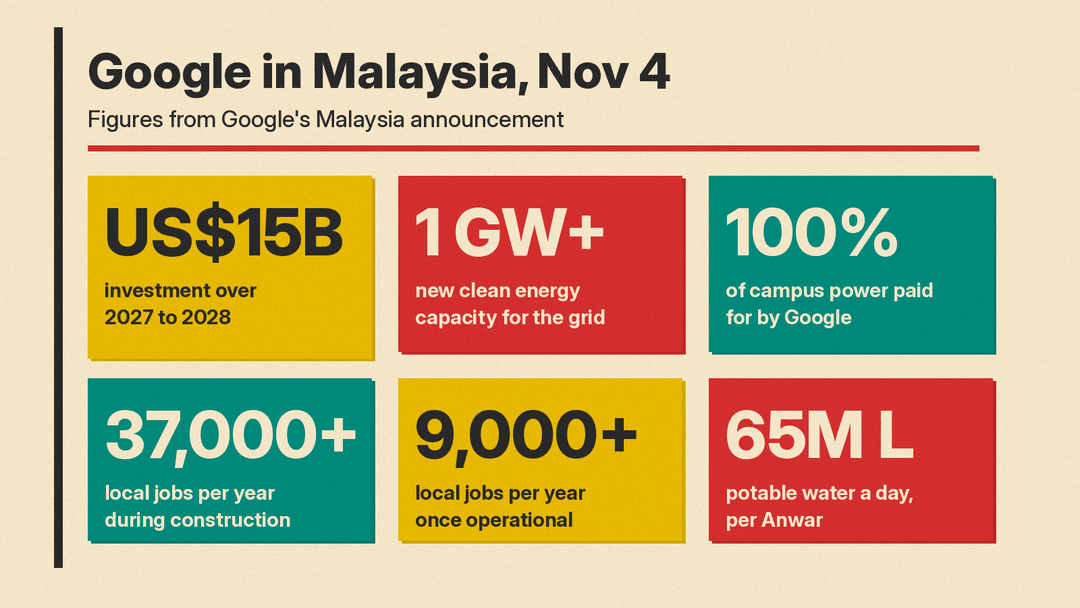
Google made the announcement in a post on its Malaysia blog, "in the presence of" Malaysian Prime Minister Anwar Ibrahim. The US$15 billion covers "the next two years (2027 to 2028)" and builds on the digital infrastructure investment Google announced in 2024. DCD notes that the 2024 commitment was $2 billion.
The footprint includes Google's first Malaysian data center campus at Elmina Business Park in Selangor, which Google says is now operational, plus new planned campuses in Selangor and Negeri Sembilan. Google also says its computing capacity in Selangor will support an upcoming Google Cloud region in Malaysia for enterprise customers.
The company says the new infrastructure will "provide the world-class computing capacity needed to run homegrown, next-generation digital and AI applications," and will also power Google services such as Search, Maps and Chrome.
What is known about the sites
Google's own post gives few site details. DCD, which cites Bloomberg for the headline investment, adds some context. It reports that Google bought 389 acres in Port Dickson, Negeri Sembilan, in May 2025, and that, according to reports, the data center there will have a capacity of between 500MW and 1GW, with Gamuda Engineering in charge of engineering and infrastructure works. DCD also says the first phase of the existing Elmina campus is expected to have a capacity of 100MW and is slated for completion sometime this year.
Treat the 500MW to 1GW range as reported, not confirmed by Google. The company's announcement does not state a megawatt figure for the new campuses.
Power: Google says it will pay for its own
The energy section is the most specific part of the plan. Google says it will bring "more than 1 GW of new clean energy capacity" to Malaysia's national grid. This is anchored by a collaboration with Tenaga Nasional Berhad, and Google plans to enable new clean energy generation facilities under Malaysia's Corporate Renewable Energy Supply Scheme. Because solar output is intermittent, the collaboration will also explore round-the-clock clean energy projects, Google says. The plan sits on top of Google's ongoing partnerships with consortiums led by Shizen Energy-Solarvest and TotalEnergies.
On cost, Google says it "will also pay for 100% of the power its data center campuses use and the direct infrastructure costs required to connect them to the grid, while complying with all applicable local regulations." In 2027, it plans to invest in community-based initiatives, including programs that bring down electricity bills for households in the states hosting its infrastructure.
At the launch event, The Sun Malaysia reported, Ruth Porat, president and chief investment officer of Alphabet and Google, described the approach as "Bring Your Own Power," under which electricity supply would be increased alongside the growth of Google's facilities. Anwar said Google had accepted environmental conditions imposed by the government. "Yes, these are the conditions imposed and they have accepted," he told reporters.
Efficiency claim
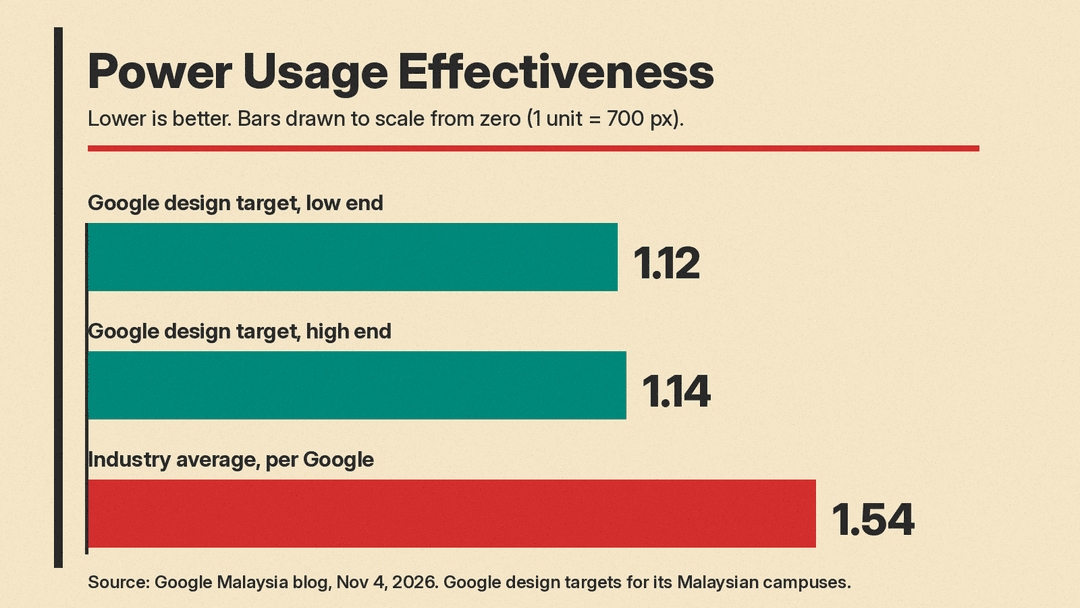
Google says its campuses will run at a Power Usage Effectiveness (PUE) of 1.12 to 1.14 in warmer tropical climates like Malaysia's. It compares that with an industry average of 1.54, and says it will disclose quarterly PUE figures for each site once it is fully operational. PUE is the ratio of a facility's total energy use to the energy used by its computing equipment, so a lower number means less energy goes to cooling and overhead. These are Google's stated targets for its Malaysian campuses, not measured results.
Water: cooling with water, plus replenishment projects
Google says it will use water cooling at its Selangor and Negeri Sembilan campuses. Its stated reason is that water risk assessments with environmental scientists and hydrologists "concluded that local watershed supplies were not at high risk of scarcity or depletion." Google adds that water cooling can reduce a data center's energy use by approximately 10% compared to air cooling.
To help sustain long-term water resilience, Google announced two new water replenishment projects: river basin stewardship work with the Global Environment Centre in the Sungai Buloh and Sungai Selangor watersheds, and rainwater harvesting and storage at four schools in Selangor. It also points to its development of an off-river storage reservoir and water treatment plant in Negeri Sembilan.
Anwar said that plant is designed to deliver 65 million litres of potable water daily, and that ownership will be handed to the state government as a permanent public asset after completion. The Sun also reports that Google announced a US$160 million investment on November 2 in the reservoir and treatment plant on the Linggi River in Negeri Sembilan, with Gamuda Bhd appointed to build it.
Jobs and local economy
Google projects that construction of the new campuses in 2027 and 2028 will contribute an annual average of US$1.1 billion to Malaysia's GDP and support more than 37,000 local jobs per year, with about 6,000 of those in construction. Once operational, it says the facilities will sustain more than 9,000 local jobs per year, with wages averaging 45% above the national median. Google says it works with a domestic supply chain of more than 80 Malaysian entities.
It also announced four skills programs aimed at upskilling 800,000 Malaysians from 2027 to 2031, including Data Center Institutes at selected polytechnics in Selangor and Negeri Sembilan, which will offer a 10-week curriculum for data center deployment and operations roles.
Why it matters for AI infrastructure
The headline number matters less than the structure. AI data center buildouts are running into limits on power, financing and local approval, as our reports on 47 stalled US projects and on the Ohio ballot results show. The Malaysian plan addresses power and water up front: paid-for power, new generation capacity, a water plan, and a government that publicly says conditions were accepted. Whether the plan delivers will depend on the projects Google lists, such as the Tenaga Nasional generation facilities and the Linggi River plant, reaching completion on the timeline of the campuses they serve.
Two limits are worth keeping in mind. First, Google does not say how much of the US$15 billion goes to servers and chips versus buildings, power and water. Second, the campus capacity figures come from DCD's reporting on third-party reports, not from Google. Readers tracking AI compute supply should watch for confirmed megawatt figures and for the timing of the planned Google Cloud region in Malaysia. For context on Alphabet's overall spending, see our report on Alphabet's third-quarter capital expenditures.
Sources
- Google Malaysia blog: Google Announces Digital Infrastructure Expansion, Local Jobs, Water Replenishment, and Clean Energy Initiatives with US$15 Billion Malaysia Investment
- DCD: Google commits to $15bn investment in Malaysian data centers
- The Sun Malaysia: Google accepts environmental conditions for US$15b Malaysia investment: Anwar
- CNA: Google to invest US$15 billion in Malaysia in 2027 and 2028
