
Two sets of numbers about AI data centers arrived on the same day, and at first they seem to disagree. On October 18, the Financial Times reported that at least 47 large US data center projects were delayed, withdrawn or blocked in 2026, which we covered as the four limits on the buildout. Late on October 18 Pacific time, SemiAnalysis published "Datacenters 2027: The Year of Acceleration, +50GW in a Single Year", by Jeremie Eliahou Ontiveros, Reyk Knuhtsen and Dylan Patel.
Both can be true. They measure different stages of the same pipeline, and the gap between them is where the risk sits for anyone who depends on new compute.
What SemiAnalysis says
The core claim is visual. SemiAnalysis shows ">24GW of datacenters in advanced stage of construction, most of it to be delivered in 2027" across 40 campuses, according to the report. It says most of them "are more than halfway done, with exterior cooling and electrical equipment already installed," and that the 40 campuses are "a tiny share of the multiple hundred sites in advanced stage of construction." The report's subtitle reads "60GW Under Construction."
The firm frames the piece as a reply to skeptics. It says Brad Gerstner of Altimeter showed its data on the All-In Podcast, called "SemiAnalysis' forecast of +43GW in 2027" too aggressive, and said he thought only about 25GW would get built, per SemiAnalysis. The report's own headline figure is now +50GW in a single year. SemiAnalysis adds a comparison: "+50GW is essentially the global cumulative datacenter market up through 2024 being built in one year."
 24GW in advanced construction across 40 campuses" loading="lazy">
The report rests on two leading indicators. The first is quarterly self-build construction starts by US hyperscalers. SemiAnalysis says "US hyperscalers have never launched more construction of datacenters" and that the megawatts starting construction each quarter are "going parabolic, driven in particular by two hyperscalers." It does not name the two in the free section; that detail is for subscribers to its Datacenter Industry Model.
The second indicator is leasing. SemiAnalysis says developers "typically only spend 5-10% of project capital without a customer" and need a pre-lease, "typically a 15-20 year contract, with a TCV of $30-50B per GW." The report gives three versions of the year-to-date lease total. It says "slightly under USD 1T of binding / non-cancellable datacenter leases have been signed." Later it says it has "identified over a trillion USD of lease value that was signed and closed" in 2026 so far. The subtitle says "1.3T of Lease Contracts Signed YTD." We report all three as written; the free text does not explain the difference.
Why the two numbers do not cancel out
The FT tally, based on data from RegLayer, counts projects that hit trouble: delays, withdrawals, blocks. The FT also cited Bernstein's estimate that only about 35% of the planned US pipeline is credible, as we reported. That is a statement about plans.
SemiAnalysis counts megawatts at sites it tracks through construction. It says most of the buildings in its >24GW figure already have exterior cooling and electrical gear installed. A project stuck at a permit hearing and a building with chillers on the roof are at opposite ends of the pipeline. Both counts can rise in the same year.
Scope differs too. The FT number is US only. SemiAnalysis says "the ex-US buildout is sharply accelerating in 2027," and that it expects ex-US sites "to gain a lot of market share in 2028, largely driven by US challenges." In other words, some of the US friction we described pushes capacity abroad rather than removing it.
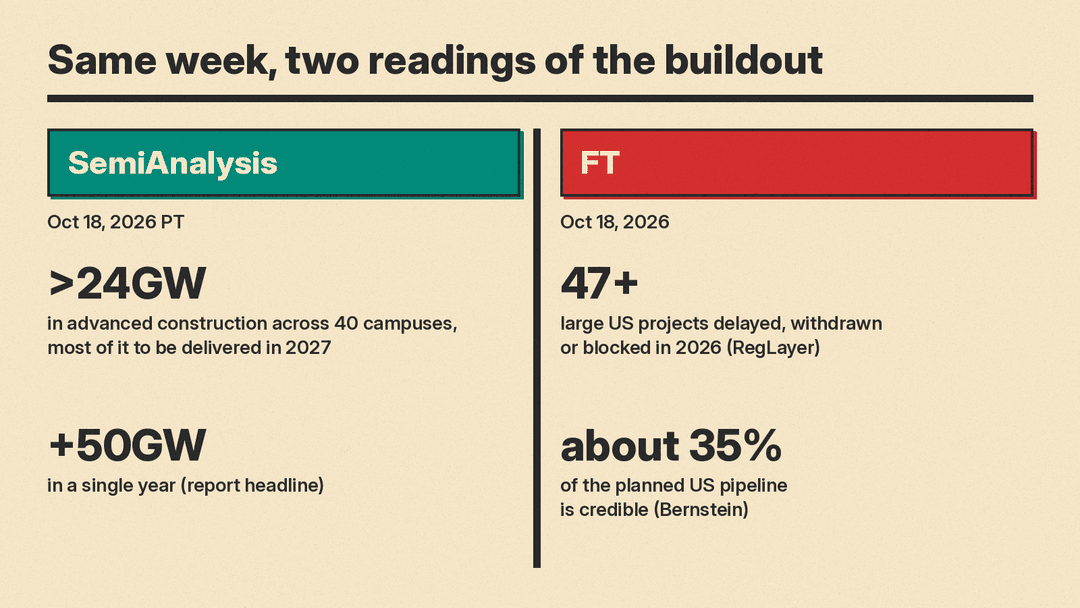 24GW in advanced construction across 40 campuses, most of it to be delivered in 2027; +50GW in a single year. FT, Oct 18: 47+ large US projects delayed, withdrawn or blocked in 2026 (RegLayer); about 35% of the planned US pipeline credible (Bernstein)" loading="lazy" width="1600" height="900" srcset="https://cms.llms.blog/content/images/size/w600/2026/10/semianalysis-forecasts-50gw-2027-2-qa0930.png 600w, https://cms.llms.blog/content/images/size/w1000/2026/10/semianalysis-forecasts-50gw-2027-2-qa0930.png 1000w, https://cms.llms.blog/content/images/2026/10/semianalysis-forecasts-50gw-2027-2-qa0930.png 1600w" sizes="(min-width: 720px) 720px">
Where the tension is real
SemiAnalysis does not deny the constraints. It says "there are labor issues, supply chain delays, fundraising challenges, among many others," and that it has called out "countless datacenter delays," including "the Oracle New Mexico Force Majure site delay in April," in its report. It says its model "adjusts for all of that and still points to a material acceleration." Our view: on three points, the two sets of reporting pull hard in different directions.
Power. SemiAnalysis says behind-the-meter generation, from "fuel cells to truck engines to refurbished turbines," means "the power generation problem has broadly been solved." The same report also says grid headroom "dips negative at the end of 2027." Against that, Microsoft canceled its lease of 23,000 Nvidia chips at Nscale's planned site in Loughton, Essex, after the local grid operator reportedly told Nscale it could not supply enough power until the early to mid 2030s, as we covered. On-site power can work for sites that can build it. It does not help a site that planned on the grid.
Money. SemiAnalysis says its Compute, Capital & Markets Model "can confirm that most of this debt has been raised" for the year's leases. That matters, because the stress we described sits in the debt market: the yield on CoreWeave's 9.625% bonds due 2032 rose to about 14.8% on October 14, CNBC reported, and listings for an AirTrunk REIT, Firmus and SB Energy were pulled or paused, Reuters reported. SemiAnalysis itself expects more pressure: "Reflexively rates will have to shoot up to enable the buildouts from a capital demand perspective." Our reading: if debt already raised covers 2027 sites, the rate shock bites later, on the 2028 pipeline.
Speed and redesigns. SemiAnalysis says modular designs, such as Meta's tent design and an AWS rapid design dubbed "SAMDC," bring construction timelines "under 10 months," and that prefabrication can cut MEP labor "up to 63%." It says DayOne cut build times to "~9 months" against ">18 months" for traditional developers. Our earlier post showed the other side: at a Texas site Cipher is building, tenant design changes added $359.3 million in costs and moved completion from this year to the first quarter of next year, the Seoul Economic Daily reported. Fast shells do not stop the spec from changing during the build.
Why it matters
If SemiAnalysis is right, 2027 is a supply year. The firm says the result "will be significantly more compute supply," which "means cheaper and smarter AI, faster pace of AI model progress." It also says data centers and power "may be the tip of the iceberg, with memory and logic possibly becoming the new #1 constraint in 2027-28." For chip buyers, that moves the bottleneck from buildings to silicon.
Our reading: if the skeptics are closer, the shortfall is likely to show up first at smaller, debt-funded builders, not at the 40 campuses SemiAnalysis pictures. The likely outcome sits between the two: the large, leased, power-secured sites finish, and the long tail of planned projects slips. The forecast and the stall count describe two halves of one market.
What to watch
- Whether SemiAnalysis names the two hyperscalers driving construction starts, and whether their earnings guidance matches.
- A clear reconciliation of the "slightly under USD 1T," "over a trillion" and "1.3T" lease figures.
- New RegLayer and FT counts of stalled US projects, and whether the stalls reach sites that were already under construction.
- Debt pricing for neoclouds and campus developers as 2028 projects try to raise money.
Sources
- SemiAnalysis: Datacenters 2027: The Year of Acceleration, +50GW in a Single Year
- Financial Times: report on US data center delays (RegLayer, Bernstein)
- SemiAnalysis: Datacenter Industry Model
- llms.blog: 47 US AI Data Center Projects Stalled This Year
- llms.blog: Microsoft Cancels 23,000-GPU Deal at Nscale UK AI Data Center Over Grid Delays
- CNBC: CoreWeave shares tumble as bond yields near 15%
- Reuters via Lee Enterprises: Market selloff, rising rates test AI data center deal boom
- Seoul Economic Daily: Four bottlenecks shake AI data center boom
