
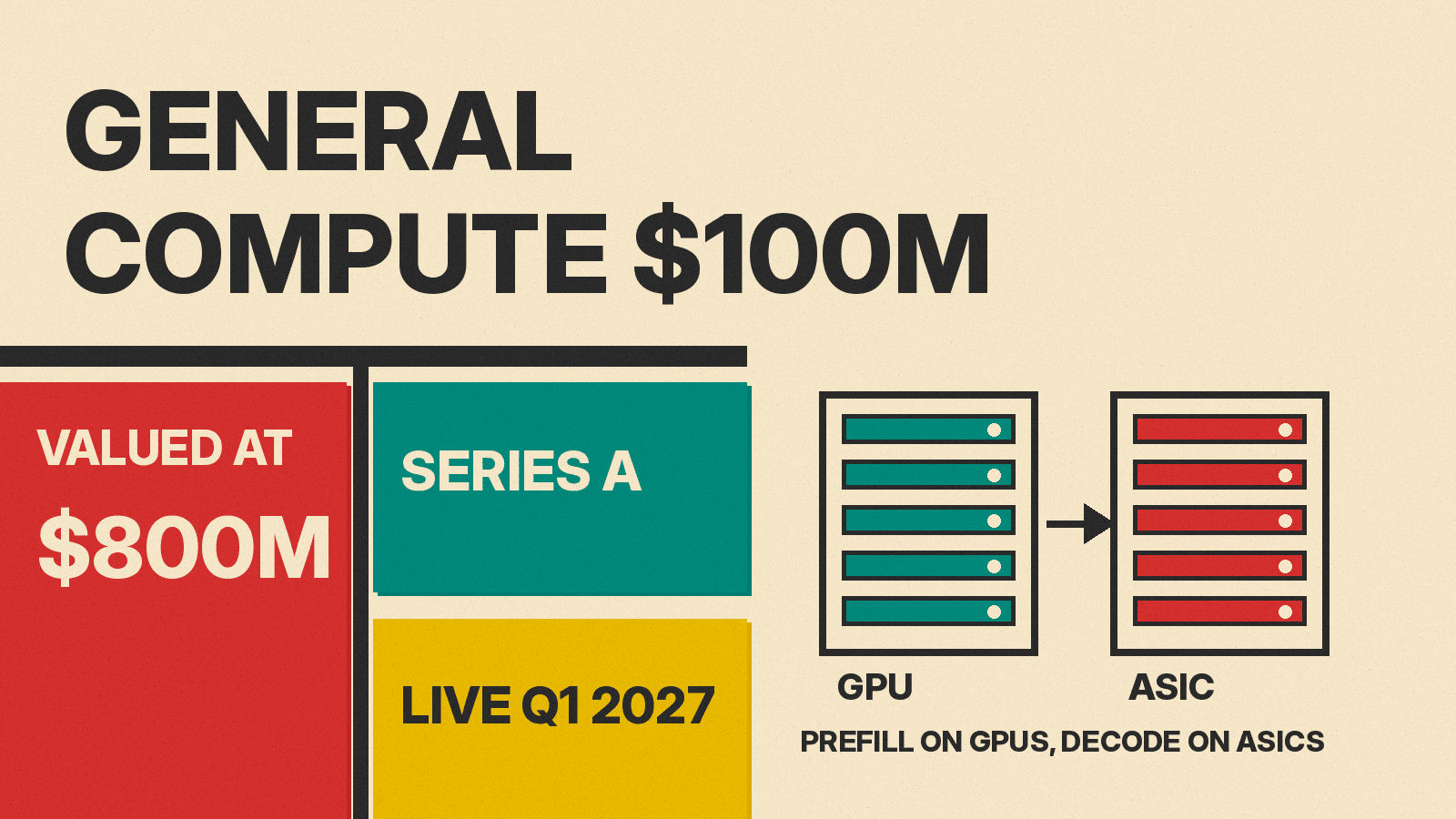
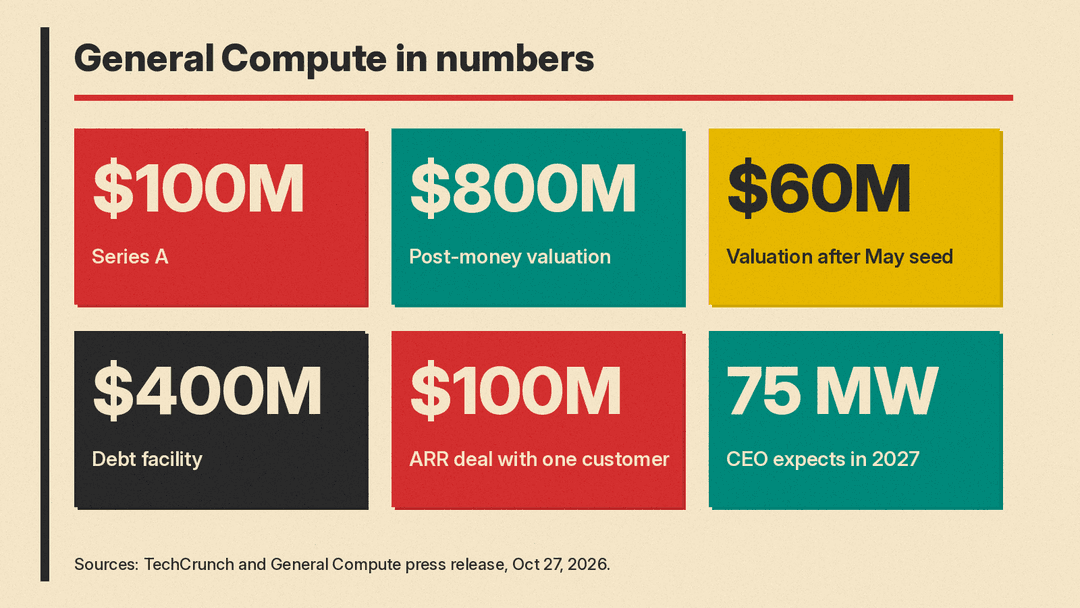
General Compute, a San Francisco neocloud that builds its fleet from inference chips made by Nvidia rivals, has raised a $100 million Series A at an $800 million post-money valuation, TechCrunch reports. Blackbird and Abstract co-led the round. The company was valued at $60 million after a seed round in May.
TechCrunch notes the timing: CoreWeave's stock is at a 12-month low, and Elon Musk, who is lining up $40 billion in debt for computing capacity, predicted that "200+ neoclouds are going to see guppy-level death and consolidation." General Compute raised anyway, for a cloud built on specialized inference chips rather than on GPUs alone.
What General Compute does
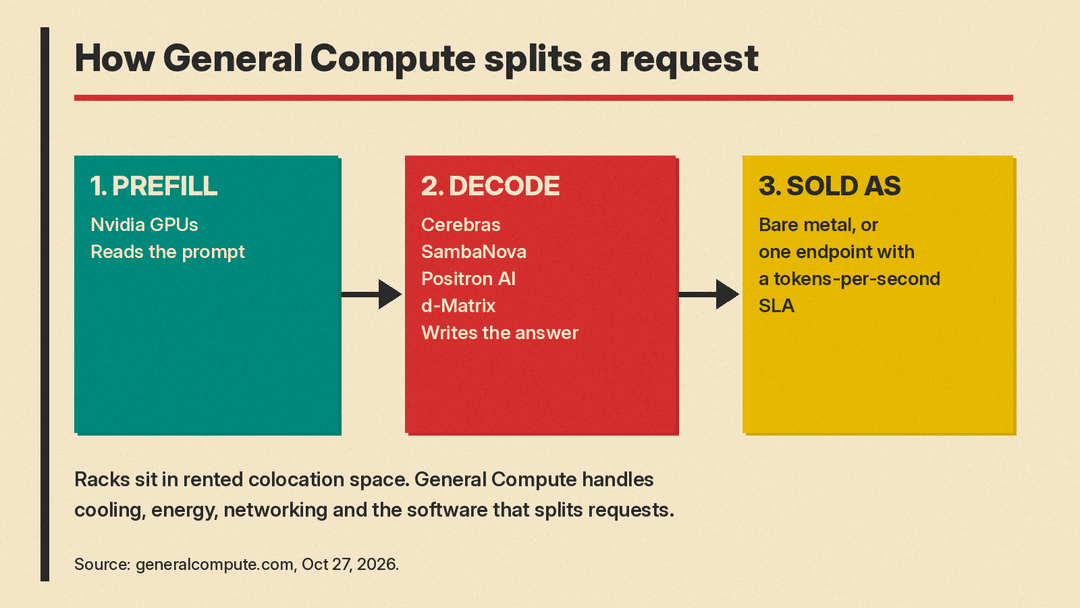
The company's own site describes it as "the inference cloud for alternative chips." Its model has three parts:
- It buys the hardware. Per the site, that means "GPUs for prefill and ASICs for decode."
- It places the racks in colocation data centers and handles cooling, energy, networking and software.
- It sells the result as dedicated bare metal or as a guaranteed tokens-per-second service level agreement (SLA).
Prefill is the step where a model reads the prompt. Decode is the step where it writes the answer, one token at a time. General Compute's site says prefill runs on Nvidia GPUs and decode runs on chips from Cerebras, SambaNova, Positron AI and d-Matrix, with its software splitting each request across the two. The site calls this disaggregated inference and says it "moves the whole curve out: each rack serves more users, and each user gets tokens faster."
The funding announcement names Cerebras, SambaNova and Positron AI as the current partners and says the cloud can run "nearly any model across major frontier labs & open-source models." Its headline claims results "up to 40x faster than GPUs," while a bullet in the same release says "up to 20x faster results." Neither figure comes with a benchmark, so treat both as company claims.
The money behind it
The raise sits on top of a large debt line. The press release says General Compute "recently secured a $400 million debt facility from Upper90 to finance its neocloud buildout." TechCrunch describes a $400 million deal to buy new chips from SambaNova and calls it "the first debt financing of inference chips." David Kwon, a partner at Abstract, said in the release that within months the team had "a big partnership with Cerebras and a debt facility of up to $400 million."
According to TechCrunch, a deal with a large customer worth $100 million in annual recurring revenue paved the way for the Series A. TechCrunch does not name that customer. It says General Compute's key customers are cloud companies that sell fast inference to developers, and that General Compute gives them the bare metal to bring their own offerings to market.
The round also included Fuse Venture Partners, Village Global, Bold Capital, QED Fund, 645 Ventures, Carbide Ventures, Uncorrelated Fund, Endeavor Catalyst, Icehouse Ventures, MatterScale, Carya and Plug and Play, per the release.
How it plans to grow
TechCrunch says General Compute avoids building huge data centers from scratch. Instead it uses smaller power sources, rents space in other companies' data centers and converts former bitcoin-mining sites to run AI models. The trade-off, as TechCrunch puts it, is that the company will not jump into the top ranks of neoclouds soon, but "when General Compute has chips, it will have someplace to plug them in."
The capacity numbers differ by source, so here they are as each one states them:
- The press release says first major deployments go live in Q1 2027, "with more than 50 MW of capacity in the pipeline."
- The company website says it has "over 30 MW of capacity and counting" and that deployments go live from Q1 2027.
- CEO Finn Puklowski told TechCrunch he expects to deploy 75 megawatts in 2027 and suspects he will have access to 200 megawatts of power, "more than we can probably fund and get hardware for."
Puklowski also said financing is far from finished: "capital is going to be a full-time job for me, both on debt and equity."
Why it matters
TechCrunch frames the strategy as zigging where others zag: General Compute focused on chips built for inference while everyone else chased GPUs.
James Palmer, a principal at Blackbird who co-led the round, told TechCrunch that "Cerebras, Positron, SambaNova, all need distribution partners who can take them to scale, who can navigate the complexity of the physical world." In the press release, Positron AI CEO Mitesh Agrawal called the partnership "a path to get our architecture into more customers' hands." SambaNova CEO Rodrigo Liang said: "Everyone in this market is selling speed. The real question is whether you can make money doing it."
The risks are in the same TechCrunch story: Musk's prediction of death and consolidation across 200+ neoclouds, and Puklowski's own statement that raising debt and equity is not done. Puklowski told TechCrunch that fears of a chip-led collapse are "massively overstated" and that people call him "every single week" asking for more compute.
For buyers, the pitch is inference capacity on alternative chips sold "under one contract and one set of SLAs," per the release. Palmer said in the same release that "both power and silicon supply chains are slow to scale." On the silicon side, TSMC is reportedly weighing a CoWoS packaging price increase. General Compute's first major deployments are not due until Q1 2027.
