
Voters in dozens of US towns and townships turned down data centers at the ballot box on November 3, and Ohio led the count. Data Center Dynamics (DCD) reported on November 4 that at least 14 Ohio measures passed as bans or other restrictions, and that "most anti-data center measures pass" across the country. The results matter for AI compute because they land at the level where sites get zoned, powered and approved.
What Ohio voters decided
According to DCD's running tally, Ohio held the largest number of data center votes. Granville, Hubbard, Piqua, Upper Sandusky and Urbana voted to ban data centers outright. Conneaut, Defiance, Oregon and Sunbury voted to ban data centers with a power consumption above 25MW. Pataskala and Trenton voted to ban large-scale data centers.
Other Ohio measures added oversight instead of a ban. Grove City voted to require a public vote on projects that are more than 50 acres, 20MW or more, or that use 500,000 gallons or more of water a day. Perry voted to require hyperscale developers that seek tax incentives to set financial guarantees. Monroe Township and Sprigg Township, both in Adams County, voted to adopt township zoning, which gives residents more control over major projects including data centers.
Two votes went against specific projects. In Ashville, voters rejected a term sheet for two EdgeConneX data centers. In Wilmington, voters turned down the rezoning of four parcels of land to light industrial for data center development.
The Cincinnati Enquirer, in a report on the Ohio results carried by the Columbus Dispatch, said 18 Ohio municipalities voted on data center measures, the most of any state. Residents in 11 of them voted on outright bans, and the other seven weighed measures that added regulation or oversight.
The vote reached beyond Ohio
DCD's list covers several other states.
- Maine: North Berwick voted to ban data centers of 25,000 square feet or more. Peru, Wells and Eliot voted for a 180-day moratorium, and Wiscasset voted for a six-month moratorium.
- Illinois: Bloomington voted for an advisory moratorium on large-scale projects. Voters in Joliet and in four Madison County townships said no when asked whether officials should permit data centers.
- Kansas: El Dorado approved a ten-year ban on "high impact" data center development and large battery energy storage systems. Emporia voted to ban data centers above 10MW and 100,000 gallons of water a day, but DCD says a court has yet to decide whether that vote has power. The same is true of a vote in Ottawa on a ban above 25MW.
- California: Alhambra voted to ban data centers in the city.
- Florida: Edgewater voted for a charter amendment against new data centers and expansions of existing sites.
- Wisconsin: Janesville voted to require a public vote on a data center at the former GM site if the project costs more than $450 million.
DCD also noted one outlier. In Harwood, North Dakota, locals voted down a measure that would have added a review before industrial projects, data centers included, could be approved.
The scale before election day
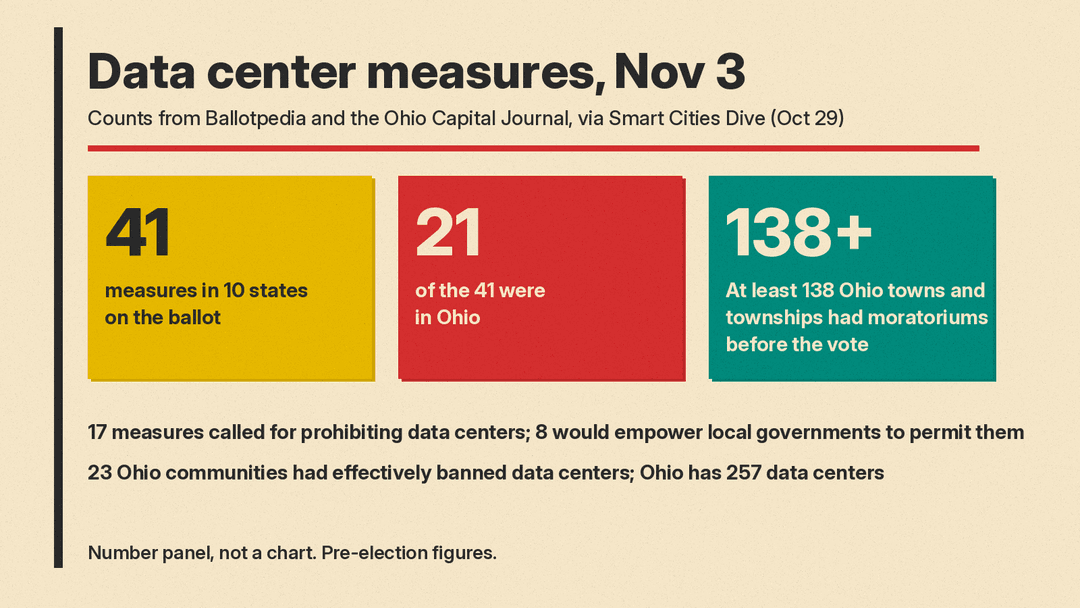
Smart Cities Dive reported on October 29, citing Ballotpedia, that voters in 10 states would decide 41 data center measures on November 3. Seventeen called for prohibiting data center development, and eight would empower local governments to permit it. Of the 41, 21 were in Ohio, which has 257 data centers.
The same report, citing the Ohio Capital Journal, said at least 138 Ohio municipalities and townships had already placed moratoriums on data center development, and 23 Ohio communities had effectively banned them. A grassroots effort to amend Ohio's constitution to prohibit data centers with a peak load of more than 25 megawatts per month missed the deadline for the November 3 ballot, and its backers plan to try again next year.
Voters and candidates: the national picture
DCD said candidates running on anti-data-center pledges swept to victory in the US midterm elections. In the gubernatorial races, 26 candidates across 21 of the 36 states up for grabs ran on tickets promising anti-data center legislation.
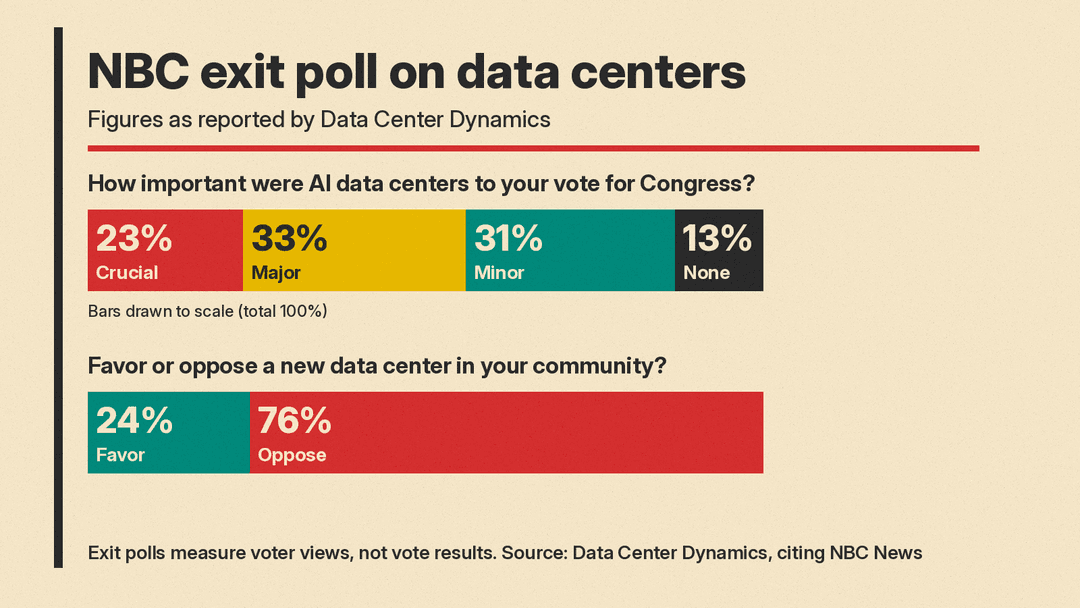
DCD's report on the NBC exit poll gave these answers to the question of how important AI data centers were to a vote for Congress: 23 percent crucial, 33 percent a major factor, 31 percent a minor factor, and 13 percent not a factor. DCD said the topic came behind government corruption, cost of living, immigration enforcement and the war in Iran. Asked whether they favor or oppose a new data center in their community, 24 percent said in favor and 76 percent opposed.
What it means for AI infrastructure
A local ban is narrow. It covers one village or township, and as the Emporia and Ottawa votes show, courts may still rule on whether some of them hold. But AI buildouts depend on many local approvals, and these votes remove sites from the list of places where a developer can expect one. In Trenton, for example, the Enquirer noted that the ban applies only inside city limits, so a planned Amazon Web Services data center on land just outside the city could still move forward if that land stays in neighboring rural townships. Earlier llms.blog coverage tracked 47 US AI data center projects stalled this year, and a bond sale tied to an Anthropic data center in Texas was shelved after a pause. On the market side, we covered how AI stocks moved after the midterms.
Smart Cities Dive quoted Ishyan Veluppillai, who tracks state and local data center policy for Capstone, saying state officials could respond to the results by giving cities and counties more autonomy over data center policy. He said that for city and county officials the biggest implication is in the pre-filing windows for the 2027 state sessions, and that once the elections are complete he expects to see a lot of legislation get introduced. That is his forecast, not an outcome yet.
Some developers are answering power and water objections in advance. On November 4, Google said it will pay for 100% of the power its planned Malaysian data center campuses use and announced water projects there. See our report on Google's $15B Malaysia data center plan.
OpenAI answered the same backlash on November 5 with a community compact that pledges to pay full power costs and not to use NDAs with public officials. See our report on OpenAI's no-NDA campus compact.
DCD says its article will be updated as more races are called and votes are tallied, so the counts above may change.
Sources
- Data Center Dynamics: Local data center moratoria, limits, and restrictions voted in across the US
- Data Center Dynamics: NBC exit poll, 56% say AI data centers were a crucial or major factor
- The Cincinnati Enquirer via The Columbus Dispatch: Ohioans overwhelmingly pass data center bans, restrictions on ballot
- Smart Cities Dive: Data centers on more than 3 dozen local ballots
