
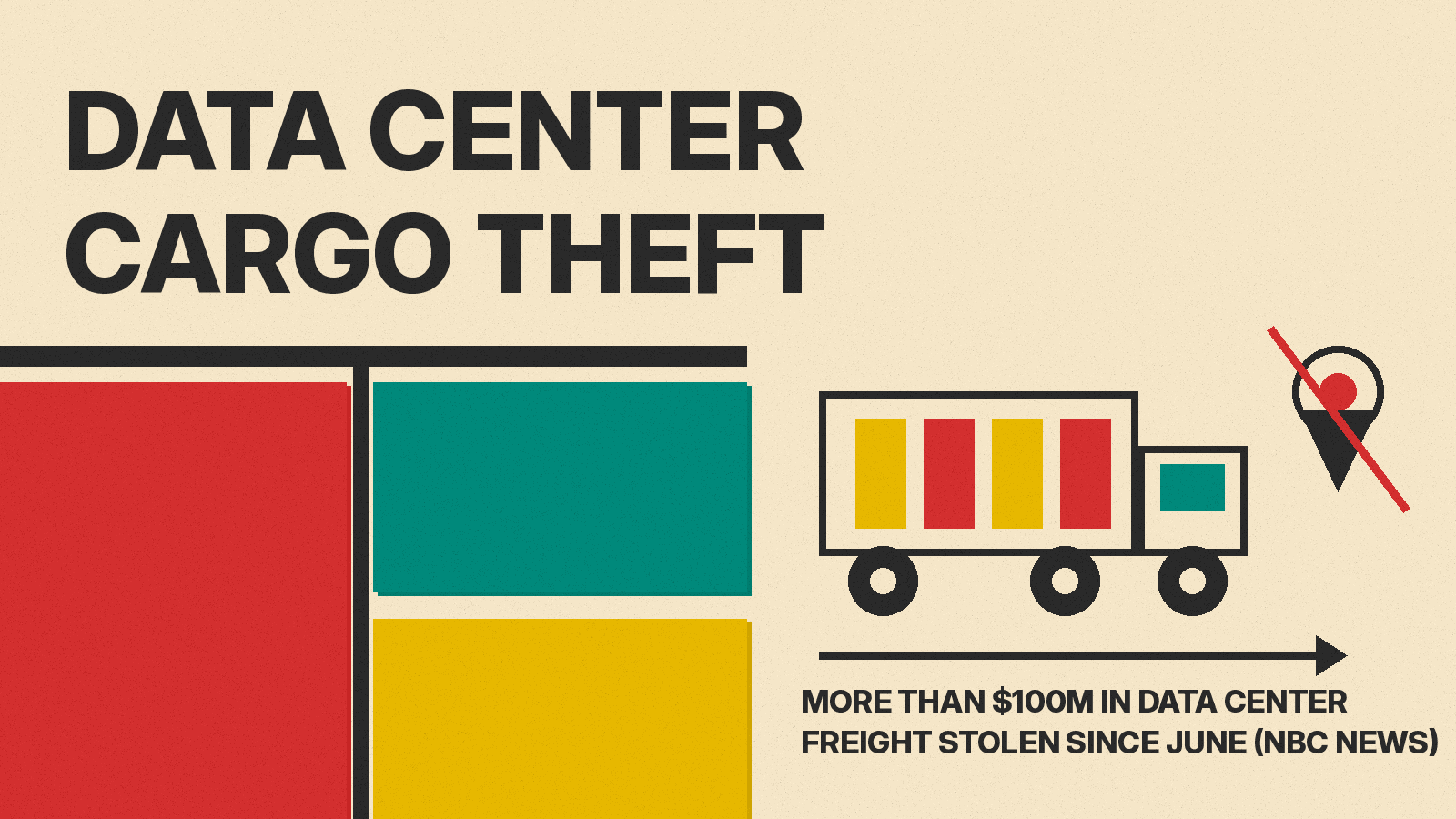
Thieves have taken more than $100 million in data center freight since June, NBC News reported on Oct. 26, citing industry leaders, consultants and investigators who advise law enforcement. NBC describes organized criminal groups targeting valuable data center equipment with deceptive techniques.
This post explains how the thefts work, what gets taken, where it goes, and what security experts say would help. Details below come from NBC's report as summarized by Ars Technica, plus earlier reporting from FreightWaves and WIRED.
The two largest cases
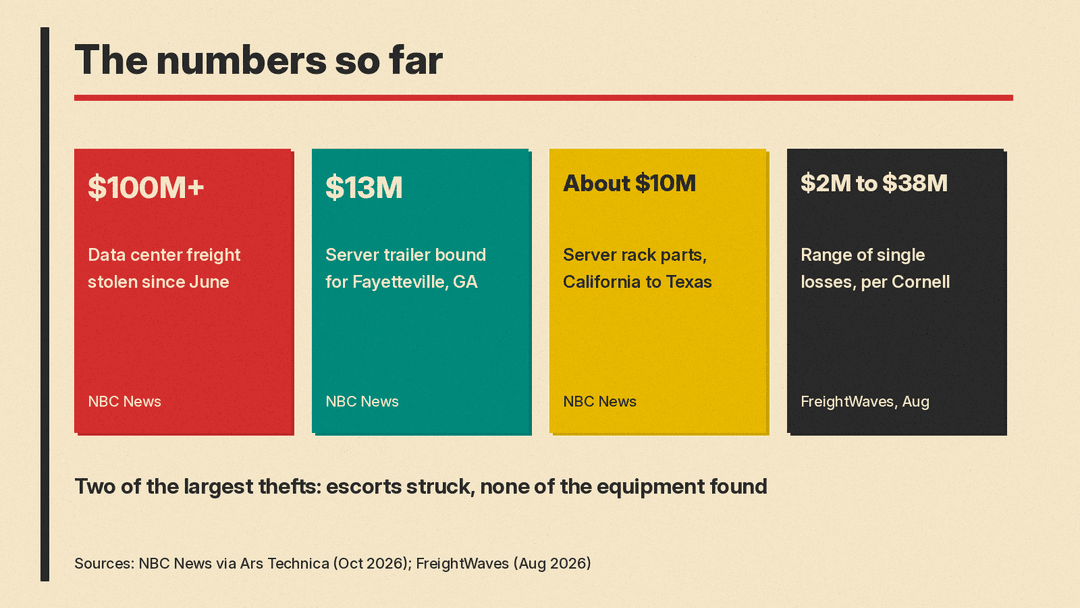
In early June, a trailer carrying about $13 million in computer server equipment was headed to Fayetteville, Georgia, which NBC calls "home to one of the largest data center developments in the country." According to Ars Technica's summary of NBC, two off-duty police officers hired as escorts lost sight of the trailer after an unmarked sedan struck their car. The trailer drove on.
Gerardo Pachuca, a private investigator and former Los Angeles County Sheriff's Department officer, told NBC: "the accident was not an accident. The bad guys wanted that load, so they intentionally took out the escorts."
A second shipment, from California to Texas, carried "server rack components estimated to be worth around $10 million." An SUV struck the escort vehicle and the trailer sped off. That cargo was also tracked by a location app, but "the tracking coordinates had apparently been spoofed." In both cases, none of the equipment was found.
FreightWaves reported this "bump-and-run" pattern in August. Scott Cornell, chair of TAPA Americas, said then that known reported data center freight thefts had reached $110.6 million since June 3, with individual cases from $2 million to $38 million. He also cautioned against treating two events as a nationwide trend.
How the thefts work
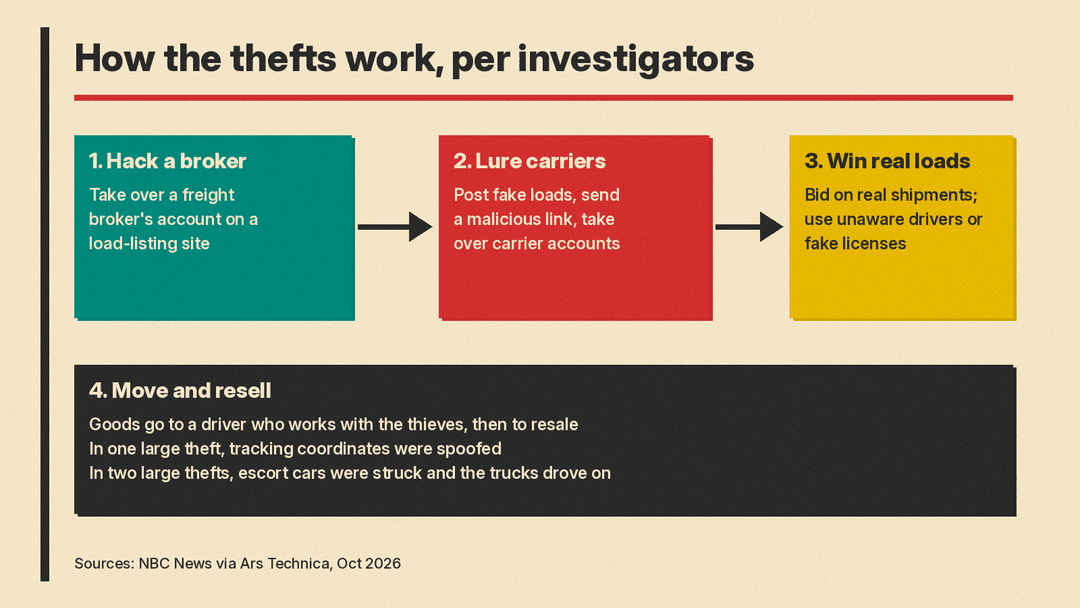
Investigators describe a mostly digital scheme, per Ars Technica:
- Thieves hack freight brokers' accounts on shipment-listing websites and post fake loads to attract real bids.
- They send a malicious link to trucking companies that respond, then take control of those carriers' accounts and bid on real shipments.
- Sometimes a real driver, unaware of the scam, picks up the cargo. Other times, fake driver's licenses get accomplices hired.
- The goods end up with a driver working with the thieves, who resells them.
Sgt. David Pantoja of the Los Angeles County Sheriff's Department told NBC "that's how most of it is being done." Thieves also infiltrate email accounts, misdirect shipments, disrupt GPS tracking and use AI to make fake driver's licenses. Investigators said this is a shift from the past, when highway theft was largely opportunistic.
What gets stolen
NBC lists "servers, fiber-optic cables, computer memory chips, copper wires, and bitcoin mining machines." Two stolen trailers found in Illinois held about $300,000 in copper wire spools and about $1 million in "custom-made data center modular power solutions equipment," according to Cook County Sheriff's Office estimates. In a Los Angeles County case, data center cooling equipment bound for Deepcool AI was recovered alongside nicotine pouches, televisions, shoes and cosmetics.
The trend predates this summer. WIRED reported that in April, thieves allegedly took 34,560 optical transceiver cables and 96 network switch modules bound from Olive Branch, Mississippi, to Richardson, Texas.
Where the gear goes
Unlike most stolen cargo, data center equipment rarely shows up on online marketplaces, experts told NBC. Shipments can be broken into parts and sold on gray markets to tech firms that accept questionably sourced equipment to keep costs low. Investigators said an overseas buyer is often lined up before the theft, particularly in regions where access to high-end US technology may be restricted, like China.
Keith Lewis, head of operations at Verisk CargoNet, told NBC "it's like stealing pure gold bars" and "it's so much easier to steal this than to rob a bank." NBC counts nearly two dozen such incidents since 2025 in states including California, Texas and Utah, and the issue "is only expected to grow."
Why it matters
Data center builders already face power, debt and local pushback, as our report on 47 stalled US AI data center projects showed. Meanwhile, SemiAnalysis counts more than 24GW of data centers in an advanced stage of construction, most of it due in 2027, as we covered in its 50GW forecast. Theft adds another risk at the last step: getting hardware from the factory to the site. A stolen load has to be replaced, and escorts and driver checks add cost. If investigators are right that buyers are often lined up in places where US high-end technology may be restricted, the thefts could also be a way around those limits.
What could stop it
Cornell told NBC "the only way this works is if the drivers are not properly vetted." His fix is low-tech: slow down and run background checks on drivers. In the August FreightWaves interview he said the bump-and-run tactic only works if the driver keeps going after the escort is hit.
Escorts are still in demand despite the attacks. Mike Duffy, CEO of Southern California escort firm Solutions Group International, told NBC "we're escorting hundreds of loads per month," and "much of it" is "associated with data centers." NBC also reports that states hit by large thefts have formed task forces, and lawmakers are looking at ways to strengthen the federal response to overseas theft rings.
Sources
- NBC News: Grand theft AI: Highway thieves are stealing millions in data center gear
- Ars Technica: Highway thieves are spoofing GPS to steal millions in data center-bound cargo
- FreightWaves: Nearly $111M in data center freight stolen as thieves test 'bump and run' tactic
- WIRED: 'The Worst I've Ever Seen': Cargo Thefts Have Turned Violent in Pursuit of AI Hardware
