
Google's ninth-generation TPU may reach customers later than its partners planned. A TrendForce report published Monday, citing Taiwan's Commercial Times and unnamed institutional investors, says a design revision has pushed the TPU v9 tape-out to January 2027. Shipments could slip to the first quarter of 2028.
Google has not commented on the report, and the figures come from investor sources rather than from Google or MediaTek. Treat it as a supply-chain signal, not a confirmed schedule.
What reportedly changed
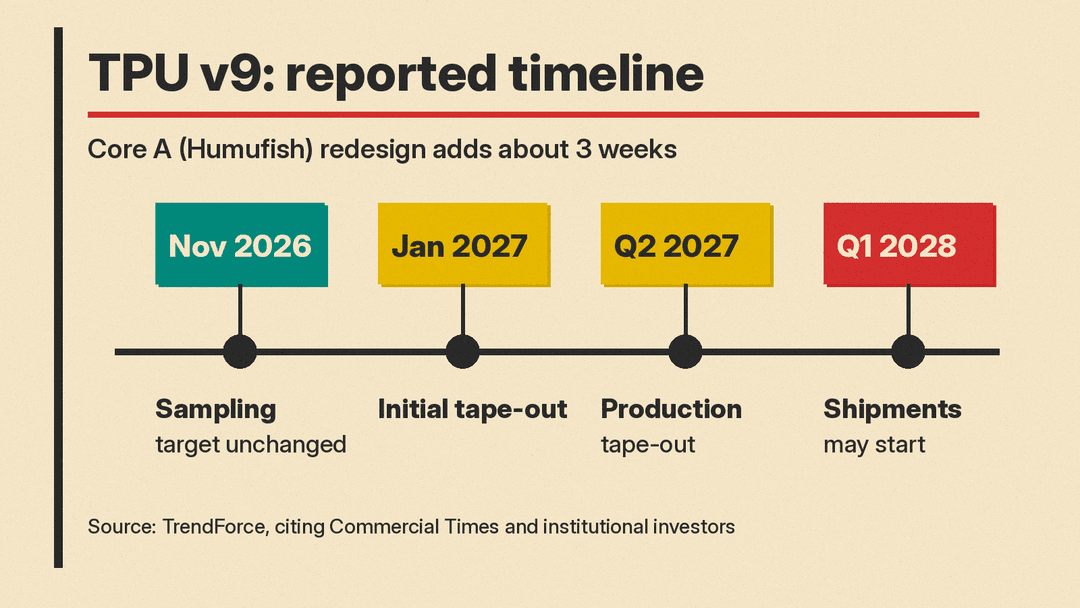
According to the report, Google revised the design of TPU v9 Core A, codenamed Humufish. That revision added about three weeks to development. The delay then carried over to the parts MediaTek is responsible for: Core B and the I/O design.
The reported timeline now looks like this:
- November 2026: sampling target, reportedly unchanged.
- January 2027: initial tape-out, the point where the design is finalized and sent for manufacturing.
- Second quarter of 2027: tape-out of the production version.
- First quarter of 2028: possible start of shipments.
A three-week design slip turning into a later shipment window is normal for leading-edge chips. Tape-out, validation, and production ramp are sequential, so a small delay early can push every later step.
Packaging is the other risk
TrendForce also says TPU v9 is expected to use Intel's EMIB-T advanced packaging. It names substrate yields as a key challenge for production scale and cost. That is a separate risk from the design revision. Even with a clean tape-out, packaging yield decides how many working chips come off the line and at what price.
Intel's packaging work with Google has been reported for some time. TrendForce reported in May that EMIB was gaining traction at Google and Meta. A v9 on EMIB-T would make Intel a meaningful part of the TPU supply chain, next to TSMC for wafers.
MediaTek's role in the TPU line
MediaTek is a newer TPU partner, next to Broadcom. In June, TrendForce reported, citing Commercial Times, that MediaTek won major TPU v9 orders. The reason given was its 336G SerDes, the high-speed interface that moves data between chips. Google had first aimed for a 448G SerDes architecture, but that work reportedly lagged on signal integrity, power, and thermal problems.
MediaTek is also trying to add customers beyond Google. TrendForce cites Bloomberg reporting that ByteDance is close to a deal to buy MediaTek data center chips. Commercial Times adds that Qualcomm is the first supplier on that project, and that it is not yet clear if MediaTek can get a US Commerce Department license for it.
Why it matters
The current generation is not affected. Google announced its eighth-generation chips, TPU 8t for training and TPU 8i for inference, at Cloud Next in April, with general availability later this year. Broadcom said in September that it had started production shipments of TPU 8i, according to Businesskorea.
The v9 timing matters for planning beyond 2027. TPUs train and serve Gemini, and outside buyers now commit to TPU capacity years ahead. Anthropic is the best-known example. A later v9 would mean the eighth generation carries more of the load for longer. It would also leave Google's TPU roadmap with less margin against competing accelerators.
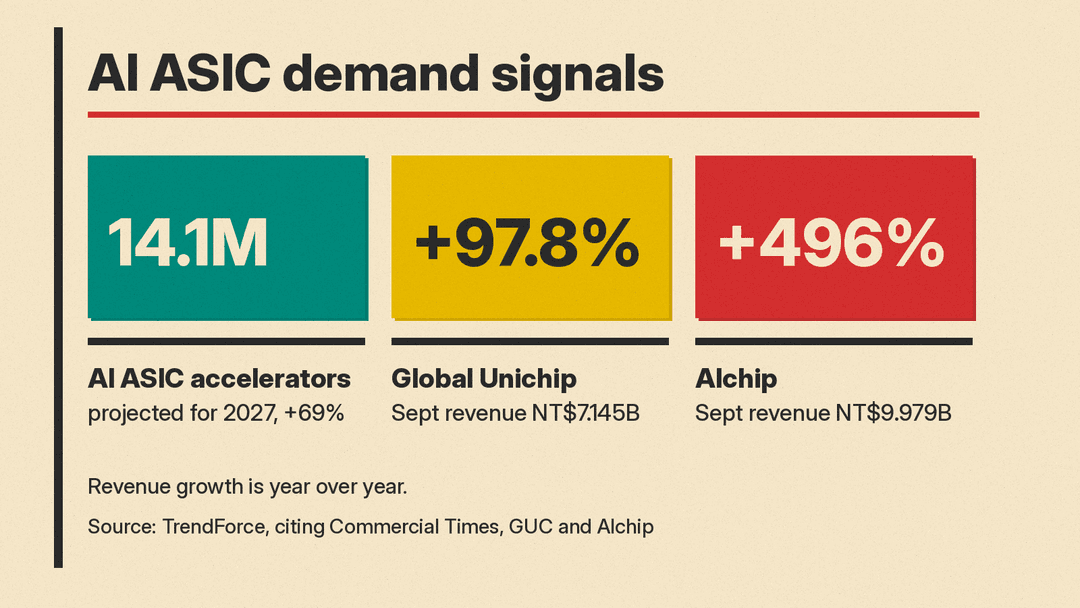
There is also a wider market signal. Commercial Times, citing institutional investors, projects global AI ASIC accelerator shipments of 14.1 million units in 2027, up about 69% year over year. Taiwan's design-service firms are already seeing it in revenue. Global Unichip reported record September revenue of NT$7.145 billion, up 97.8% year over year. Alchip reported NT$9.979 billion, up 496%, on higher 3nm AI accelerator shipments.
What to watch
The November sampling date is the first check. If samples go out on time, the January tape-out estimate is easier to believe. After that, watch for comments from MediaTek and Broadcom on their next earnings calls, and for any EMIB-T yield news from Intel. Google usually announces new TPU generations at Cloud Next or I/O, so an official v9 timeline would most likely come from one of those events.
Sources
- TrendForce: MediaTek's Google TPU v9 shipments may slip to 1Q28
- Commercial Times (Chinese)
- TrendForce: MediaTek reportedly wins TPU v9 orders on SerDes shift (June 2026)
- Bloomberg: ByteDance in talks to secure MediaTek AI chips
- Google: Our eighth generation TPUs
- Businesskorea: Google speeds up next-gen TPU mass production
