

Anthropic has signed a 20-year lease for the first phase of a planned data centre campus at Point Tupper, Nova Scotia. The developer and owner is EverWind, which also plans green hydrogen and ammonia production at the same industrial site. Reuters reported that this is Anthropic's first data centre agreement in Canada, citing a company executive.
EverWind announced the project on October 16 in a press release that named only "a leading frontier AI developer" as its tenant. Anthropic confirmed later the same day in its own release, which said the facility "will power Claude models and serve growing demand from Canadian and global customers," according to CBC News.
What was announced
The headline figure is more than $10 billion (Canadian dollars, per Bloomberg) in planned private investment. EverWind splits it into two parts:
- More than $8 billion to develop, construct, own, and finance the data centre campus.
- $2 billion for four onshore wind projects in its Nova Scotia portfolio: Bear Lake, Windy Ridge, Kmtnuk, and Upper Afton.
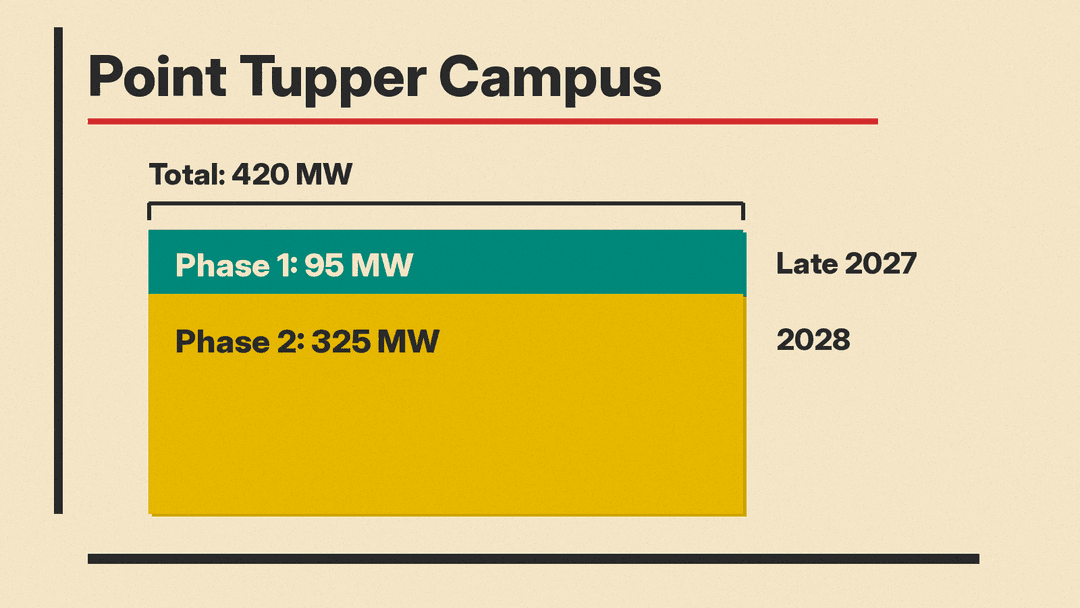
The campus is phased. The first phase is 95 MW, targeted for late 2027. A 325 MW expansion is targeted for 2028, for 420 MW at full build. EverWind says the expansion is "subject to applicable commercial, technical, and regulatory conditions." The lease covers only the first phase. EverWind did not disclose the value of the lease, The Canadian Press reported.
Power is the real constraint
The more useful number in this story is not the dollar figure. It is the grid. CBC notes that Nova Scotia's current generating capacity is close to 3,000 MW. The first phase alone is roughly 3% of that, and the full 420 MW campus would equal roughly 14%.
EverWind's wind farms will not be ready when phase one opens, so the site will draw mainly on existing grid generation at first. EverWind officials told reporters they have been assured there is grid capacity for phase one. The province's Independent Energy System Operator told CBC that it studies every new project before connection, but it did not say whether there is capacity for this one. EverWind's release states that the expansion "will not be connected to the grid until the required system studies and approvals are complete."
To manage the load, EverWind lists three measures:
- It will fund all connection, network upgrade, and other grid costs attributable to the project, so ratepayers do not carry them. CBC reports that both EverWind and Anthropic committed to pay for required upgrades.
- The campus will include "several hundred megawatt hours" of battery storage.
- The campus will be designed to reduce or stop grid draw when needed to protect reliability.
That last point matters. Whether an AI cluster can tolerate curtailment depends on the workload, and neither company has said what Anthropic will run there beyond "Claude models."
The timing contrast with the UK is direct. This weekend, Microsoft walked away from a 23,000 GPU deal at Nscale's UK site after local grid connection was pushed into the 2030s. Point Tupper is an existing industrial site with grid access, which is likely a large part of why a frontier lab committed to it.
Water and community terms
The campus will use a closed-loop water and glycol cooling system, with air as the main heat rejection method. EverWind estimates about 100,000 litres of water per day for phase one and about 500,000 litres per day at full build. It says that is about 1% of the roughly 34 million litres per day safe yield of nearby Landrie Lake.
EverWind also promises a community benefit program "valued in the tens of millions of dollars" for the first phase, with no specific figure. A First Nations consortium led by Membertou Development Corporation is negotiating an ownership stake, which CBC reports as 9%.
Not everyone is satisfied. Nova Scotia NDP leader Claudia Chender questioned how the province would enforce the ratepayer assurances, and the Ecology Action Centre said impact assessments are needed before the project proceeds.
Why it matters
For Anthropic, this is a step toward owning more of its compute footprint outside the big US clouds. Reuters reported that Anthropic spent $7.33 billion on computing and infrastructure last year, a threefold increase from 2024. The Logic reported in August that Anthropic was hiring in Canada for site and power acquisition, with one posting describing plans to bring "gigawatts of compute online in Canada." At 95 MW, Point Tupper is a modest first step against that goal.
For EverWind, a signed 20-year tenant is what unlocks financing. The company plans to seek funding from banks and pension plans now that it has a long-term lease, according to The Canadian Press. That comes during a hard week for AI infrastructure credit, with CoreWeave bonds trading at distressed levels and several data centre listings paused, per Reuters.
Open items remain. The lease value is undisclosed. Phase two depends on grid studies that have not finished. The wind farms that would make the campus mostly renewable come later than the first megawatts. Land clearing has started, and EverWind told CBC it hopes to pour foundations before winter.
Sources
- EverWind press release (GlobeNewswire), Oct 16, 2026
- CBC News: Nova Scotia to host massive data centre to power Anthropic's AI assistant Claude
- Reuters via Investing.com: Anthropic signs lease for first Canadian data center
- Bloomberg: Anthropic Signs First Data-Center Deal in Canada With EverWind
- The Logic: Anthropic revealed as client for EverWind's $10B Nova Scotia data centre
- TheEnergyMag (The Canadian Press reporting)
- Reuters via Lee Enterprises: Market selloff, rising rates test AI data center deal boom
