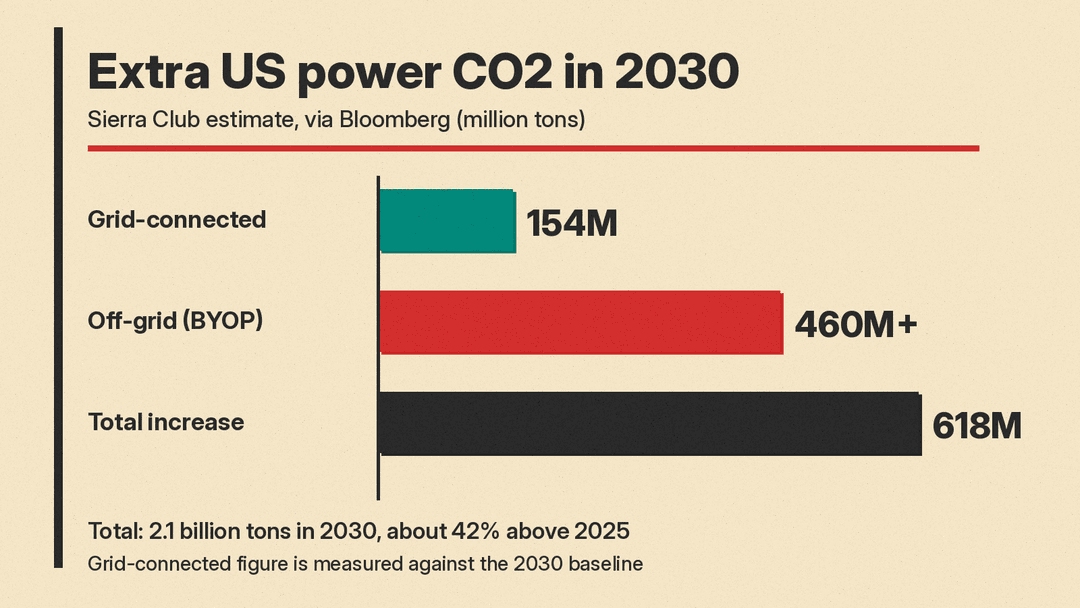
The rush to power AI data centers with new fossil fuel plants could undo 15 years of emissions cuts in the US power sector, according to an internal Sierra Club analysis reported by Bloomberg. The group calculates that US electricity generation would emit 2.1 billion metric tons of carbon dioxide in 2030 once planned AI projects are counted. That is 618 million tons more than in 2025, or about a 42% increase.
The biggest share of that growth does not come from the grid. It comes from power plants that data center developers build for themselves.
What the Sierra Club found
The analysis, as described by Bloomberg, breaks out two sources of new emissions:
- Grid-connected generators would raise 2030 baseline emissions by 10%, or 154 million tons of CO2.
- Off-grid sources, often built by tech companies to avoid the long wait for a grid connection, could exceed 460 million tons. Jeremy Fisher, the Sierra Club's principal advisor for climate and energy, said that is roughly the same as the annual emissions of Mexico.
The work draws on public filings and on other groups' data center projections, including the Environmental Integrity Project's count of expected plants and emissions by 2030.
Fisher said that a year and a half ago, the group's researchers would have put the buildout and its impact at a quarter or half of current projections. "The numbers continue to sort of boggle our minds," he told Bloomberg.
Why off-grid power matters
Developers call the off-grid approach "bring your own power," or BYOP. Wait times for grid service are long, so many developers now procure dedicated generation instead of relying only on the grid. Most of that generation is gas. Grid delays have already cost deals: Microsoft dropped a 23,000 GPU lease at Nscale's UK site, as we covered in October.
A separate report by Earthjustice and the Better Data Center Project, published Oct. 8, estimates that gas will power about 80% of energy generation from BYOP projects coming online in the next five years. Its other findings show the scale of the gas buildout:
- As of mid-2026, the US has over 300 gigawatts of AI data center capacity planned or under construction. Peak US electricity demand on the hottest day of 2025 was 760 GW.
- The report identifies 177 GW of planned gas capacity for BYOP, equal to 23% of US peak demand in 2025.
- As of August 2026, nine proposed gas BYOP projects are 4.5 GW or larger. If all are built, nine of the 10 largest power plants in the US would be data center gas BYOP.
- The 177 GW of gas proposals would emit over 400 million metric tons of CO2 equivalent a year, raising total US power sector emissions by 23%.
- More than half of disclosed gas BYOP capacity uses technologies that are less efficient and more polluting than typical gas plants.
The Earthjustice report also says behind-the-meter BYOP projects can bypass planning and regulatory processes that usually apply to large new power plants, and that most of them are proposed in states with weak environmental laws. It expects most BYOP projects to seek a grid connection eventually. Federal rules have also eased: in July, the EPA issued guidance that islanded plants serving only data centers fall outside the Clean Air Act's Acid Rain Program, as we covered in our EPA guidance post.
How this compares with other forecasts
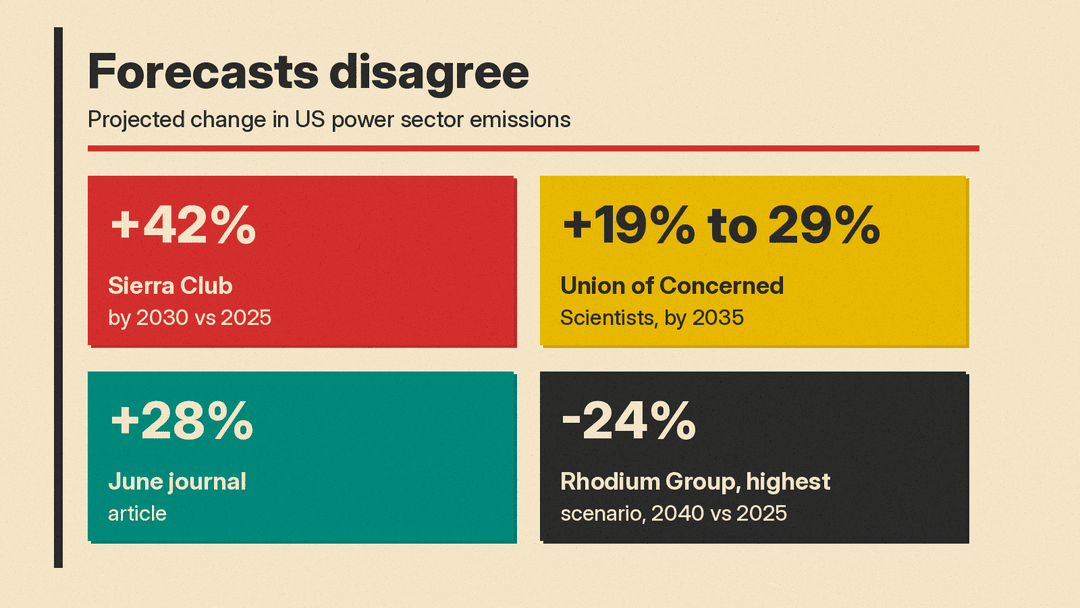
The Sierra Club estimate is higher than others released so far, Bloomberg reports. Forecasts vary widely:
- The Union of Concerned Scientists projected in January that fossil-fuel-powered electricity for data centers could increase US power sector emissions by 19% to 29%, or as much as 342 million tons a year by 2035.
- US and Canadian researchers published a journal article in June projecting a 28% rise in the sector's emissions.
- Rhodium Group finds that even in its highest-emission scenario for 2040, the sector's greenhouse gas emissions fall 24% below their 2025 level, as competitive renewables keep displacing fossil fuels.
Bloomberg notes that the uncertainty is large enough that the lowest and highest projections differ by more electricity than the combined demand of California and Florida. The spread comes down to how many facilities actually get built, what technology they use, and how much renewable capacity comes online in the next few years.
Brendan Pierpont, director of electricity at the think tank Energy Innovation, said new gas running inefficient turbines around the clock at some sites could drive emissions up. "There's certainly a risk that that's enough emissions to push us back many years of our progress on reducing power-sector emissions," he said. "But it's not a foregone conclusion that that's going to happen."
The projects may not all get built
Much of the forecast depends on projects that are still on paper, and many plans slip: RegLayer counted at least 47 large US data center projects delayed, withdrawn or blocked in 2026, as we reported in our look at stalled projects. Pierpont said little is known about factors such as gas turbine order backlogs and grid connection wait times, which can slow or stop projects. Bloomberg points to Oracle, which last month sent a force majeure notice to the developer of its Project Jupiter data center in New Mexico, saying it may not come online by 2028 as planned because of regulatory setbacks and community opposition.
"The big question of the day is trying to create an accurate forecast of project demand," said Helen Kou, a BloombergNEF analyst.
Why it matters
US power sector emissions peaked in 2007 and fell for years as cheap fracked gas displaced coal and federal rules tightened. Bloomberg reports that low gas prices and the Trump administration's rollback of climate rules helped push power sector emissions back up in 2025. If the AI buildout lands near the top of these projections, it would reverse what Bloomberg calls a two-decade trend toward less US power sector climate pollution.
For the AI industry, the numbers turn a compute question into an energy and permitting question. The speed advantage of building private gas plants is exactly what makes them hard to track, and Bloomberg notes that local air and climate pollution from such plants has already helped fuel opposition to data centers across the country. Every new gigawatt deal announced by a hyperscaler or GPU cloud now comes with a second question: where the power comes from.