

Democrats won both the House and the Senate in the November 3 midterms, and on Wednesday the stock market sorted AI companies into winners and losers based on one question: will the data center boom slow down? According to CNBC, many of the biggest technology companies surged on Wednesday, while smaller AI cloud providers and data center operators fell.
What moved on Wednesday
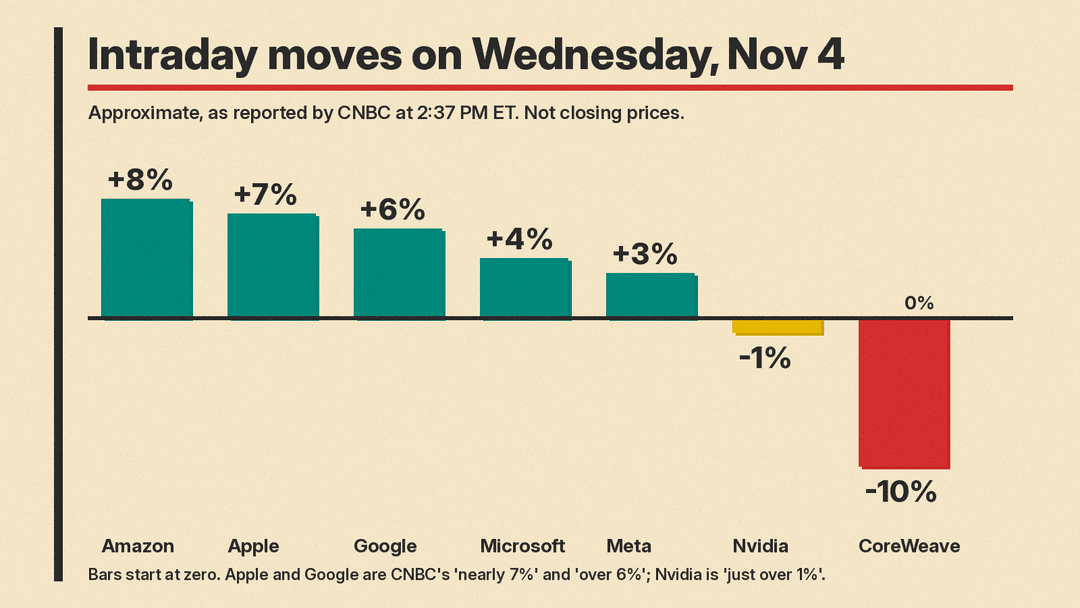
CNBC reported that during Wednesday trading "Amazon surged 8%, Google rose over 6%, Microsoft rose 4%, Meta was up 3%, and Apple, which faced Trump's tariffs and recently got refunds, climbed nearly 7%." The same story said CoreWeave fell 10% and that Nvidia "slipped just over 1%." CNBC published its story at 2:37 PM Eastern, so those figures are intraday moves, not closing prices.
Reuters, in a report carried by Investing.com, said investors bet that "potential curbs on new data-center construction could cement their grip on scarce computing power while easing pressure on strained cash flows." Reuters put Amazon at a three-month high and said the five companies were on course to add more than $750 billion in combined market value if the gains held. Bloomberg reported that investors bet a Democrat-controlled Congress will slow the massive spending on AI that is eating up free cash flow, and that the five companies were on pace to add nearly $1 trillion in market value on Wednesday. The two estimates came from different points in the day.
The other side of the trade was sharper. A separate Reuters report said Applied Digital fell 8.8%, CoreWeave 9.5% and Cipher Digital 21%. It also said GE Vernova fell 11.5%, Constellation Energy 9.2% and Vistra 15.4%, because utilities and equipment suppliers tied to data center projects came under pressure too.
The same week, Supermicro reported fiscal Q1 2027 results with record sales and a lower gross margin; see our Super Micro Q1 numbers post.
Why data centers are the political issue
The election results gave data center opponents real offices. Reuters reported that in Texas and Georgia, Democrats who campaigned partly on a moratorium on data center development won governorships the party had not held for decades. MarketWatch quoted Glenmede analyst Jason Pride saying Democrats captured the governorships of several states central to data center development, including Texas, Ohio and Georgia, and that at the federal level "there may also be efforts to scale back or eliminate the 100% expensing of capital expenditures tied to data centers."
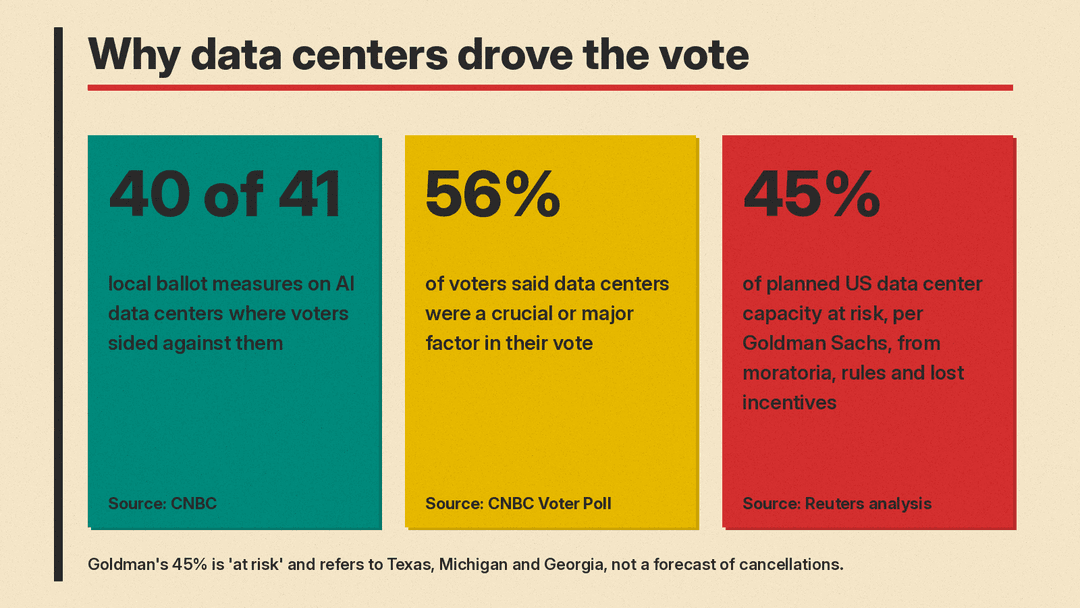
CNBC reported that there were 41 local ballot measures on Tuesday to restrict or clear the way for AI data centers, and that voters sided against data centers in 40 of them. For the local results by state, see our report on the local data center bans and limits Ohio voters passed. In a CNBC Voter Poll, 56% of voters said data centers were a crucial or major factor in their vote. MarketWatch cited a Wall Street Journal poll of more than 79,000 registered voters with the same 56% figure.
Goldman Sachs said, according to a Reuters analysis, that Democratic statehouse victories in Texas, Michigan and Georgia could put roughly 45% of planned US data center capacity at risk from potential construction moratoria, tighter regulations and reduced tax incentives. Morgan Stanley analysts said the election of Amy Acton as Ohio governor creates a significant risk of delays in that state, including a 10-gigawatt project involving Nvidia that is the largest in Ohio.
How analysts read it
The analysts quoted do not agree that this is a nationwide stop. In the Reuters analysis, HSBC analysts Max Kettner and Duncan Toms wrote that "one possible and entirely feasible scenario is that we won't see broad-based data center moratoriums but rather more regulations/higher oversight on data centers." Another scenario they named is that data centers simply move from Texas to other states. The Reuters report on data center stocks said analysts doubt any legislation could meaningfully stall construction, but that a Democratic Congress raises the odds of more hearings and investigations into the AI buildout.
Needham analyst Laura Martin wrote, as quoted by CNBC, that "We believe higher regulatory barriers entrench incumbents, and increase risks (and raise required ROICs) for new entrants," and that "Hyperscalers are AI incumbents." Macquarie analyst Paul Golding said he remains bullish on AI infrastructure and that well-capitalized, high-quality operators stand to benefit most if projects in some states slow down. He also noted that "backup power emissions, zoning, water, interconnect/grid, and tax considerations are often overseen by state regulators," which points to state governments as the place where this will be decided.
Not every voice was cautious about AI itself. Amundi's Aidan Yao said, as quoted by Reuters, that the election looked "more like a referendum on AI than a referendum on (Donald) Trump." Reuters also reported that Elon Musk said on social media after the election, "Data centres in space looking pretty appealing right now."
What to watch next
The AI trade was already under pressure before the vote. Investing.com reported that the Goldman Sachs Broad AI basket fell 15% in October, and cited Data Center Watch for at least 45 data center projects worth $68 billion disrupted by local opposition in the second quarter of 2026. The same piece said Texas and Georgia together account for roughly a third of AI data center spending and projects.
Reuters noted that the hyperscalers' recent earnings showed the AI race turning cash-rich companies into heavy spenders reliant on borrowing, and that they plan to spend more than $740 billion this year, up from roughly $400 billion last year. We covered those results in our posts on Microsoft's capex and Amazon's $220B capex. We also reported earlier on how a Texas pause stalled a bond sale for an Anthropic data center and how Microsoft capacity delays hit CoreWeave and Nebius.
On November 5, OpenAI published a community compact and policy blueprint aimed at the local backlash. It pledges full power costs and no NDAs with public officials; see our report on OpenAI's campus pledges.
This is a news report on market moves, not investment advice. Wednesday's figures were intraday and will change, and the new Congress and the incoming governors have not yet acted on data centers.
Sources
- CNBC: Apple and other big tech stocks surge after 2026 midterm elections
- Reuters via Investing.com: Democrats' midterm sweep fuels $750 billion Big Tech rally
- Reuters via Investing.com: Analysis, Trump's midterm drubbing demonstrates the power of data center opponents
- Reuters via StreetInsider: AI data-center stocks slide, renewables rally after Democratic US midterm sweep
- Bloomberg: Big Tech Soars on Bet Dems Will Save AI Spenders From Themselves
- MarketWatch: Data-Center Stocks Down After Democrats Win Congress
- Investing.com: AI data center stocks drop as Democrats sweep U.S. midterms
