
NVIDIA wants AI data centers to arrive the way shipping containers do: built, wired and tested somewhere else, then dropped onto a prepared site and plugged in. At GTC Berlin on October 21, the company introduced DSX POD, a reference design for complete Vera Rubin AI factories that partners build inside modular containers. NVIDIA says the approach cuts deployment time at a prepared site "from six months to as little as 14 days."
The pitch is about speed to revenue, not a new chip. Here is what DSX POD is, what is inside one, what it does not change, and why it matters.
What DSX POD is
DSX POD is a reference design. NVIDIA supplies the design, and partners build, deliver and support the units. In NVIDIA's words, it is "a reference design for complete NVIDIA Vera Rubin AI factories built by partners inside modular containers, integrated and validated before delivery," according to the press release.
The NVIDIA Technical Blog places it inside a larger framework. NVIDIA DSX is the broad design framework for AI infrastructure at the data center level. DSX POD is "a specific realization of that broader design," made of factory-built container types with defined interfaces between them. The blog says it "describes a complete AI factory rather than a compute enclosure in isolation," covering compute, management, scale-out networking, storage, power, cooling and cabling.
NVIDIA also says the design "does not make containerization mandatory for every AI factory." Conventional builds remain an option. DSX POD is meant for large deployments "where schedule predictability, repeatability, and reduced onsite work are priorities."
What is inside one container
NVIDIA's own release does not list rack or GPU counts. Trade press did:
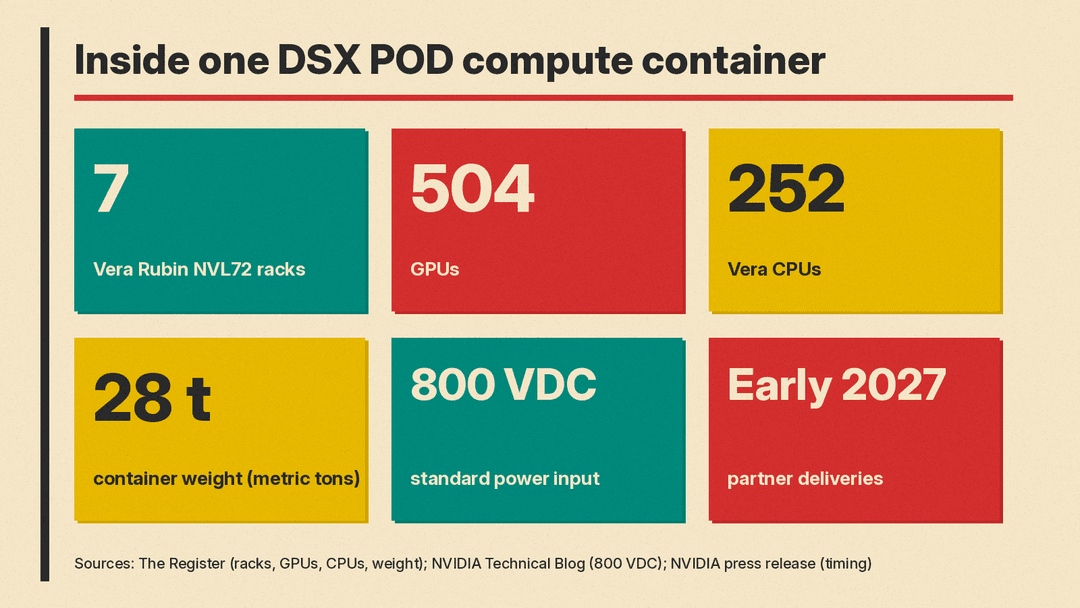
- The Register reports: "Inside the 28 metric ton containers you'll find seven Vera Rubin NVL72 racks packing 504 GPUs and 252 Vera CPUs."
- Data Center Knowledge also describes seven Vera Rubin NVL72 racks per container, with networking, cabling and cooling already installed.
- Power uses "a standard input 800 VDC power design" at the container, per the Technical Blog. Partners engineer the upstream generation and conversion for each site, because utility conditions, codes and grids differ by region.
- Cooling is liquid. Partners "assemble, flush, pressure-test, and validate the internal cooling loop at the factory," then connect it to the site's water and heat-rejection systems.
How deployment changes
In a conventional build, teams choose a site, design power and cooling, lay out the hall, install racks and cables, then validate the cluster piece by piece. NVIDIA's blog says these steps have "critical dependencies" on each other, and delays can push back the date the infrastructure begins producing tokens.
DSX POD splits that work into two tracks that run at the same time.
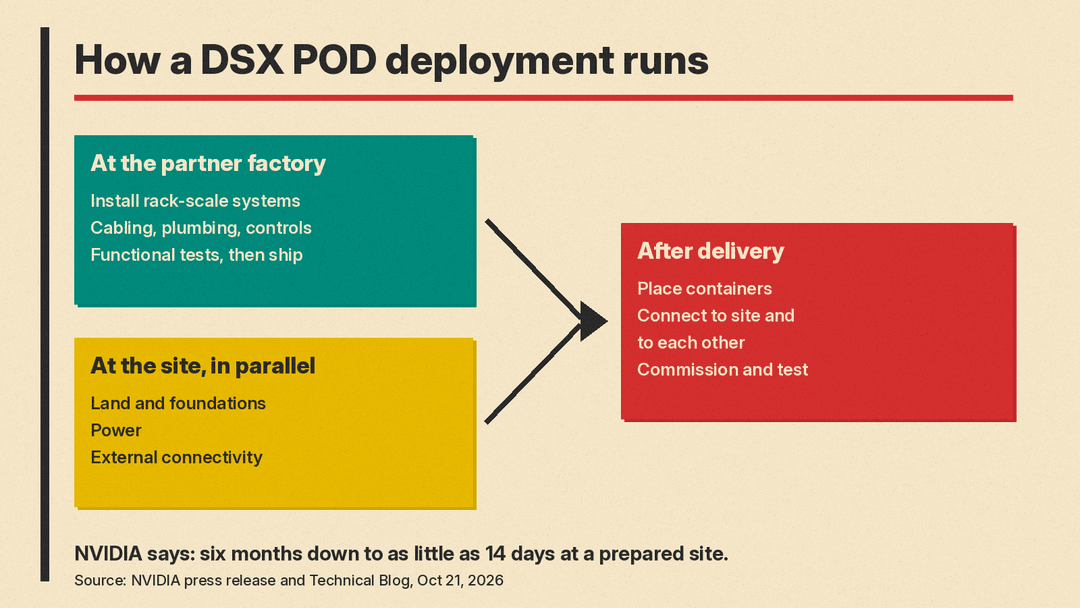
At the factory, partners install the racks, finish internal cabling and plumbing, load configuration baselines and run functional tests. NVIDIA's release says partners "complete rack-to-rack cabling, wiring, piping and functional validation before shipment." At the site, crews prepare foundations, power and external connectivity. After delivery, the work is placement, connections between containers, hookup to site systems and commissioning.
The blog is direct about the limit: "This model does not remove onsite work." It also says DSX POD "does not eliminate the supporting facility infrastructure." The 14-day figure applies to a site that is already prepared. Site teams still have to prepare the land, foundations, power and external connectivity, and the site's water and heat-rejection systems still have to exist, per the blog.
Who builds it, and when
NVIDIA lists 17 partners: Anduril, Armada, Bull, Crusoe, DayOne, Dell Technologies, Delta, Eaton, Foxconn (Ingrasys), GIGABYTE, HPE, Lenovo, Pegatron, Quanta Cloud Technology (QCT), Schneider Electric, Vertiv and Wistron. They will "deliver DSX POD AI factories worldwide in early 2027," per the release.
The launch was framed for Europe, but Data Center Knowledge quotes Ian Buck, NVIDIA's vice president of hyperscale and high-performance computing, saying the container is intended for worldwide deployment, aimed at organizations that want to bring compute online "at the hundreds-of-megawatts scale." IDC analyst Ashish Nadkarni told the outlet it could suit sovereign AI deployments that need physical isolation, smaller purpose-built deployments, and edge AI.
Why it matters
Chips are not the only limit on new AI capacity. We covered 47 US AI data center projects that stalled this year over power, debt, chip redesigns and local pushback, and SemiAnalysis's forecast of +50GW in a single year, 2027, despite those stalls. DSX POD targets one part of that problem: the months of specialized onsite integration after the shell and power are ready.
It also moves NVIDIA one more layer up the stack. The blog traces the path from chips and boards to rack-scale systems to DGX SuperPOD, and now to a factory-built AI factory unit. Large operators such as Meta build their own custom clusters, like Meta's Prometheus supercluster. DSX POD instead offers one standard design that many partners can build.
The open questions are practical. The announcement does not list pricing, per-container power draw, or named customers. The six-months-to-14-days comparison is NVIDIA's own claim and will need real deployments to test. The first units are not due until early 2027.
Other infrastructure news from GTC Berlin
- NVIDIA and supply chain partners said they plan to increase substrate capacity by 2.5 times over the next three years and expand advanced packaging capacity by more than 300% by 2028, per Data Center Knowledge.
- Google Cloud and NVIDIA announced A5X instances on Vera Rubin NVL72, with general availability coming next month and plans to scale to as many as 960,000 Rubin GPUs across multiple sites.
- The Register reports NVIDIA also laid out new DSX specs for waterless data centers that use closed loop coolants and dry coolers instead of cooling towers.
Sources
- NVIDIA Newsroom: NVIDIA Introduces DSX POD AI Factories to Accelerate Europe's Infrastructure Deployment
- NVIDIA Technical Blog: Achieve Productive AI Capacity Faster and More Predictably with NVIDIA DSX POD
- The Register: Nvidia's grand plan for speeding up datacenter deployments
- Data Center Knowledge: Nvidia Unveils DSX Pod for Faster AI Data Center Builds
- NVIDIA Blog: Google Cloud and NVIDIA Announce General Availability of NVIDIA Vera Rubin Infrastructure
