
Viggle, the company behind an app that puts a character into a dance or meme video, launched a new foundation model on October 19, 2026. JST-2 does not predict pixels frame by frame. It builds a shared 3D world of scenes, characters and motion, then renders views of it. Viggle calls it a "physics-native world foundation model" in its launch article.
Here is what it is, what Viggle claims, what it costs, and where the claims stop.
What JST-2 is
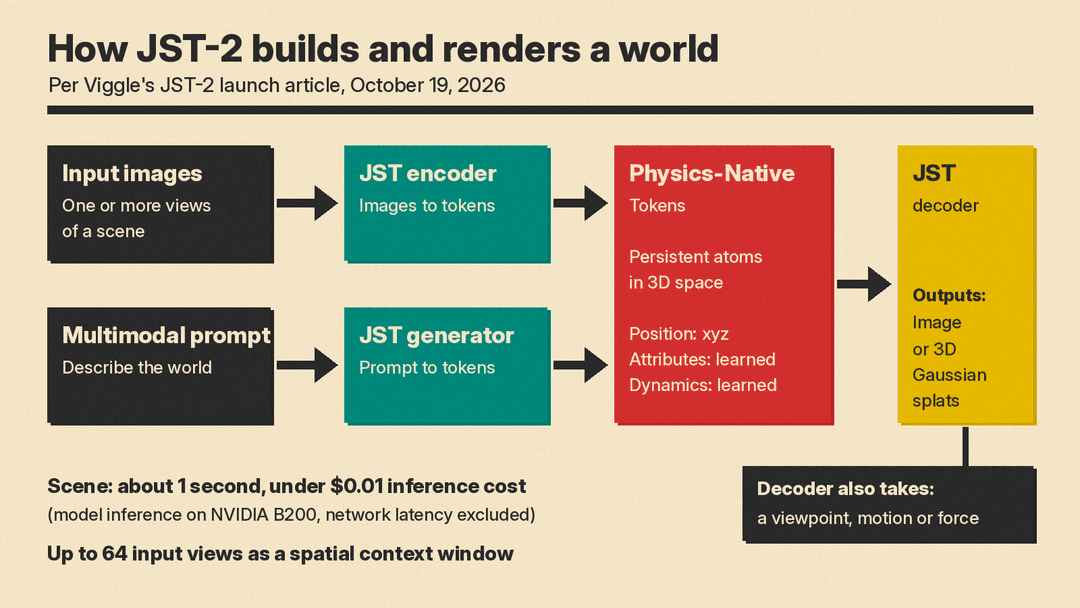
JST is short for Joint Space-and-Time. Per the launch article, the model represents the world as "persistent atoms in 3D space". Each atom is a piece of matter or an object part, and it keeps its identity as it moves and deforms. An atom has an explicit xyz position plus learned vectors for its attributes and its dynamics. Viggle encodes these atoms as what it calls Physics-Native Tokens.
The pipeline has three parts:
- Encoder. Maps one or more input images of a scene to Physics-Native Tokens.
- Generator. Produces the same tokens directly from a multimodal prompt.
- Decoder. Takes the tokens, a viewpoint, and optional motion or force inputs, and outputs an image or 3D Gaussian splats.
Viggle says it built the full stack itself, from the encoder to the training pipelines. Founded in 2022, it spent its first two years on JST-1, which powered its meme app. Viggle says that app has reached 50M+ users. JST-2 was developed from 2024 to 2026.
Why it matters for AI video
Viggle argues that many world models learn in pixel space, where physical structure "must be learned indirectly from how it looks". JST-2 learns that structure directly. That differs from the clip generators in our guide to the best AI video generators, which return finished video.
That is a different bet from Runway's GWM Worlds 2, which generates continuous 720p video at 24 fps with audio at 48,000 Hz as you steer it. It also differs from VAST's EdenLive, which repaints a game engine's rough render, as our EdenLive explainer describes. JST-2 outputs 3D scenes, characters and motion.
Scenes in about one second
Viggle says JST-2 generates a 3D scene in about one second, at an inference cost below $0.01. The timing covers model inference on NVIDIA B200 and excludes network latency. For comparison, the launch article puts Marble at about 5 to 6 minutes. Viggle's own product facts file adds that this "is not an equal-fidelity claim" and that Marble's hardware and timing scope are unspecified.
Other scene details from the launch article:
- Up to 64 input views act as a spatial context window. Each new view adds context as you expand a world.
- Splats render locally in the browser, so a finished scene can be explored from new viewpoints without rerunning the model.
- JST-2 can reconstruct 3D environments from sparse real-world views. Viggle names robot simulation, autonomous driving, mapping and construction as potential uses; the facts file calls these "directions, not validated results".
Characters and motion
JST-2 generates 3D characters from text or a single image. Because the dynamics are learned, Viggle says characters are ready to animate without separate rigging and skinning steps.
For motion, JST-2 makes full-body 3D motion from a text prompt or from video. For video, it reconstructs visible movement and infers how hidden body parts move. Motions apply to JST-2 characters without a retargeting step and work with standard 3D character rigs.
Viggle ran blind human evaluations against named rivals. A score is the win rate plus half the draw rate, so 50% means equal preference. These are Viggle's own tests, not third-party results.
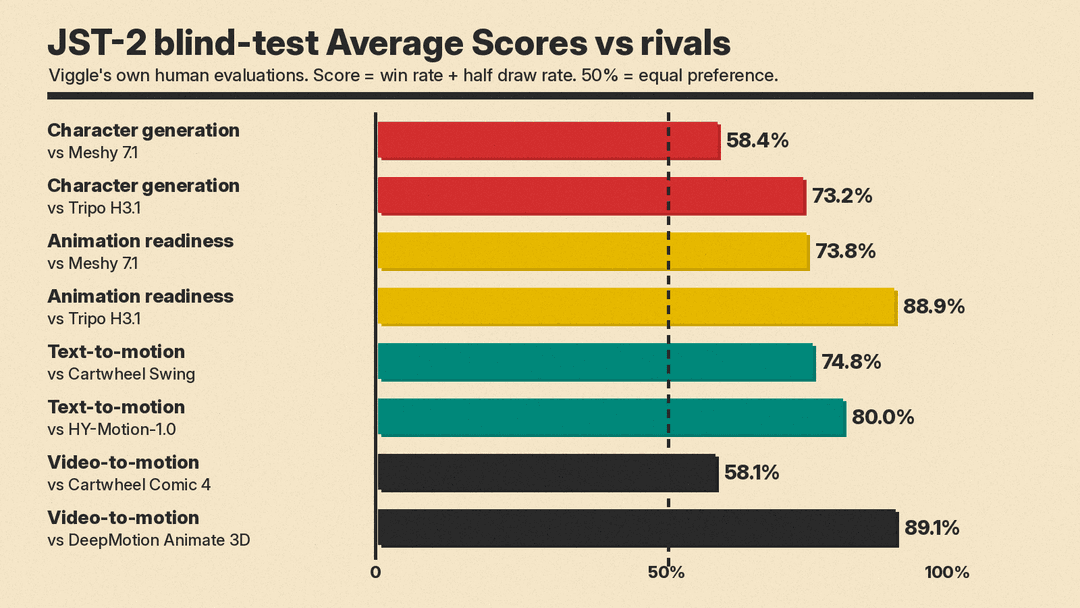
The character benchmark says JST-2's strongest results are on face quality, at 63.0% against Meshy 7.1 and 82.0% against Tripo H3.1. The motion benchmark says JST-2 performs particularly well on hand gestures and dance in text-to-motion. It also states that Cartwheel Comic 4 "still leads" in video-to-motion on fast sports and athletics footage, and that feet can slide slightly on plant and lift-off.
Limits Viggle states
- JST-2 scenes are static. Scene collisions and object interactions still rely on rule-based physics. Character motion is driven by learned dynamics.
- Viggle is building JST-3 to replace those rules with learned dynamics. Its stated goal is "an experience engine for physical AI".
How to try it and what it costs
As of October 2026, Viggle offers JST-2 in three ways:
- PINOC, free in the browser, with a scene mode and an agent mode that combines scenes, characters and motion. The facts file says PINOC credit pricing is unchanged.
- The API. The API pricing page lists 1 credit as $0.01, with 100 free credits for new accounts. Listed rates include $0.06 per scene from a prompt (Scene Model), $0.30 per 3D character ($0.25 with enhance off), $0.10 per text-to-motion request, and $0.05 per source-video second for 3D motion from video.
- MCP. The launch article invites use with Codex, Claude Code and other MCP-compatible agents. The facts file says "MCP coverage of JST-2 is not yet confirmed", so check before you build on it.
Do not confuse the two scene figures. The sub-$0.01 figure is Viggle's stated inference cost, while $0.06 is the API list price per scene from a prompt.
For ready-made clips rather than 3D assets, our AI video generator pricing comparison covers per-second rates for the main video models.
