

Deploying hundreds or thousands of fine-tuned language models across enterprise workflows presents a fundamental infrastructure dilemma. While parameter-efficient fine-tuning (PEFT) methods like Low-Rank Adaptation (LoRA) reduce training compute by freezing base model weights and training compact low-rank matrices, naive deployment strategies fail at scale. Merging adapter weights directly into the base model creates a distinct 7B to 70B parameter checkpoint for every specialized task, requiring isolated GPU instances that cause prohibitive memory costs and severe hardware underutilization.
Multi-LoRA serving frameworks solve this economic bottleneck. By hosting a single shared copy of the base foundation model in GPU high-bandwidth memory (HBM) and dynamically routing requests to task-specific low-rank matrices at inference time, a single GPU cluster can serve thousands of distinct fine-tuned variants simultaneously.
Executing batched inference across heterogeneous adapters introduces substantial systems challenges: memory fragmentation, non-contiguous tensor gathers, diverging matrix dimensions, and distributed communication overheads. Production systems rely on custom CUDA kernels, unified memory paging, and specialized tensor parallelism strategies to maintain high throughput.
The Mathematical Anatomy of Heterogeneous Batches
In a standard transformer layer, an input activation tensor undergoes linear projection via a frozen weight matrix :
When augmenting this projection with a LoRA adapter, two low-rank matrices and parameterize the task-specific weight update , where the rank . The adapted layer output is:
where is a constant scaling factor.
During single-tenant inference, can be pre-merged into a static matrix. In multi-tenant serving, however, every sequence in a batch of size may request a distinct adapter with varying rank :
- Base Model Branch: All tokens in the batch execute a single, dense General Matrix Multiply (GEMM) against . This operation leverages maximum GPU Tensor Core utilization.
- Adapter Branch: Each sequence must perform two matrix multiplications against its assigned low-rank matrices and .
Executing the adapter branch naively by looping over each request launches dozens of small CUDA kernels per transformer layer. Because each kernel processes only a handful of tokens against narrow matrices (such as or ), kernel launch latency dominates execution time, leaving GPU compute units underutilized.
Custom CUDA Kernels: SGMV and MBGMV
To prevent kernel launch thrashing, multi-LoRA systems batch the adapter computation into custom fused operations designed for non-contiguous memory layouts and heterogeneous dimensions.
Segmented Gather Matrix-Vector Multiplication (SGMV)
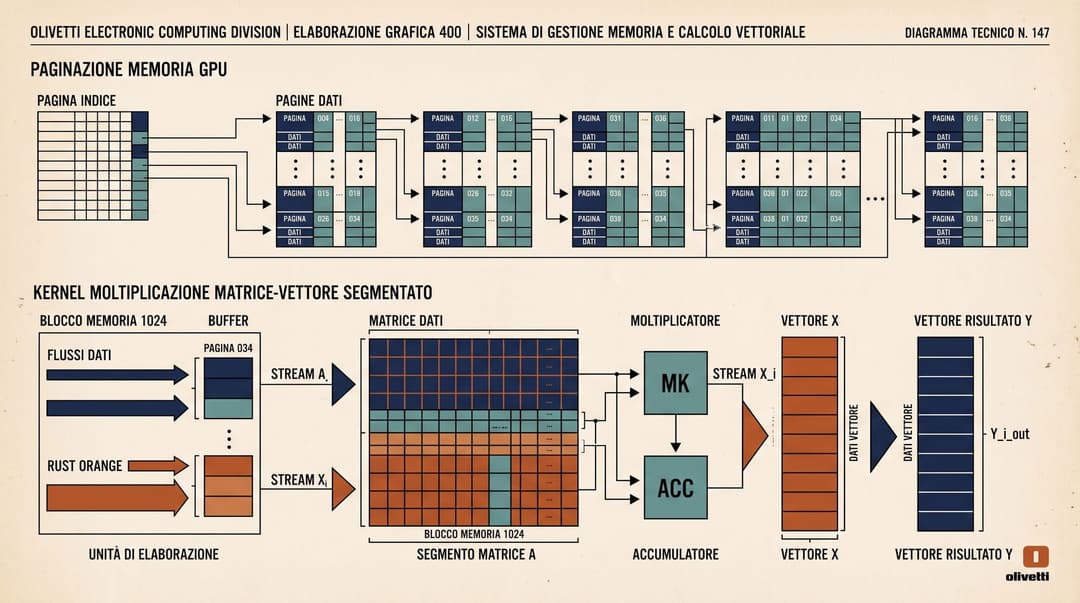
Introduced in the Punica multi-tenant serving architecture, the Segmented Gather Matrix-Vector multiplication (SGMV) kernel groups requests in the current batch by their target LoRA adapter.
Rather than iterating sequentially, SGMV assigns each unique adapter index to a distinct CUDA block grid dimension (blockIdx.y). Within the kernel:
- Input token activations corresponding to adapter are gathered from the global activation tensor.
- Tensor Core instructions compute the intermediate rank- projection (the shrink operation).
- A second kernel computes the output projection (the expand operation), scaling the result by and adding it to the base GEMM output.
By grouping identical adapters within a single batch, SGMV increases operational intensity, allowing batched token vectors to saturate GPU memory bandwidth during the autoregressive decoding phase.
Multi-Size Batched Gather Kernels (MBGMV and MBGMM)
While Punica assumed uniform adapter ranks, production environments regularly mix adapters with varying ranks (such as for simple classification and for complex reasoning).
S-LoRA introduced Multi-Size Batched Gather Matrix-Vector (MBGMV) for token decoding and Multi-Size Batched Gather General Matrix Multiply (MBGMM) for prompt prefilling:
- MBGMV (Decode Phase): Operates on single tokens per sequence, gathering non-contiguous adapter weights across heterogeneous rank buffers without requiring padding to the maximum rank in the batch.
- MBGMM (Prefill Phase): Operates on variable-length sequence tiles, processing multi-token prompt chunks while dynamically indexing into rank-specific weight matrices.
Modern inference engines like vLLM and FlashInfer implement optimized variants of these kernels, employing warp-specialized tile scheduling and vectorized 128-bit memory loads to minimize latency overhead to under 2 milliseconds per token relative to base model execution.
Memory Management: Unified Paging and Tiered Caching
GPU memory allocation is the primary operational constraint in multi-LoRA serving. A production cluster must simultaneously manage:
- Base model parameters (e.g., 14 GB for a 7B model in FP16/BF16).
- Dynamic Key-Value (KV) cache memory for variable sequence lengths.
- Hundreds of task-specific adapter weights with heterogeneous rank allocations.
The Memory Fragmentation Bottleneck
Traditional runtime memory managers allocate contiguous memory chunks for newly loaded adapters. As requests arrive and adapters are dynamically loaded and evicted, GPU memory suffers severe external fragmentation. These interleaved gaps prevent the allocation of large contiguous KV cache blocks, artificially constraining batch sizes and causing out-of-memory (OOM) errors even when aggregate VRAM appears available.
Traditional Contiguous Allocation (Severe External Fragmentation):
[ Base Model: 14GB ] [ LoRA 1: 50MB ] [ Free: 30MB ] [ LoRA 2: 200MB ] [ Free: 80MB ] [ KV Cache Block (Fails) ]

Unified Paging Architecture (Virtual Page Pool):
[ Base Model ] [ Page 0: KV ] [ Page 1: LoRA-A ] [ Page 2: LoRA-B ] [ Page 3: KV ] [ Page 4: LoRA-A ]
Unified Paging Architecture
S-LoRA resolved this issue by extending the PagedAttention concept to adapter weights through Unified Paging.
Under Unified Paging, all dynamic GPU memory outside the frozen base model is divided into a single pool of fixed-size physical memory pages (typically 4 KB to 64 KB). The memory manager treats KV cache tensors and LoRA weight matrices identically:
- Adapter weights are sliced into page-sized chunks along their layer and rank dimensions.
- Logical page tables track the non-contiguous physical pages assigned to each adapter's and tensors.
- When an adapter is scheduled, the kernel gathers weights directly from non-contiguous pages using physical page indices passed in metadata.
This eliminates external memory fragmentation entirely, allowing the serving system to dynamically rebalance memory between KV cache and adapter storage based on instantaneous traffic demand.
Tiered Storage Hierarchy
Production deployments implement a three-tier memory hierarchy to support thousands of registered adapters without exhausting GPU HBM:
+-------------------------------------------------------------------------+
| Tier 1: GPU HBM (Paged Memory Pool)                                     |
| Low latency (~1-2 ms dispatch), holds active & hot adapters + KV cache. |
+-------------------------------------------------------------------------+
                                   ▲  │
                  PCIe Gen4/5 D2H  │  │  H2D Async Prefetch (5-15 ms)
                                   │  ▼
+-------------------------------------------------------------------------+
| Tier 2: Host DRAM (Pinned CPU Memory Pool)                              |
| Staging area for thousands of warm adapters (100GB+ pool).              |
+-------------------------------------------------------------------------+
                                   ▲  │
                      Storage I/O  │  │  Streaming Adapter Fetch (50-200 ms)
                                   │  ▼
+-------------------------------------------------------------------------+
| Tier 3: Model Registry / Remote Storage (S3, GCS, Local NVMe)          |
| Complete catalog of tens of thousands of cold adapter checkpoints.      |
+-------------------------------------------------------------------------+- GPU HBM (Active Pool): Holds the base model, active KV cache pages, and currently referenced LoRA adapters.
- Host DRAM (Warm Pool): Pinned host memory maintains hundreds or thousands of pre-parsed adapters. Transfers from Host to Device (H2D) over PCIe Gen5 achieve bandwidths exceeding 60 GB/s, loading a 50 MB adapter in under 1 millisecond.
- Remote Object Storage / Local NVMe (Cold Pool): Frameworks like Predibase LoRAX stream adapters on demand from S3, GCS, or Hugging Face Hub, storing them in local NVMe disk caches before promotion to RAM.
Distributed Multi-LoRA: Tensor Parallelism Strategies
Serving frontier models (such as Llama 3.1 70B or Qwen 2.5 72B) requires partitioning weights across multiple GPUs using Megatron-style Tensor Parallelism (TP). Extending tensor parallelism to batched LoRA inference requires partitioning the low-rank matrices without adding communication synchronization points.
Partitioning Rules for Linear Layers
Standard Megatron-style tensor parallelism splits linear layers into column-parallel or row-parallel configurations. LoRA adapters attached to these layers must be partitioned to align with the base model's communication flow:
Column-Parallel Layer (e.g., QKV Attention Projections):
Input X (Replicated) ────────► Base GEMM [W0,1 | W0,2] ────────► Y_base [Y1 | Y2]
                     └───────► LoRA-A [A (Replicated)] ──────► Intermediate v (Replicated)
                               └─► LoRA-B [B1 | B2] ───────────► Y_lora [Y1 | Y2]
                               (Outputs concatenated locally, no All-Reduce needed)

Row-Parallel Layer (e.g., Attention Output, MLP Down-Projection):
Input X [X1 | X2] ───────────► Base GEMM [W0,1 / W0,2] ────────► Partial Y_base
                  └──────────► LoRA-A [A1 / A2] ──────────────► Partial v
                               └─► LoRA-B [B (Replicated)] ───► Partial Y_lora
(Combined All-Reduce: Sum(Partial Y_base + Partial Y_lora))- Column-Parallel Projections (Q, K, V Projections and MLP Gate/Up Projections):
- The base weight is split column-wise: .
- In the LoRA branch, matrix is replicated across all TP ranks (), while matrix is split column-wise ().
- Each GPU computes independently. The output aligns with the partitioned base output without requiring any cross-GPU communication.
- Row-Parallel Projections (Attention Output and MLP Down Projections):
- The base weight is split row-wise: .
- In the LoRA branch, matrix is split row-wise (), while matrix is replicated across all TP ranks ().
- Each GPU computes its partial activation , projects it locally via , and adds the result to the local base GEMM output. A single All-Reduce operation synchronizes the combined sum across ranks, introducing zero additional communication primitives.
S-LoRA TP Communication Optimization
When adapter ranks are exceptionally small (), S-LoRA implements an alternative partitioning for row-parallel layers:
- Split column-wise instead of replicating it.
- Perform an All-Gather or Reduce-Scatter on the intermediate rank- vector .
Because , communicating the compact intermediate vector over NVLink consumes significantly less interconnect bandwidth than communicating the full hidden state vector , reducing communication latency on bandwidth-constrained clusters.
Framework Comparison
| Metric / Capability | vLLM Multi-LoRA | S-LoRA | Predibase LoRAX |
|---|---|---|---|
| Primary Base Backend | vLLM Engine (PagedAttention) | Custom S-LoRA Engine | HuggingFace TGI Fork |
| Adapter Kernel Engine | Punica BGMV / FlashInfer | Custom MBGMV / MBGMM | Punica SGMV |
| Heterogeneous Rank Support | Dynamic (via FlashInfer/BGMV) | Native (MBGMV memory gathering) | Dynamic (Punica kernels) |
| Memory Management | PagedAttention integration | Unified Paging (Adapter + KV) | Dynamic VRAM Adapter Cache |
| Dynamic Loading Protocol | REST API (/v1/load_lora_adapter) | Internal Dynamic Scheduler | On-demand URI / S3 Streaming |
| Remote Registry Fetch | Local disk / Mounted shared FS | Pre-loaded Host RAM / Disk | Direct S3 / GCS / HF Hub |
| Tensor Parallelism Support | Standard vLLM TP Integration | S-LoRA TP (Optimized All-Reduce) | TGI Tensor Parallelism |
Production Engineering Guidelines
Implementing multi-LoRA serving in production systems requires specific operational safeguards:
1. Asynchronous Prefetching and Request Queuing
When a request arrives for an adapter that resides in Host DRAM or object storage, fetching the weights synchronously stalls the inference engine's continuous batching loop.
Production architectures decouple scheduling from weight transfer:
- The routing gateway inspects the incoming request's
modelparameter. - If an adapter cache miss occurs, the gateway initiates an asynchronous CUDA non-blocking transfer (
cudaMemcpyAsync) from pinned host memory to the GPU adapter pool. - The request remains in the scheduling queue for 1 to 2 engine iterations until the transfer completes, preventing head-of-line blocking for active requests.
2. Guarding Against Rank Skew
Mixing extreme rank variations in the same batch (e.g., alongside ) degrades Tensor Core warp efficiency, as smaller adapters complete early while execution warps wait on larger matrix multiplications.
Standardize fine-tuning configurations across internal teams to a small set of canonical ranks (such as ). When wide rank disparity is unavoidable, configure the scheduler to group batches by rank affinity.
3. Prefix Affinity and Semantic Gateway Routing
To maximize GPU cache hit rates, the load balancing gateway in front of a multi-replica inference cluster should implement adapter-aware routing.
Directing all traffic for a given adapter subset (e.g., customer tenant or task domain) to specific inference replicas minimizes adapter thrashing and maintains high HBM cache residency.
Update (Oct 19, 2026)
Correction: the dead vLLM LoRA documentation link now points to the current page.
Sources
- S-LoRA: Serving Thousands of Concurrent LoRA Adapters (Sheng et al., 2023, arXiv:2311.03285)
- Punica: Multi-Tenant LoRA Serving (Chen et al., 2023, arXiv:2310.18547)
- LoRA: Low-Rank Adaptation of Large Language Models (Hu et al., 2021, arXiv:2106.09685)
- vLLM Multi-LoRA Serving Documentation and Architecture
- Predibase LoRAX: Multi-LoRA Inference Server (GitHub Repository)
- FlashInfer: High-Performance GPU Kernel Library for LLM Serving
- Efficient and Cost-Effective Multi-Tenant LoRA Serving on Amazon SageMaker
