

Production deployments of large language models frequently fail not because models lack capability, but because they lack reliable uncertainty estimation. Autoregressive language models generate hallucinations with the exact same fluent, assertive cadence as verified ground truth. When an enterprise application relies on downstream actions, database writes, or customer-facing advice, uncalibrated generations introduce severe operational risk.
Treating raw token probabilities as calibrated confidence metrics leads to flawed routing. A model generating a factually accurate response may assign low token-level probabilities simply because the concept can be phrased in dozens of valid ways. Conversely, a model can assign near-1.0 probabilities to entirely fabricated entities when locked into a hallucinated trajectory. Building reliable production AI systems requires moving beyond naive token logits toward meaning-space dispersion metrics and distribution-free statistical guarantees.
The Miscalibration of Autoregressive Transformers
Neural network miscalibration is well-documented. As established by Guo et al. (2017), modern deep neural architectures with high capacity and normalization layers tend to be overconfident, exhibiting poor Expected Calibration Error (ECE). In large language models, this issue is exacerbated by reinforcement learning from human feedback (RLHF) and instruction fine-tuning, which often induce sycophancy and assertive output styles regardless of epistemic uncertainty.
Research from Kadavath et al. (2022) demonstrated that while base models possess latent self-knowledge regarding what they do and do not know, standard decoding strategies fail to surface calibrated probabilities.
Two primary failure modes dominate naive confidence scoring:
- Lexical dispersion: If a question has multiple valid phrasings (for example, "Paris", "It is Paris", or "The capital of France is Paris"), the probability mass splits across disparate token sequences. The resulting sequence log-likelihood is low, falsely signaling high uncertainty.
- Entrenched confabulation: Once a model begins generating a false premise, autoregressive conditioning forces subsequent tokens to maintain narrative consistency. The token-level log-probabilities for the remainder of the generation appear exceptionally confident despite the entire response being factually invalid.
Token-Level Metrics and Their Operational Limits
Engineers often attempt to extract confidence signals directly from the generation runtimes like vLLM or SGLang. Common token-level proxies include:
- Average sequence log-likelihood: The geometric mean of conditional token probabilities across sequence length L:
(1 / L) * sum(log p(w_t | w_<t, x)). - Per-token Shannon entropy: The entropy of the next-token probability distribution:
H(P_t) = - sum(p(v) * log p(v))over the vocabulary V. - Minimum token logit probability (Min-p): The lowest probability assigned to any selected token in the generated sequence, often used as a red flag for generation stumbling blocks.
While token entropy can detect local syntactic hesitation or vocabulary transitions, it measures uncertainty over words rather than uncertainty over facts. Temperature scaling can adjust overall distribution sharpness, but global scaling factors do not resolve the structural difference between linguistic variety and factual unreliability.
Semantic Entropy: Quantifying Dispersion in Meaning Space
To isolate factual uncertainty from syntactic variation, Kuhn et al. (2023) and Farquhar et al. (2024) introduced semantic uncertainty and semantic entropy. Instead of evaluating a single token sequence, the system samples K stochastic completions at temperature T > 0 and clusters them by semantic equivalence.
The Semantic Clustering Pipeline
The semantic entropy calculation operates across four steps:
- Stochastic Sampling: Generate K completions (typically K = 5 to 10) for prompt x using multinomial sampling at temperature T = 0.7.
- Equivalence Evaluation: Compare completion pairs using bidirectional Natural Language Inference (NLI). Two completions
uandvbelong to the same semantic cluster ifuentailsvandventailsu(u <=> v). In production, this classification is performed by a dedicated, low-latency cross-encoder such as DeBERTa-v3-small. - Cluster Mass Aggregation: Discrete semantic clusters
C_1, C_2, ..., C_Mare formed (where M <= K). The total probability mass of clusterC_mis computed by summing the sequence likelihoods of its constituent generations:P(C_m) = sum_{k in C_m} P(y_k | x). - Semantic Entropy Computation: Calculate the Shannon entropy over the discrete semantic clusters:
H_semantic(x) = - sum_{m=1}^M P(C_m) * log P(C_m).
When all sampled trajectories convey the exact same meaning despite varying wording, M = 1 and H_semantic = 0, indicating high epistemic confidence. If the model generates contradictory facts across samples, the probability mass fragments across distinct semantic clusters, yielding high semantic entropy. Farquhar et al. (2024) demonstrated that semantic entropy significantly outperforms token-based perplexity and verbalized self-evaluation in AUROC benchmarks for hallucination detection across diverse question-answering datasets.
Conformal Prediction and Distribution-Free Risk Control
Heuristic uncertainty thresholds (such as dropping requests when semantic entropy exceeds 0.4) lack rigorous performance bounds. When user distributions shift, fixed heuristics degrade silently.
Conformal prediction, formulated comprehensively by Angelopoulos and Bates (2021), provides a distribution-free framework to convert heuristic uncertainty scores into prediction sets with provable, finite-sample statistical guarantees.
Split Conformal Calibration
Under standard split conformal prediction:
- Calibration Set: A held-out dataset
D_cal = {(x_i, y_i)}_{i=1}^ndrawn exchangeably from the deployment distribution is maintained. - Non-Conformity Scoring: A non-conformity function
s(x, y)evaluates how poorly a candidate outputyconforms to promptx. In text generation,s(x, y)can be defined as1 - SemanticScore(x, y)or sequence negative log-likelihood. - Quantile Computation: For a user-specified error tolerance alpha (e.g., alpha = 0.05 for 95% coverage), compute the calibrated quantile threshold
q_hat:
q_hat = Quantile( ceil((n + 1) * (1 - alpha)) / n, {s(x_i, y_i)}_{i=1}^n )- Prediction Set Construction: For a new query
x_test, form the prediction setC(x_test) = {y : s(x_test, y) <= q_hat}.
The theoretical guarantee ensures that P(y_test in C(x_test)) >= 1 - alpha holds in finite samples without distributional assumptions beyond exchangeability.
Conformal Risk Control
For natural language generation where simple set containment is insufficient, Angelopoulos et al. (2021) and Quach et al. (2023) extended conformal prediction to Conformal Risk Control (CRC). CRC allows teams to bound the expected value of an arbitrary bounded loss function L(C(x), y) (such as factual error rate, hallucination rate, or unfaithful claims per paragraph) below a target risk level epsilon: E[L(C(x), y)] <= epsilon.
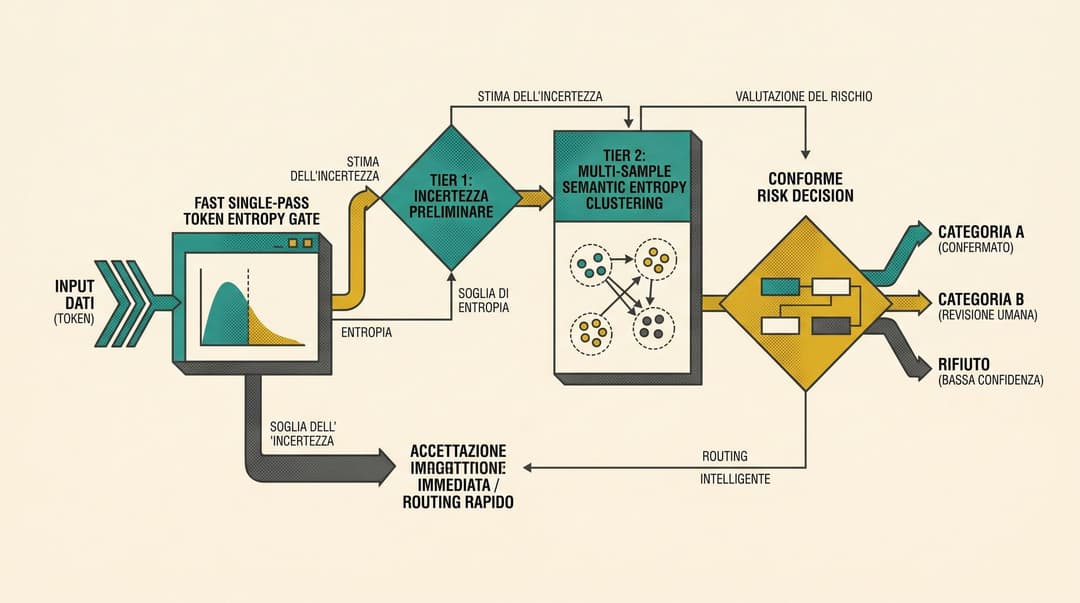
Two-Tier Production Serving Architecture
Evaluating multi-sample semantic entropy on every request imposes a 5x to 10x compute multiplier. In high-throughput environments, a two-tier serving topology balances computational efficiency with statistical reliability.
Tier 1: The Fast Path (Single-Pass Gating)
During the primary autoregressive generation pass:
- The inference engine emits tokens alongside token-level log-probabilities.
- A streaming filter tracks mean token entropy and the lowest 5th-percentile token probability.
- If token entropy remains below a conservative threshold
tau_fast, the generation is classified as high-confidence and immediately returned to the client. This handles 70% to 80% of standard, in-distribution queries with zero additional latency.
Tier 2: The Slow Path (Semantic Clustering and Risk Verification)
If Tier 1 encounters ambiguous token transitions, low-confidence entities, or flagged domain keywords:
- The engine forks execution to generate
K = 5stochastic completions in parallel. Modern engines (such as vLLM) utilize a shared KV cache prefix for the prompt, eliminating redundant prefill computation across the K samples. - Completions are dispatched to an internal NLI cross-encoder service to construct the bidirectional entailment matrix.
- The system computes
H_semanticand evaluates conformal non-conformity scores.
Dynamic Routing Actions
Based on calibrated risk boundaries, the orchestrator triggers one of three execution paths:
- Direct Delivery: If
H_semanticsatisfies the conformal acceptance criterion (s(x, y) <= q_hat), the dominant cluster median response is returned. - Retrieval Escalation: If semantic entropy indicates moderate factual divergence, the query is routed to an agentic retrieval loop (such as automated web search or vector database queries) to ground the ambiguous entities in authoritative context.
- Risk-Controlled Abstention: If semantic entropy exceeds critical risk ceilings or the conformal prediction set is empty, the model abstains from answering ("Insufficient verifiable data to complete this request") or routes the query to a human-in-the-loop review queue.
Systems Economics and Operational Trade-Offs
Deploying calibrated uncertainty estimation requires managing three core operational considerations:
Compute Overhead and KV Cache Sharing
Running K parallel rollouts increases decode FLOPs linearly with K. However, because all K rollouts share the identical system prompt and user input, prefill time is constant. In prefix-caching architectures, the overhead is confined strictly to parallel token decoding. Setting K = 5 typically yields sufficient cluster stability for short-form factual generation while capping latency inflation.
NLI Cross-Encoder Optimization
Pairwise NLI evaluation across K samples requires K * (K - 1) directional inferences. For K = 5, 20 sentence pairs must be evaluated. Running a quantized 8-bit DeBERTa-v3-small model on a shared CPU or sidecar inference worker evaluates 20 pairs in under 12 milliseconds, preventing NLI computation from becoming the primary serving bottleneck.
Covariate Shift and Rolling Calibration
The fundamental assumption of conformal prediction is data exchangeability. In production environments, prompt distributions drift due to seasonal patterns, user behavior changes, and upstream application updates.
Maintaining valid coverage guarantees requires continuous calibration maintenance:
- Rolling calibration buffers: Expire calibration pairs older than a fixed time window (e.g., 7 to 14 days) and continuously ingest audited production traces.
- Stratified calibration: Calibrate distinct
q_hatthresholds across specific task domains (e.g., code generation, biomedical QA, customer support) to prevent easy tasks from artificially lowering coverage on complex queries.
By combining token-level fast gating, semantic entropy clustering, and distribution-free conformal risk bounds, engineering teams can eliminate silent confabulation and build resilient AI systems with verifiable safety guarantees.
Sources
- Farquhar et al. (Nature 2024): Detecting hallucinations in large language models using semantic entropy
- Kuhn et al. (ICLR 2023): Semantic Uncertainty: Linguistic Invariances for Uncertainty Estimation in Natural Language Generation
- Angelopoulos and Bates (2021): A Gentle Introduction to Conformal Prediction and Distribution-Free Uncertainty Quantification
- Angelopoulos et al. (2021): Learn then Test: Calibrating Predictive Algorithms to Achieve Risk Control
- Quach et al. (2023): Conformal Language Modeling
- Kadavath et al. (2022): Language Models (Mostly) Know What They Know
- Guo et al. (ICML 2017): On Calibration of Modern Neural Networks
