
MiniMax has confirmed what a lot of developers suspected for almost four weeks. Space Bunny, the anonymous "stealth" model that topped usage charts on OpenRouter and OpenCode, was an early version of MiniMax M3.1 Flash. MiniMax teased the reveal on X at 2:21 AM PDT on October 19 with "Welcome back. Space Bunny.", then posted the full launch about two and a half hours later. Our news breakdown of M3.1 Flash covers the specs and vendor benchmarks. This roundup covers what people said about it, during the stealth run and in the first hours after the reveal.
Almost all of the discussion is on X. When we checked at about 5:30 AM PDT, no Hacker News thread on the launch had more than a handful of points. That makes this an unusual launch: the model arrives with weeks of public, anonymous testing behind it, and the reactions below mix early impressions of Space Bunny with first takes on the named release.
The reveal: usage first, branding later
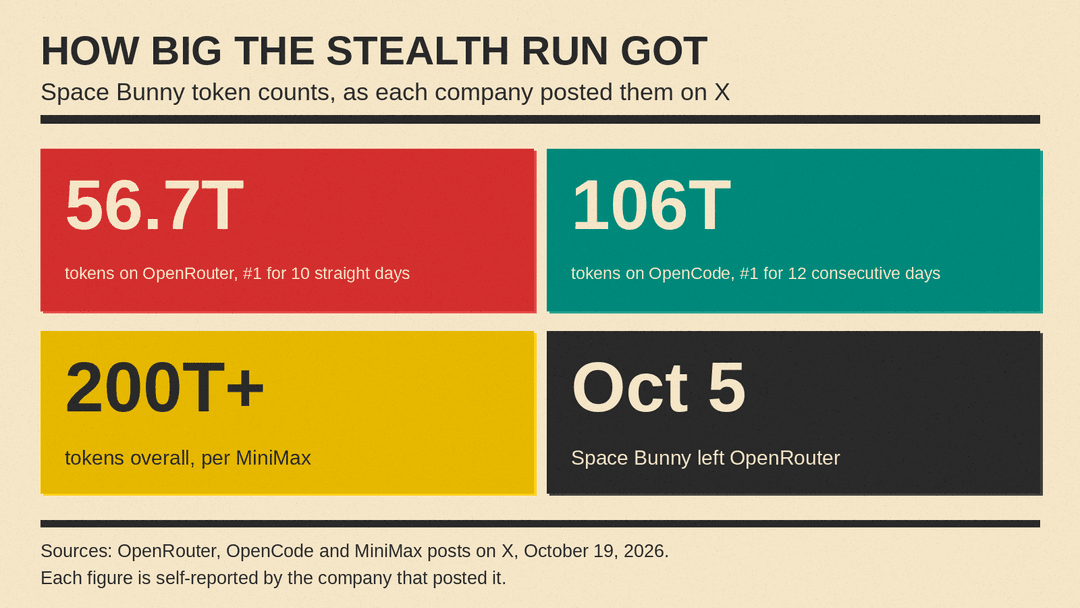
The stealth run was large by any measure the platforms published. OpenRouter said "Space Bunny was OpenRouter's #1 model for 10 straight days, processing 56.7T tokens", adding: "The most of any stealth model we've run." OpenCode posted that it was "#1 on OpenCode for 12 consecutive days, 106T tokens served". MiniMax's own launch post on X says Space Bunny "has topped global leaderboards with 200T+ tokens".
@soycronus summed up why some people found that more persuasive than a benchmark table: "Usage before branding. That's the signal I trust."
The identity was not much of a secret. On the day OpenRouter listed it, September 23, @cheatyyyy wrote that Space Bunny "is most certainly MiniMax M3.1" and that "the text tokenizer perfectly matches that of the MiniMax M3." @MarMarLabs ran a more cautious test: "Across 12 distinct text fixtures, I made 36 input-token comparisons. Every one matched MiniMax's public M3 tokenizer." The same post added that "M2.7 matched too, so this points to the family rather than a specific release." On launch day, @AI_Screening called it "The worst-kept secret in AI".
Praise: speed, and visual coding work
Speed is the most common compliment. @itsjdraven tested it in OpenCode in the first days of the preview and wrote that "the coding output was clean and the image task gave accurate results". @SaniAiTech asked it to build an interactive experience with multiple scenes and said "the speed immediately stood out." @notjazii posted first impressions on September 26: "space bunny is fast and its outputs look way better than grok 4.7 and i am pretty sure it's minimax m3.1".
Some praise goes further than the evidence so far. After the reveal, @Bhavani_00007 wrote that "when I tested it, it was insanely fast, and the results were better than Opus 5 and GPT 6 Sol." That is one user's impression, and the independent tests below do not show that result.
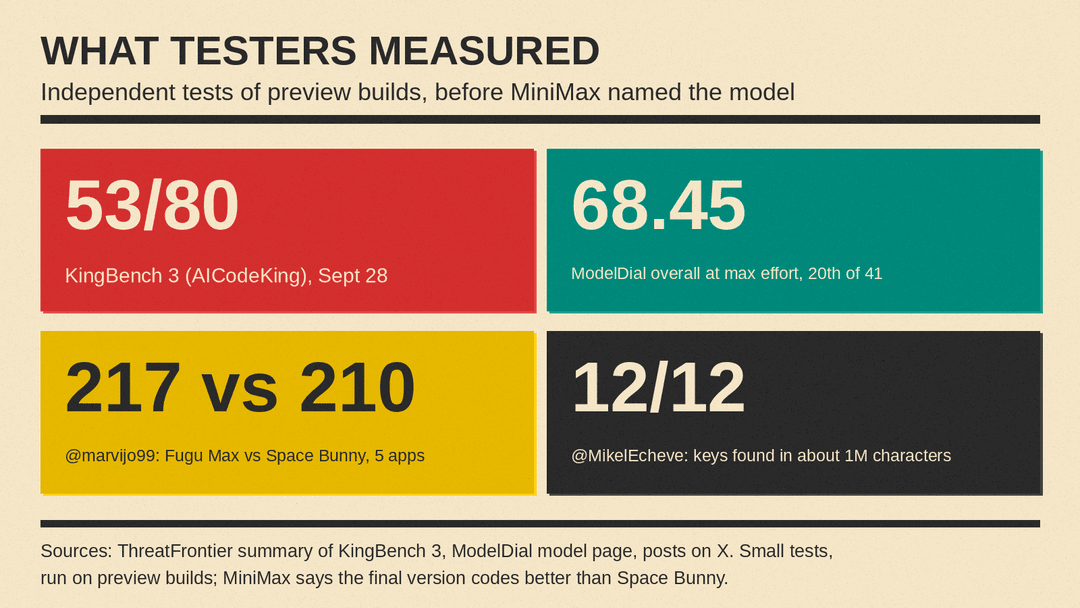
Long context got one concrete check. @MikelEcheve reported testing it free in OpenCode Zen on October 2: "Fast, 12/12 finding keys in ~1M characters of context".
Complaints: loops, long runs, and a moving target
The criticism is mostly about agent behavior. On September 27, @eragoaugustus wrote: "Space Bunny can't complete tasks. It goes into loops or just stops to tell you what it wants to do next." @follistatindev said that on one benchmark it was "the slowest model on this test, spending upwards of 4 hours per task", even though its raw speed was "around 140tok/s", because it produced far more output tokens than other models.
That fits a detail in MiniMax's API docs: the model always reasons, and if a request does not set an effort level, it runs at max. Tools that leave the setting alone pay for the longest thinking on every call.
Several testers also said the model changed during the preview. @HermesAgentTips wrote on October 1 that it was "good but its pretty slow" and "definitely better than what it was like a week ago". @Rohit_115 said that "before it was very slow and bad at tasks which i tested , now it got a update so now its looking better." That raises a fair question for anyone relying on stealth-period results. @jimmyyangrz put it this way after the reveal: "Still missing are the price and proof that the shipped checkpoint is the one people tested for free." MiniMax's Ryan Lee answered a related question in Chinese, writing that the final version performs better at coding than Space Bunny (our translation).
Others want independent numbers before they switch. @CodeByNZ called the pricing "aggressive" but said "independent results vs DeepSeek V4.1 Flash and Kimi K3 are still thin." @sachintwtss cited "62.2 on Automation-Bench, but 38.1 vs Opus 5's 51.8 on Terminal Bench" and concluded: "cheap agent loops yes, but test it on a real repo first". We could not find the Terminal Bench figure in MiniMax's launch blog text, so treat it as that poster's reading.
Benchmarks people ran
The independent tests so far are small and were run on preview builds, not the final release.
- KingBench 3: AICodeKing's eight build-from-scratch coding tasks scored M3.1 Flash Preview at 53 of 80 (66.25%) on September 28, according to ThreatFrontier's summary. Claude Opus 5.5 topped the same run at 93.75%. The model scored 9 of 10 on a 3D geometry task but 3 and 4 of 10 on two interactive builds.
- ModelDial: the ModelDial model page lists an overall score of 68.45 at max effort, 20th of 41 models, with backend engineering at 75 and maintainability at 53. The page lists September 28, 2026 as a test date.
- Head to head: @marvijo99 gave Sakana's Fugu Max and Space Bunny the same prompt for five SaaS apps. "Space Bunny Alpha was faster in every round, Fugu Max had the better design in 4 of 5. final evidence score 217 vs 210".
- Skeptics: @bruce_x_offi wrote on October 11 that "if space bunny was minimax, we might not be so impressed", pointing to his own open-weight model results.
No Artificial Analysis score was out at launch. @MATKA_r noted "no artificial analysis score yet, so no benchmark claims from me", and @soareso said they were "curious to see how it performs on Artificial Analysis."
Price and weights: early numbers were wrong
In the hours between the teaser and the launch, a widely shared price was off. Posts such as one from @Mr_Salio listed "$0.165 input / $0.66 output per 1M tokens". @rudraxx13 warned at the time that there was "no price for it on their pricing page yet, so the $ numbers going around aren't official". The official price in MiniMax's launch post is $0.15 per million input tokens, $0.60 per million output tokens and $0.015 per million cached input tokens.
Weights timing also differs by source. MiniMax's blog says "Model weights will be released later." Its X launch post is more specific: "Model weights will arrive on Oct 23." OpenRouter wrote that "MiniMax plans to release the weights later this week."
Benchmark figures vary by source too. MiniMax's X post lists 62% on Automation-Bench. OpenRouter's post says "MiniMax reports 72.5% on AutomationBench-AA". The blog text gives no score for AutomationBench-AA, so these may be two different tests.
The price comparison most people reached for was DeepSeek, which shipped its own Flash update two days earlier. @Nitocnt wrote that the timing "is going to make the cheap fast tier brutal." Our DeepSeek V4.1-Flash-1017 reactions roundup covers how developers received that model.
How to try it free this week
- OpenRouter: free "for the next 72 hours", per OpenRouter's post. The OpenRouter listing shows a 1M-token context and text, image and video input.
- OpenCode: "free for the next 3 days", per OpenCode.
- MiniMax Code: unlimited M3.1 Flash for subscribers "Through Oct 25, 23:59 (UTC+8)", per MiniMax's agent account. That is 8:59 AM PDT on October 25.
What to watch
Three things will settle the open questions. First, whether the weights land on October 23 as MiniMax's X post says, and under what license. Second, independent scores on the final release, since the tests above ran on preview builds that testers say changed. Third, real per-task cost, which depends on the effort level: the loop and four-hour-run complaints suggest teams should set it explicitly rather than accept the max default.
Sources
- MiniMax: MiniMax M3.1 Flash launch post
- MiniMax API docs: text generation
- MiniMax on X: "Welcome back. Space Bunny."
- MiniMax on X: M3.1 Flash launch
- MiniMax Agent on X: MiniMax Code offers
- Ryan Lee on X
- OpenRouter on X: stealth model reveal
- OpenRouter on X: benchmarks, price and weights
- OpenRouter: MiniMax M3.1 Flash listing
- OpenCode on X
- ThreatFrontier: MiniMax M3.1 Flash preview and KingBench 3
- ModelDial: MiniMax-M3.1-Flash
- CellCog: Space Bunny Alpha record
- X posts quoted: @cheatyyyy, @MarMarLabs, @itsjdraven, @SaniAiTech, @notjazii, @eragoaugustus, @follistatindev, @HermesAgentTips, @marvijo99, @jimmyyangrz, @rudraxx13
