
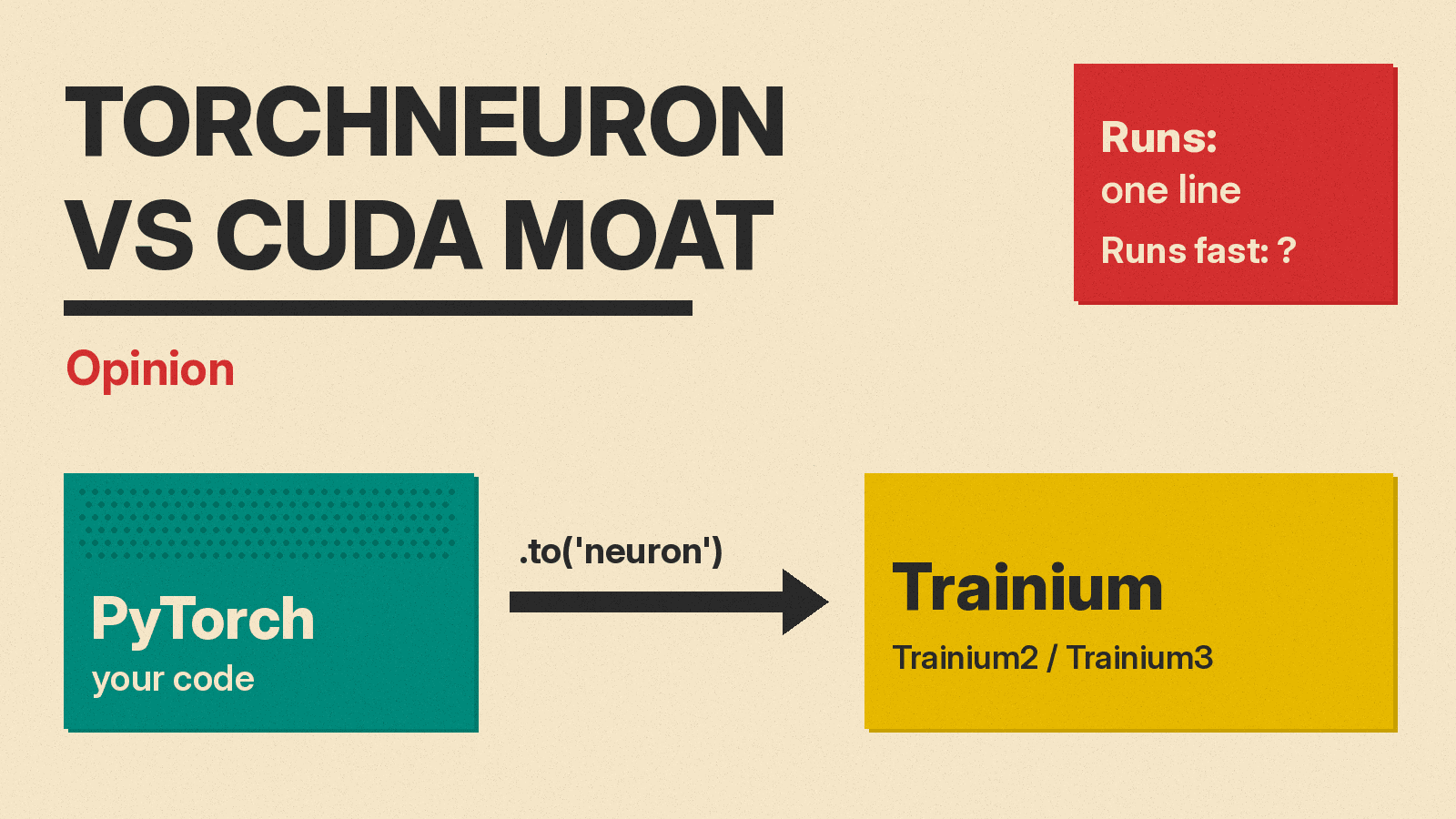
This is an opinion piece. The facts are sourced and linked; the conclusions are ours.
Amazon's new TorchNeuron software lets PyTorch code run on its Trainium chips after what GeekWire calls "a basic configuration change." Amazon's own pitch is blunter. "If you know PyTorch, then you know Trainium," Colin Brace, vice president of technology software at Annapurna Labs, told GeekWire.
My view: TorchNeuron goes after the right part of Nvidia's software advantage, and it is more important than another custom chip announcement. But it removes the cheap part of switching, not the expensive part. GeekWire's line that switching is "about as simple as changing a setting" is true for getting a model to run. It is not yet true for getting a model to run well enough to leave GPUs in production.
What Amazon actually shipped
The facts, from the PyTorch blog post and GeekWire:
- TorchNeuron is a native PyTorch backend for Trainium2 and Trainium3. It registers Trainium through PrivateUse1, PyTorch's official extension point for custom hardware.
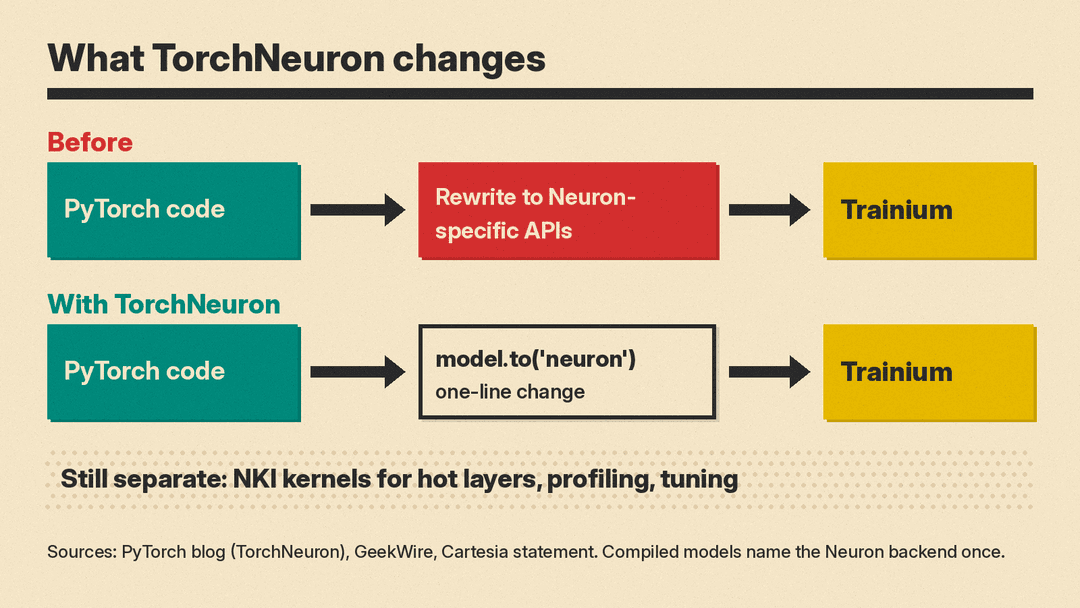
- In the simplest case the only change is
model.to('neuron'). Code written againsttorch.acceleratorruns unmodified. Compiled models need the Neuron backend named once. - It supports eager mode for debugging,
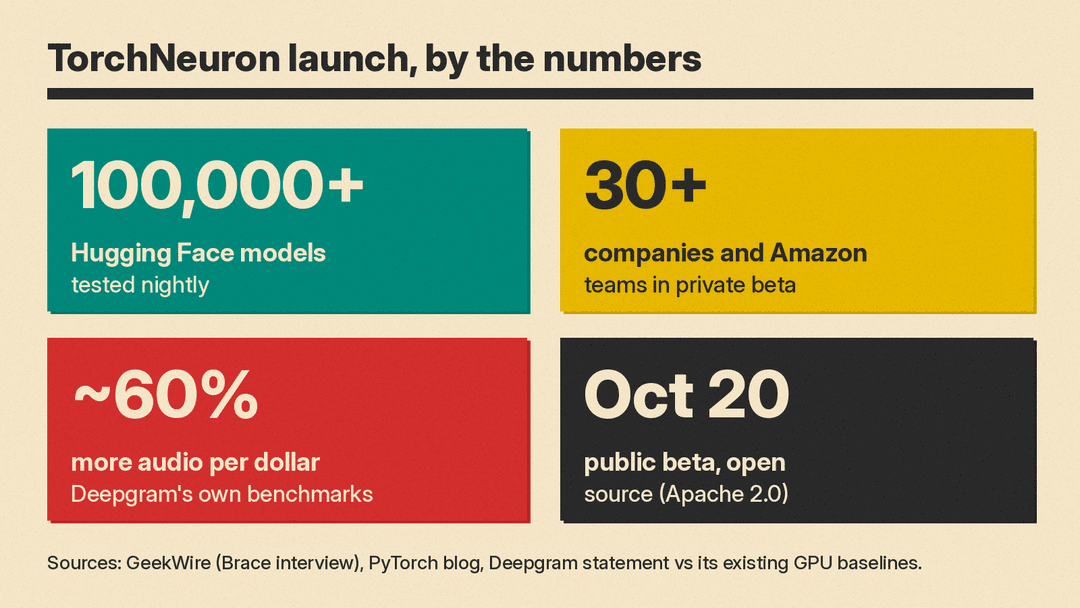
torch.compilefor production speed, and the Neuron Kernel Interface (NKI) for custom kernels. - It was in private beta since late last year, with more than 30 companies and internal Amazon teams using it, per GeekWire. It goes to public beta and open source under Apache 2.0 on October 20, at PyTorch Conference North America.
- Amazon tests it every night against more than 100,000 models from Hugging Face, Brace told GeekWire.
The part that is underrated: the on-ramp
Nvidia's lead is not only silicon. As GeekWire puts it, much of the industry's AI software was built around CUDA, and adapting that code to other hardware "can take months of engineering work." That is why companies have been slow to move even as Amazon, Google and others built their own chips.
Until now, Trainium carried an extra tax on top of that. Developers had to modify PyTorch code to call Amazon-specific interfaces, according to Brace. Hugging Face said the same thing in its statement for the launch: using Trainium "required adapting Hugging Face models with Neuron-specific software and configuration." TorchNeuron makes Trainium a native backend for Transformers and Diffusers.
That matters more than any single benchmark. Most teams do not decide to switch chips from a spec sheet. They decide after an engineer tries their own model on the new hardware and it either runs or it does not. A rewrite kills that experiment before it starts. A one-line device change lets it happen. The nightly test against 100,000+ Hugging Face models is the most credible detail in the launch, because breadth of "it just runs" is exactly what a challenger to CUDA has lacked.
It also fits a pattern. Google described the same goal for TorchTPU in April: change the initialization to "tpu" and run the training loop "without modifying a single line of core logic." When two of Nvidia's largest customers both build native PyTorch backends for their own chips, the framework, not the chip vendor's SDK, becomes the place where portability lives.
The part that is overhyped: production speed
Read the customer quotes closely and the story gets more complicated.
Deepgram, the private-beta customer GeekWire names, says Trainium processes about 60% more input audio seconds per dollar than its existing GPU baselines, in the benchmarks it evaluated. It now runs Trainium in production, Brace told GeekWire. But Deepgram also says the port happened "over a multi-month engagement" in which the AWS Generative AI Innovation Center helped it move its model. That is not a settings change. That is Amazon engineers working alongside a customer for months.
Cartesia, which builds voice AI models, ran its standard inference pipeline "with minimal changes." Its team then concentrates on writing high-performance NKI kernels for the layers that are called repeatedly and drive end-to-end latency.
Neither of those is a knock on TorchNeuron. They are an honest picture of how hardware switching works. Running is free now. Running fast still takes kernel work, profiling and people who know the chip. In my view, that second layer is where Nvidia's head start matters most. TorchNeuron does not erase that. It moves the fight there.
Who wins
PyTorch wins first. Every chip vendor now has to meet developers inside PyTorch. Meta's director of PyTorch engineering, Jana van Greunen, framed it as a "consistent experience across hardware platforms." That is the framework becoming the neutral layer, which is good for everyone except whoever benefited from lock-in.
Buyers win next. Even teams that never leave Nvidia gain leverage when a credible alternative is one line away from a test run. The argument I made in Model Loyalty Is Over, and the Winners Own the Switch about models applies to chips too: the cheaper it is to switch, the more the incumbent has to compete on price and performance.
Amazon wins if it can grow past its own investees. Trainium's biggest users so far are AI labs with close financial ties to Amazon, GeekWire notes: Anthropic, in which Amazon has invested billions, and OpenAI, which agreed to use 2 gigawatts of Trainium capacity in a deal where Amazon is investing $50 billion. Those are not open-market wins. The real test of TorchNeuron is whether teams with no Amazon money behind them try Trainium because the first run cost them nothing.
Amazon seems to know the rest of the problem is migration work. GeekWire notes that Amazon is reportedly in talks to acquire Decart, a startup whose software helps move AI models built for Nvidia chips to alternatives such as Trainium, in a deal that could value it at about $7 billion. Decart is also on the TorchNeuron partner list. Buying migration expertise is what you do when "no rewrite" is not the whole answer.
Nvidia does not lose, but its moat changes shape. "Our code only runs here" becomes "our code runs fastest here." That is a fairer fight and a harder one to win forever, especially with Microsoft saying last week that it plans to run most of its AI services on its own Maia chips, per GeekWire. Other challengers are pushing too: see Tenstorrent's $1.5B raise to scale its own AI servers.
What would change my mind
Three things to watch after the October 20 open source release:
- Independent benchmarks. So far the performance claims are customer quotes from companies that worked closely with AWS. Numbers from teams without that help would settle the "runs fast" question.
- Outside users. Adoption beyond Anthropic, OpenAI and Amazon's own teams, such as Prime Video, would show the on-ramp works on the open market.
- Outside contributions. An Apache 2.0 repo that only Amazon commits to is a product with open code. One that other companies patch is infrastructure.
If those land, TorchNeuron will look like the moment chip choice became a deployment setting. If they do not, it will look like a better demo. Either way, Amazon picked the right target: the reason most teams never tried another chip was not the chip. For how to try it and what the beta does not do yet, see our TorchNeuron explainer.
Sources
- GeekWire: Amazon challenges Nvidia's software advantage with new tool for its own AI chips
- PyTorch blog: Introducing TorchNeuron, native PyTorch backend for AWS Trainium
- About Amazon: Amazon's TorchNeuron runs PyTorch on AWS Trainium chips
- Google Developers Blog: TorchTPU, running PyTorch natively on TPUs at Google scale
- GeekWire: Microsoft makes biggest bet yet on its own silicon
