
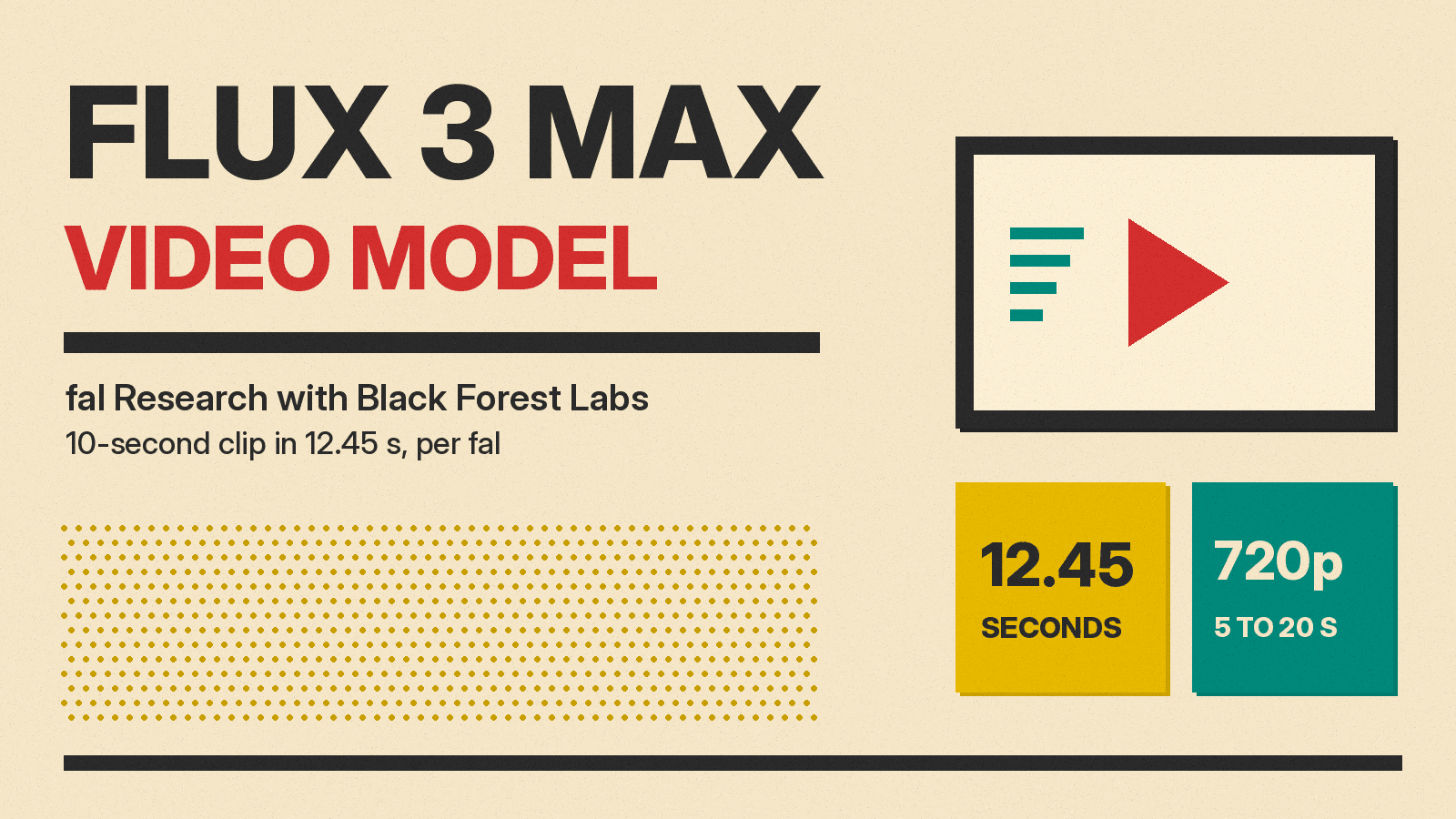
fal has released FLUX 3 Max, a video model it built with Black Forest Labs on top of FLUX 3. The pitch is speed: fal says a 10-second clip comes back in 12.45 seconds, against 277.80 seconds for Seedance 2.5, while scoring about the same in a blind preference arena. VentureBeat reported the launch on October 19, 2026.
The speed numbers are fal's own, and the quality lead is narrower than the headline. Here is what the model is, what the figures mean, and what it costs.
What FLUX 3 Max is
FLUX 3 is Black Forest Labs' own video model. FLUX 3 Max is a post-trained version of it from fal Research, the team at fal that also built H3 Max on MiniMax H3. According to fal's product page, fal worked on three layers:
- Post-training: more training on FLUX 3, aimed at visual fidelity, motion coherence, prompt adherence and image-to-video quality.
- Inference optimization: changes to how the model runs, which fal says cut a 10-second video from 126.44 seconds on FLUX 3 to 12.45 seconds.
- Systems engineering: tuning the serving path on fal's own inference engine.
fal says it is still post-training the model. fal's commercial-use permission covers what you generate through its API. VentureBeat notes that the launch materials do not establish rights to download, modify or run the model yourself. For Black Forest Labs' image models, including open-weight options, see our FLUX 3 Image explainer.
What you can do with it
fal lists two endpoints at launch: text to video and image to video. Both use the same post-trained model and cost the same. Per VentureBeat's reading of the API documentation:
- Output runs from five to 20 seconds.
- Videos generate at 720p, with optional upscaling to 1080p.
- Audio can be switched on or off.
- Landscape, portrait and square formats are supported.
- Image to video takes a starting image and can accept an ending image.
- A separate keyframes endpoint accepts up to 10 images placed along the clip.
- Text to video has low and high reasoning settings, and the higher one takes longer.
fal says content made through its API can be used in commercial projects, subject to its terms.
How fast is it, really
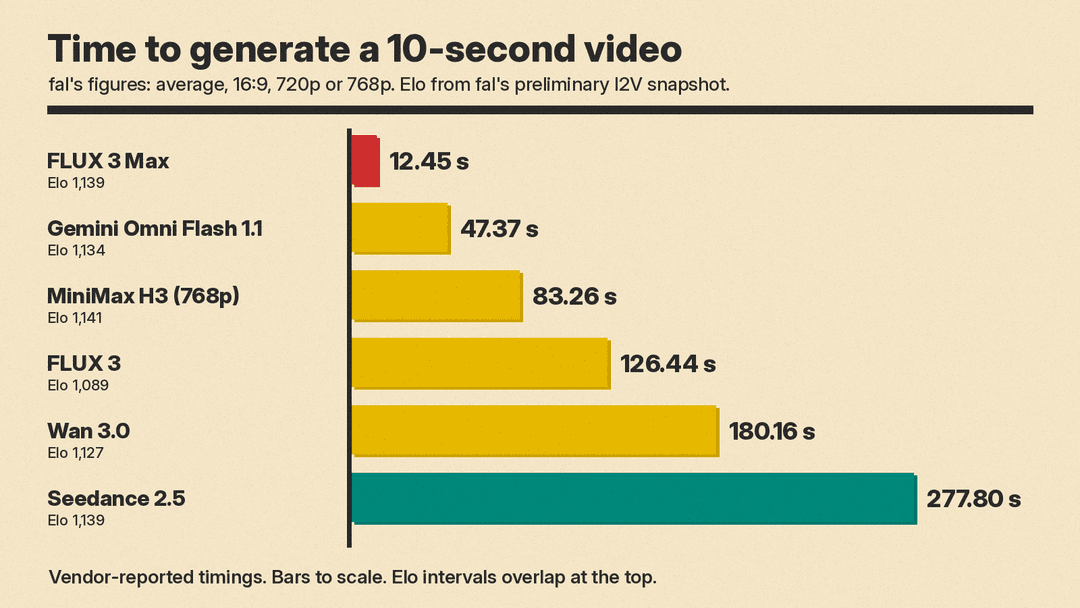
fal's comparison table measures an average for a 10-second, 16:9 video at 720p or 768p. On that table, FLUX 3 Max is about 22 times faster than Seedance 2.5 and about 10 times faster than the base FLUX 3. The only faster model fal lists is its own H3 Max, at 7.55 seconds.
Two caveats matter if you plan to build on it. First, these are vendor-reported timings, and VentureBeat notes the documentation warns that settings and operating conditions change completion time. Second, 12.45 seconds is a benchmark average, not a promise for every request. Test it on your own prompts and settings before you design a product around it.
For creators, the practical change is how many takes you can try. fal frames it as running twenty takes of a shot in the time Seedance 2.5 returns one. If that holds in your workflow, the draft model and the final model can be the same.
The quality claim, with its qualifier
fal says FLUX 3 Max is "tied for #1" in image-to-video quality. That comes from a preliminary snapshot of the Artificial Analysis image-to-video arena, where fal lists it at 1,139 Elo, level with Seedance 2.5 and just behind MiniMax H3 at 1,141.
The live board VentureBeat checked on October 19 showed slightly different numbers: MiniMax H3 at 1,140, and FLUX 3 Max and Seedance 2.5 both at 1,138. The confidence intervals overlap, and Artificial Analysis gives FLUX 3 Max a possible rank range of first through fifth. The fair reading is that it competes with the leaders, not that it beats them.
That arena also measures video made from a starting image, with audio. It does not show the same lead for text-only prompts. For how Seedance 2.5 compares with the other big model of the month, see Kling 4.0 vs Seedance 2.5.
What it costs
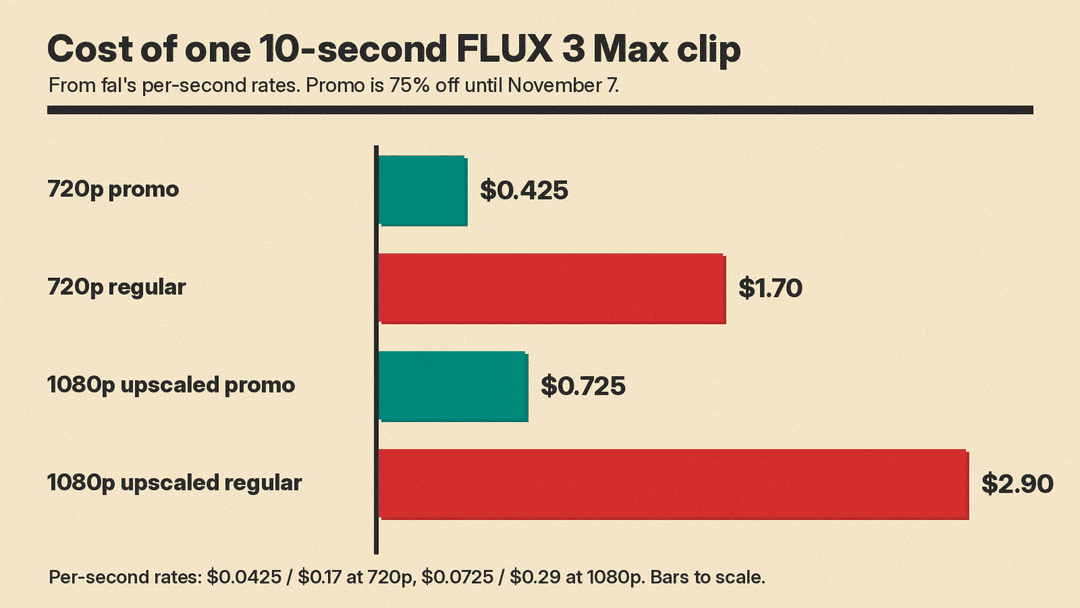
Billing is per second of output, with no minimum and no subscription. As of October 2026:
- 720p: $0.0425 per second during a 75% promotion that ends November 7, then $0.17 per second.
- 1080p, upscaled: $0.0725 per second during the promotion, then $0.29 per second, per VentureBeat.
So a 10-second 720p clip costs about $0.43 now and $1.70 after the promotion. VentureBeat's own example: 10 versions of a 10-second shot cost $4.25 at the promo rate and $17 at the regular rate. To see where that sits against Kling, Veo, Runway and others, check our AI video generator pricing comparison.
Why it matters
In fal's own table, four of the six models take more than a minute per 10-second clip. fal's pitch is that with FLUX 3 Max, "You no longer need a fast model for drafts and a slow one for finals: the take you iterate on is the take you ship." VentureBeat sees a business angle too: "A company serving models through an API can potentially differentiate its offering through further training and execution improvements, in addition to providing access."
The open questions are the ones fal's own numbers cannot answer. How fast is it on a busy afternoon, with high reasoning and audio on? How often does a take come back usable? And what happens to the cost math after November 7? Those are worth testing before you switch a pipeline. For the wider field, our best AI video generators guide covers the other options.
