
This is an opinion piece. The facts are linked to their sources; the conclusions are ours.
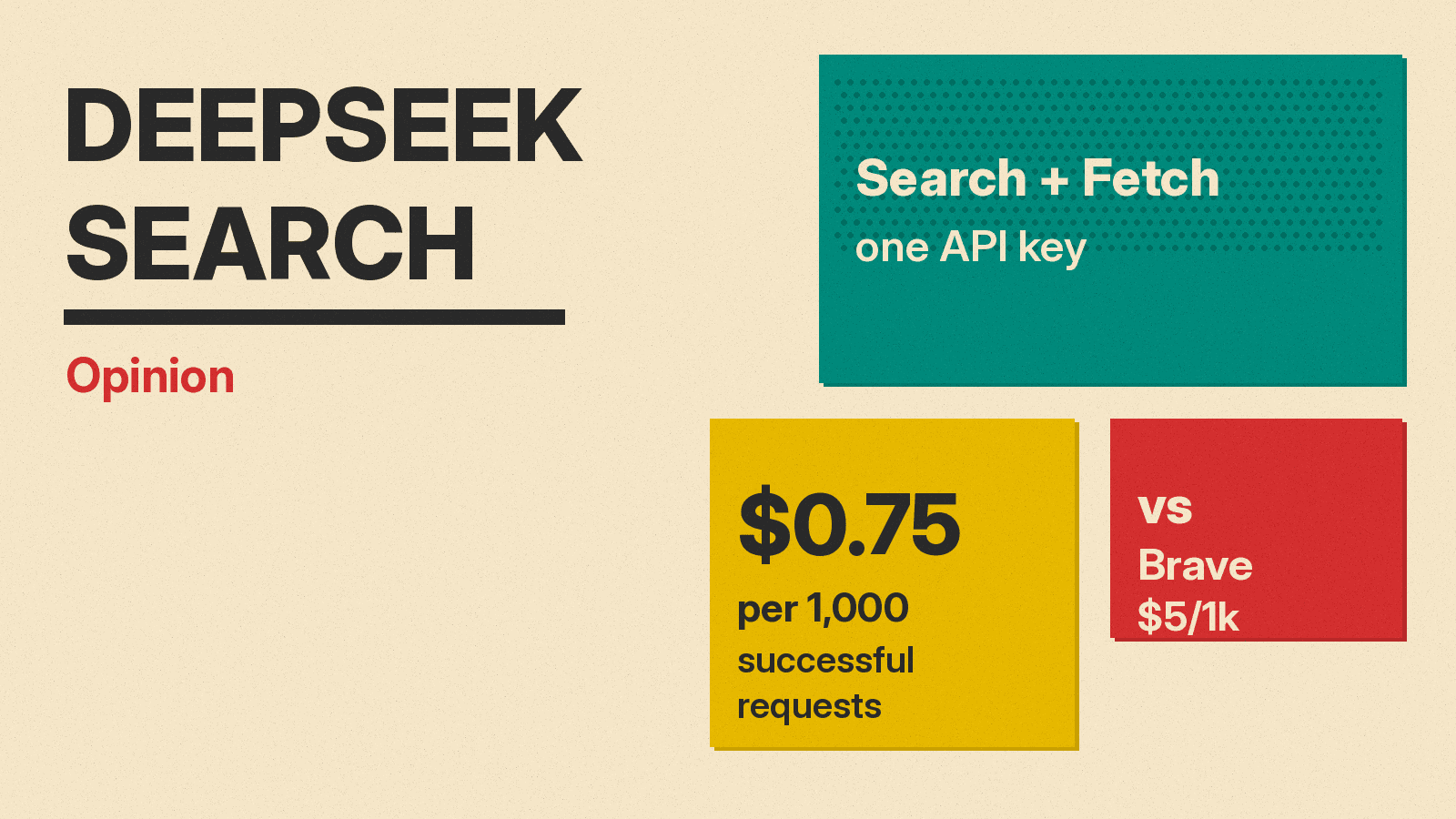
DeepSeek just shipped Search and Fetch as standalone JSON APIs on the same key developers already use for its models. According to its own docs, Search returns structured web results from DeepSeek's in-house engine, and Fetch turns a single page into Markdown. Each API is billed at $0.75 per 1,000 successful requests. Failed calls, empty results, and timeouts are free. When developers use the DeepSeek API through DeepSeek Harness, Claude Code, or Codex, the server-side Search and Fetch calls are free until 00:00 Beijing time on November 1, 2026.
That is not a small model release. It is a product move. After Vercel's October index showed open-weight models taking most token volume, and after we argued that model loyalty is over, the next layer of the agent stack is going the same way. Search is becoming a commodity. The winners will own the stack around it. The losers will sell search alone at yesterday's prices.
The price signal is the product
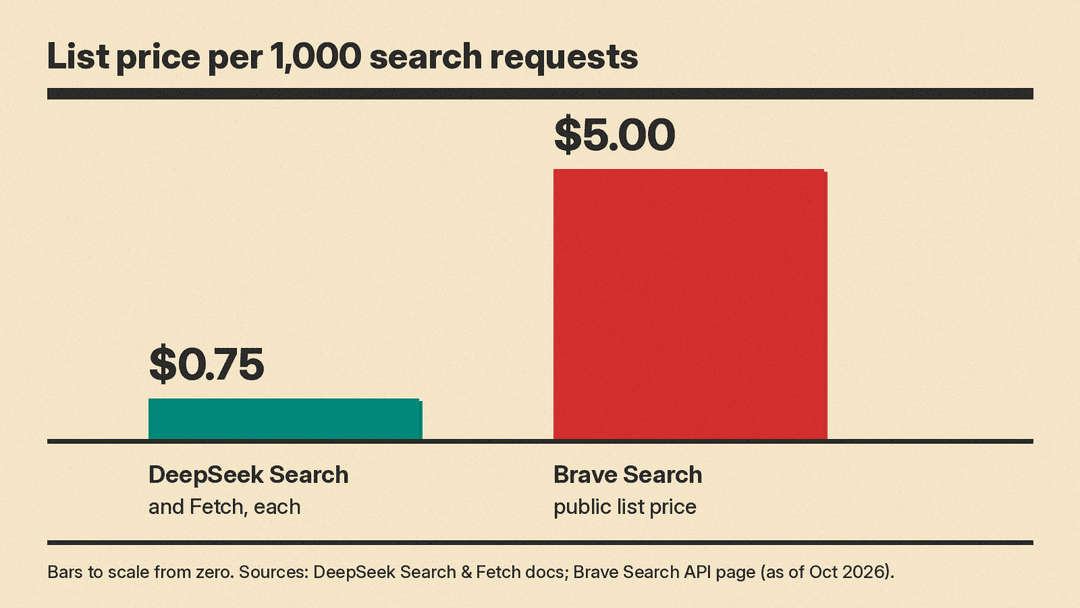
Brave's public Search plan lists $5 per 1,000 requests for web and LLM-context search. DeepSeek's Search endpoint lists $0.75 per 1,000 successful requests. That is less than one sixth of Brave's list price for a call that looks, on paper, like the same job: give an agent live web results.
The comparison is not perfect. Brave sells richer packaging (images, news, videos, LLM Context) and publishes accuracy claims on FreshQA. DeepSeek's docs describe structured results with titles, URLs, snippets, model-facing summaries, optional page content, rerank scores, and authority tiers. They do not publish a head-to-head quality score against Brave, Exa, or Tavily. Price is not proof of better retrieval.
It is still a hard signal. Agent loops burn search calls. A coding agent that searches five times and fetches three pages on every task will notice a more than 6x list-price gap before it notices a one-point quality gap. DeepSeek also bills only successes. Empty results cost nothing. That design matches how agents actually fail: they miss, retry, and empty out.
TechNode's report matches the English docs on the free window for Harness, Claude Code, and Codex, and on charging for those server-side calls from November 1. The English billing table is the source we use for the dollar price.
One key, three layers
The deeper play is bundling. Search and Fetch use the same bearer token as the chat API. The same account that already runs DeepSeek V4.1-Flash can now search and fetch without opening a second vendor relationship. Rate limits are separate from model concurrency: 100 QPS for Search and 25 QPS for Fetch at the account level, per the docs.
That matters for agents more than for chat widgets. An agent needs a model, a tool channel, and a way to read the open web. Labs that only sell the model leave the other two to someone else. Labs that sell all three under one invoice raise switching costs without asking for loyalty to a single checkpoint. You can swap the model and keep the search pipe. You can keep the model and swap search later. Either way, DeepSeek is already on the receipt.
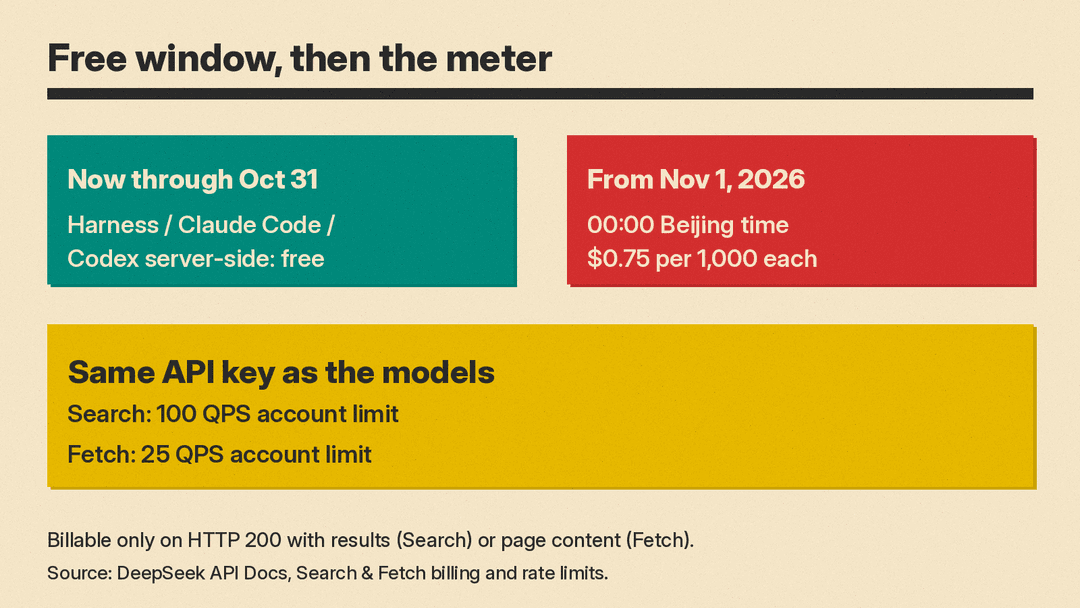
The free period for DeepSeek API calls through Claude Code and Codex is the distribution move. When those tools run on the DeepSeek API, their server-side tool calls already hit Search and Fetch. Until November 1, builders get the habit for free. After that, the meter turns on. That is classic platform seeding: put the commodity under the tools people already open every day, then charge when the path is sticky.
Who wins, who pays
Winners:
- Model labs that ship tool APIs. Search, fetch, and eventually browser or code tools become table stakes next to token price. A cheap model with expensive third-party search is not cheap end to end.
- Teams that meter the whole agent loop. If you already track model cost per task, add search and fetch. The $0.75 per 1,000 figure only helps if you know how many calls a task makes.
- Gateways and harnesses that can route search the way they route models. Once search is a plug-in endpoint, the same switching story we saw for models applies to retrieval.
Losers, or at least parties under pressure:
- Pure search APIs priced for 2024 agent volumes. A $5 per 1,000 list price can still win on quality, compliance, or feature depth. It cannot win on "good enough and already on my DeepSeek key" without a clear quality gap.
- Builders who treat search as free infrastructure. The November 1 billing start for DeepSeek API calls through Claude Code and Codex will surprise teams that never saw a search line item.
- Labs that still ship models only. OpenAI's Agents API and Anthropic's agent tooling show the same direction. Tooling is part of the product. Search is the obvious next tool.
What this does not prove
DeepSeek has not shown that its in-house index matches Brave or Google on freshness, coverage, or citation quality, and the first small tests posted by developers put it behind Exa and Parallel. Fetch is still subject to site policy: per the docs, it returns a 404 when site policy blocks a URL and a 403 when DeepSeek's own security policy rejects the request. QPS caps (100 Search, 25 Fetch) are fine for many agents and tight for heavy fleets. And a free window is not a permanent price.
The underrated part is not the headline rate. It is the shape of the offer: model plus search plus fetch, one key, success-based billing, and a free on-ramp inside the coding agents that already define how developers try new stacks. That is how commodities form. First the model became a part. Now search is becoming a part. The valuable layer is whoever owns the assembly.
Sources
- DeepSeek API Docs: Search & Fetch
- TechNode: DeepSeek launches web search and page-fetching APIs for AI agents
- Brave Search API pricing
- Vercel AI Gateway Production Index, October 2026
- llms.blog: Opinion: Model Loyalty Is Over, and the Winners Own the Switch
- llms.blog: DeepSeek V4.1-Flash-1017 Tops Opus 5 on DeepSWE
- llms.blog: OpenAI Agents API Explained
