
Recursive, the startup building what it calls an automated AI research system, released Flint on October 21: an open-weight coding model meant to run on your own laptop. The weights are on Hugging Face under the Apache 2.0 license, and Recursive invites developers to run it locally and adapt it for their own applications.
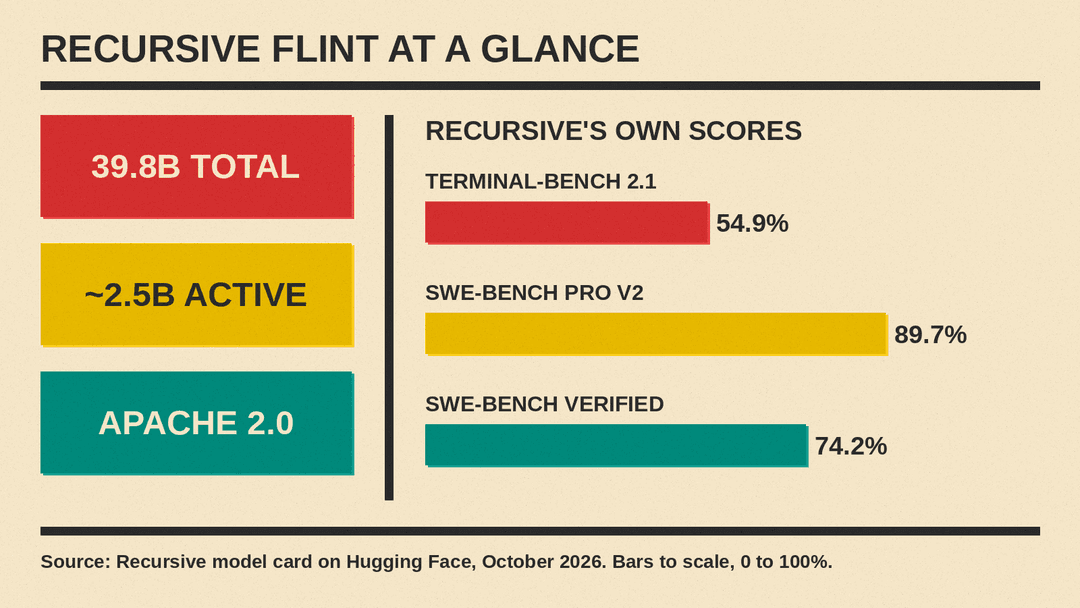
Two things make the release worth a close look. First, the size. Flint is a mixture-of-experts (MoE) model with 39.8 billion total parameters, but only about 2.5 billion are active for each token, which is why it can generate text quickly on consumer hardware. Second, the build process. Recursive says its "Eureka Machine," a system that proposes, implements and tests research ideas, helped develop nearly every part of the model-building stack, and that a small team of people and agents built Flint from scratch in under four months.
What Flint is for
Recursive pitches Flint as a daily coding model for work you want to keep local: no data sent to a remote server, no API fees, and it works offline. The model card says it is designed to investigate codebases, fix bugs, implement features, and write tests. It takes text in and gives text out, supports reasoning, and handles multi-turn tool use with OpenAI-compatible tool calls.
Recursive is also direct about the limits. Its launch post says Flint "may need more guidance than the larger closed-source coding models you're used to," and recommends breaking complex work into smaller subtasks with explicit instructions.
The numbers, and how they were measured
All scores below are Recursive's own release evaluations, not independent tests:
- Terminal-Bench 2.1: 54.9%
- SWE-bench Pro v2: 89.7%
- SWE-bench Verified: 74.2%
Recursive claims Flint leads MoE models with fewer than 50 billion total parameters on agentic coding benchmarks, and rivals dense models with 25 to 40 billion parameters while running more than five times faster.
The method notes matter here. Agentic scores are an average pass@1 over at least five attempts, with agent timeouts of up to five hours. Terminal-Bench ran with the Terminus 2 harness and internet access, and Recursive counted any solution obtained through web retrieval as a failure. The SWE-bench runs used mini-swe-agent with no internet access. The model card adds that comparison scores from other labs are developer-reported and that "evaluation setups vary across sources," so the head-to-head charts are not perfectly like-for-like.
Speed on local hardware
Recursive reports that, with its own optimized inference engine, Flint generates more than 125 tokens per second on an M4 Pro MacBook Pro and more than 150 tokens per second on a 64GB NVIDIA RTX Spark at short contexts. It says that is up to twice as fast as comparable models. Those are vendor figures, measured at short context lengths. For what RTX Spark machines are and what they cost, see our NVIDIA RTX Spark explainer.
On context length, the two official sources differ slightly. The launch post says Flint supports up to 512k tokens and recommends staying within 256k for the best results. The model card documents a 262,144-token configuration, shared between prompt and output.
What it takes to run
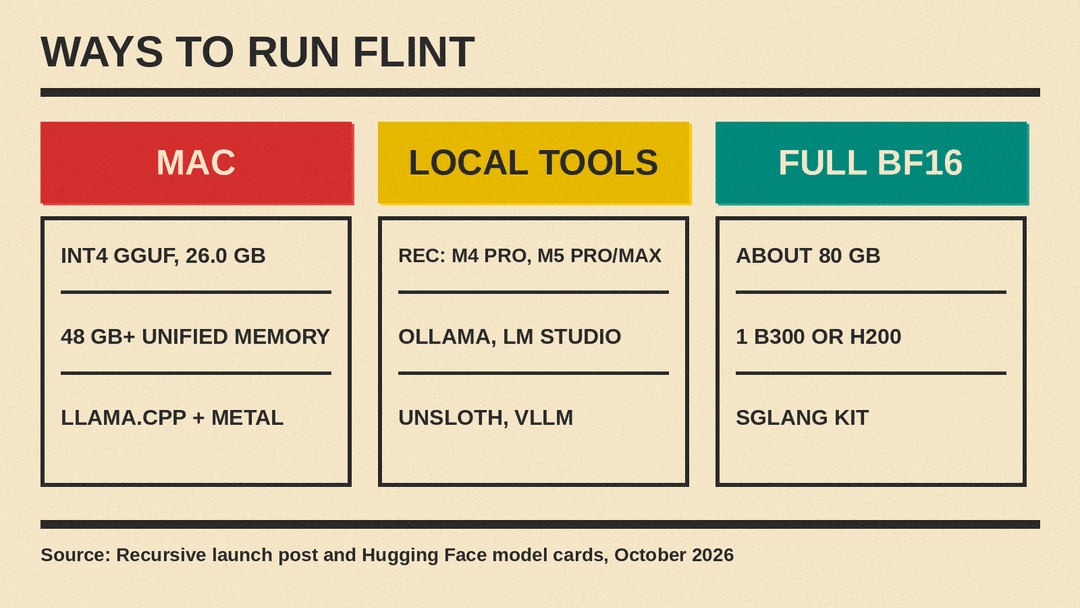
There are a few paths, depending on your hardware:
- Mac: The INT4 GGUF build is a single 26.0 GB file for llama.cpp with Metal. It needs an Apple Silicon Mac with at least 48 GB of unified memory.
- Recursive's engine: Recursive released rec, a lightweight inference engine tuned for Flint on M4 Pro and M5 Pro/Max chips.
- Common local tools: Recursive says Flint works with llama.cpp, Ollama, Unsloth, LM Studio, vLLM, and SGLang.
- Full precision: The BF16 checkpoint is about 80 GB and runs on one B300 or H200 GPU per replica with the SGLang serving kit in the repo. SGLang's docs also list B200, GB300, and DGX Spark.
One gap for developers: the model card says Transformers modeling code is not included yet. Recommended settings are temperature 1.0, top-p 0.95, and top-k 20, with an output budget of at least 32,768 tokens for hard problems, since reasoning counts against it.
Under the hood
The model card lists 49 layers (2 dense, then 47 MoE), 256 routed experts per MoE layer with 6 selected per token plus one always-on shared expert, and a mix of 35 sliding-window attention layers (a 513-token window) and 14 full-attention layers. The stated knowledge cutoff is June 2026.
Recursive's post gives three examples of what the Eureka Machine did:
- Architecture: Starting from a 35B-total, 3B-active baseline, it searched expert configurations and widths and landed on 40B total with 2.5B active, which was projected to give the best mix of speed and coding performance among the options it tested.
- Quantization: Against common practice, it quantized the output layer to 4 bits, because in a model with so few active parameters that layer is a large share of the weights read per token. It recovered accuracy with an offline distillation stage that used the 16-bit model as teacher. Recursive says the final NVFP4 model scores within 0.7 points of the 16-bit model across its benchmarks.
- Kernels: It wrote specialized kernels for Apple Silicon and RTX Spark, including a Metal "megakernel" that fuses the whole decode forward pass on M4 and M5 chips.
Why it matters
Flint's design trades memory for speed: all 40B parameters must fit in memory, but only about 2.5B do work for each token. The INT4 build, for example, needs a Mac with at least 48 GB of unified memory. With an Apache 2.0 license and support in tools such as Ollama and LM Studio, it is easy for developers to try it against the local models they already use. If you are new to this, our guide to running an AI model on your own laptop covers Ollama, LM Studio and llama.cpp, and our Nemotron 3.5 Bolt explainer covers another local agent model.
The bigger claim is about process. Recursive's stated goal is "recursively self-improving superintelligence," and it calls building Flint "a practical test" of its Eureka Machine. Press coverage, including TechCrunch and WIRED, has focused on that angle. The account of how much the Eureka Machine contributed, compared with the human team, comes from Recursive. Independent benchmark runs and real-world use over the next few weeks will show whether the scores hold up.
As with any coding agent, the model card's safety note applies: test generated code, review consequential changes, and enforce your own permissions on tool use, since structured tool calls do not stop the model from choosing a wrong action.
