
Fish Audio's Drama 3 is a text-to-speech model built for performances, not just clear reading. You write stage directions in square brackets, the way you would talk to an actor, and the model plays the line that way. It launched on October 13, 2026 on fish.audio, in the Fish Audio iOS and Android app and through the API, and the weights are on Hugging Face under a new community license.
That mix matters for creators. Drama 3 is a large, open-weight model that small studios can run on their own GPUs for commercial work, with one clear revenue cap. Here is what it does, how well it reads hard words, what it needs to run, and where the license draws its lines.
What Drama 3 does
Direction goes inside the script. Fish Audio's launch post shows lines such as [barely holding it together, forcing a smile] I'm fine. [shaky breath] Really. New direction partway through a line changes the read from that point, and sounds such as a breath or a laugh land where you place them. A paired tag wraps only the words between its opening and closing tags, so you can stress a phrase without changing the rest of the line.
Fish Audio says Drama 3 speaks 83 languages, and the direction does not have to be in the same language as the line. The launch post shows the same English line directed in Chinese, Spanish and Japanese.
The model card adds the features that matter for longer projects:
- Multi-speaker scripts, with speaker tags from
<|speaker:0|>to<|speaker:15|>, so one text can carry up to 16 characters. - Voice cloning from reference audio.
- Long text that is split into chunks automatically and can be streamed chunk by chunk.
Fish Audio pitches it for lines you render once and keep: audiobooks and narration, audio drama and fiction podcasts, game and animation dialogue, and short video. If you are comparing it with hosted options, our guide to the best AI voice generators covers the main paid services.
How well it reads hard words
Expressive reads are only useful if the words survive. Fish Audio cites Artificial Analysis' Pronunciation Robustness benchmark, where human listeners check hard words in English sentences: numbers, codes, brand names and words whose reading depends on context. Fish Audio reports that Drama 3 read 93.2% of them correctly, the top score on that leaderboard, against 88.1% for its earlier S2.1 Pro model.
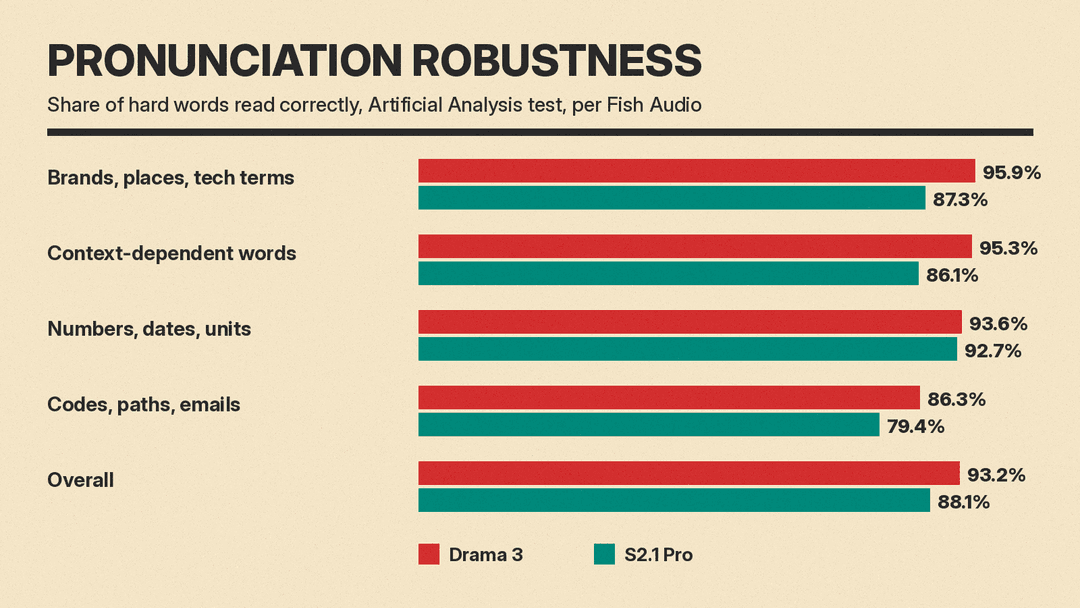
By category, per Fish Audio:
- Names of brands, places and technical terms: 95.9% for Drama 3, 87.3% for S2.1 Pro.
- Words whose reading depends on context: 95.3% versus 86.1%.
- Numbers, dates, units and notation: 93.6% versus 92.7%.
- Codes, paths and emails: 86.3% versus 79.4%.
The weakest area is still exact sequences such as file paths and email addresses. For scripts full of order numbers or URLs, test a few takes before you commit. Fish Audio itself says takes vary and suggests rendering a few and keeping the best one.
How it was trained to take direction
Fish Audio also explains how it got the model to follow direction. It says speech models, its own S2 included, are usually tuned with rewards for being easy to transcribe and for sounding like the reference clip, and those scores mark down a laugh or a whisper. Drama 3 was tuned instead with one learned reward model of which take people preferred. That model also hears the script and the voice, so accuracy and likeness still count.
The technical details from the launch post:
- A 35B-parameter mixture-of-experts backbone with about 3B parameters active per token (8 of 256 routed experts plus one shared), initialized from the language model of Qwen3.5-35B-A3B.
- 40 layers in blocks of three Gated DeltaNet layers and one gated full-attention layer, so only one layer in four keeps a KV cache.
- A new codebook-MTP audio decoder that replaces S2's per-frame decoder and attends over the whole sequence, including the reference audio.
- Reinforcement learning with GRPO and no KL penalty, using 1,536 prompts with 8 takes each per step, and no rule-based rewards.
What you need to run it
This is not a laptop model. Fish Audio's install guide says Drama 3 needs an NVIDIA GPU with at least 48 GB of memory (FP8), on Linux or WSL. CPU, Apple MPS and AMD ROCm are not supported. The older S2-Pro needs at least 24 GB and can also run on CPU.
Serving support was there at launch. The model card gives commands for SGLang-Omni and vLLM-Omni. On one NVIDIA H200, Fish Audio reports a single stream gets its first audio in 88.9 ms at the median, with a real-time factor of 0.131. At 16 concurrent streams it still generates audio about 2.7 times faster than playback, and at 64 streams the mean real-time factor is 0.80. The launch post adds that the engine decodes a single stream at 271 frames per second on one H200, against 177 for S2.
If you want something lighter to self-host, our earlier comparison of open-source TTS serving options covers smaller models, and Hurston-1 is another recent open TTS release.
The license, in plain terms
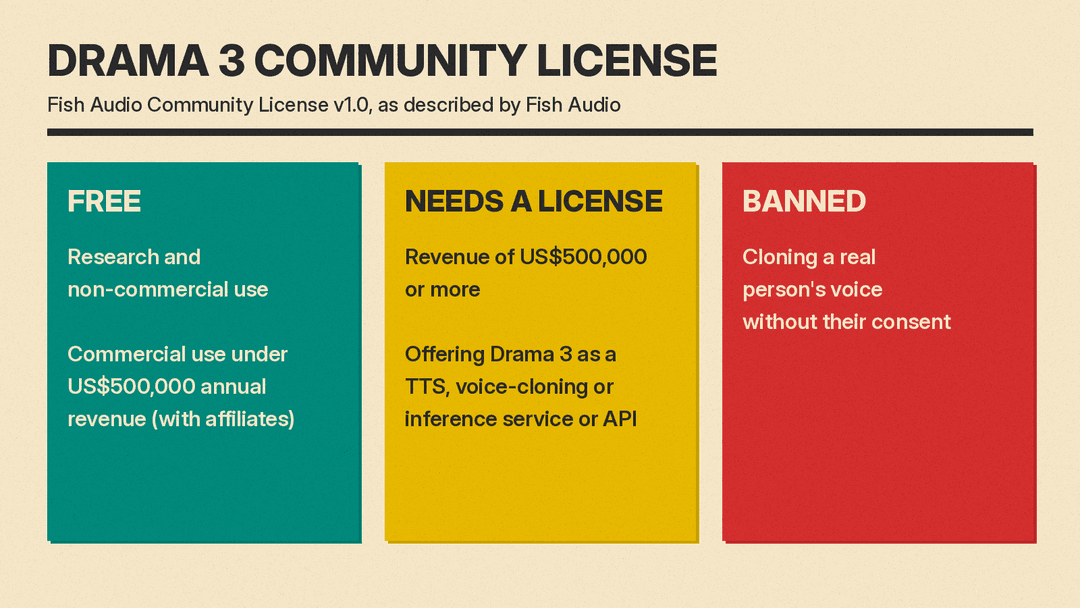
Fish Audio calls Drama 3 open-weight rather than open source. It ships under the new Fish Audio Community License v1.0, which Fish Audio describes this way:
- Free for research and non-commercial use.
- Free for commercial use if you and your affiliates have less than US$500,000 in annual revenue.
- Above that, or to offer Drama 3 to others as a TTS, voice-cloning or inference service or API, you need a license from Fish Audio.
- Making finished audio for clients is allowed, and so are free non-commercial research demos.
- Cloning a real person's voice without their consent is banned.
- Drama 3 and its output may not be used to train or improve other speech or foundation models, and products that use it must show "Built with Fish Audio". These two terms come from the license file on Hugging Face, not the launch post.
The older S2 models stay under the Fish Audio Research License. For a freelancer or a studio under the revenue cap, the result is clear: you can self-host Drama 3 and sell the audio. A voice platform that wants to resell it as an API cannot, without a deal.
Price on the hosted API
If you use the API instead of your own GPUs, set the model header to drama-3 on the same endpoint S2.1 Pro uses. Fish Audio lists the Drama 3 API at $50 per million characters. From October 13 to November 12, 2026, it is $10 per million characters, 80% off, and new Plus, Pro and Max creator plans are 50% off for the first month (monthly) or first year (annual). For comparison, AssemblyAI-TTS-1, which we covered on October 28, costs $15 per million characters, but it targets live voice agents rather than scripted performances.
What is not ready yet
Two editing tools are in small, invite-only testing: interactive editing, where you ask for a new take relative to the last one ("softer than that one"), and audio inpainting, which regenerates a single changed word inside a take you already approved. Fish Audio says an editing API is coming soon. The model card already shows a previous_takes field for editing as continuation in self-hosted serving.
Why it matters
Drama 3 puts a directed-performance model with published architecture, serving numbers and a readable license into the open-weight pool. The catch is hardware: it needs an NVIDIA GPU with at least 48 GB of memory, so for anyone without that class of card, the hosted app or API is the practical way in.
