
Underdog, a startup building a private assistant that runs on your own computer, has released Woof, an English text-to-speech model that ships as a 31.7 MB or 40.6 MB file. It runs on a laptop CPU with no GPU, no server and no API key, and once it has loaded, the smaller version runs in a browser tab with Wi-Fi turned off. By Underdog's own tests, the two-voice model gets fewer words wrong on hard sentences than much larger models, including Fish Audio Drama 3. The weights are open, but they are not free for commercial use. The Woof page is dated 26 October 2026, the Hugging Face repo went up on 5 November, and coverage of the release picked up on 9 November 2026.
What is Underdog Woof?
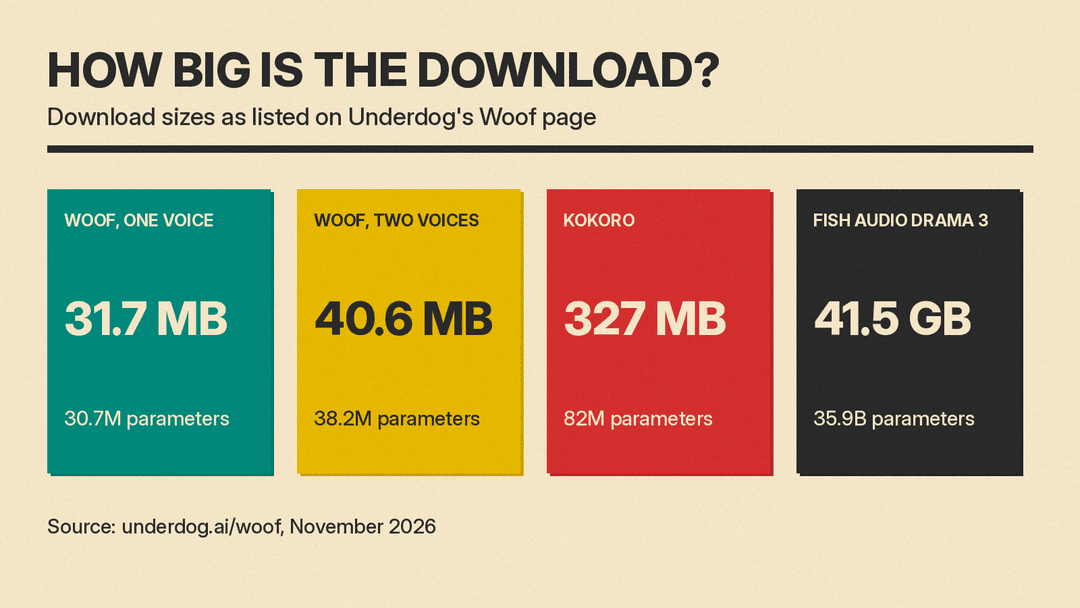
Woof is a pair of text-to-speech models. One has a single voice and a 31.7 MB download. The other has two voices and a 40.6 MB download. The Hugging Face repo holds the two-voice model, with voices named Juno (the default) and Mira. The model card calls Woof a small English text-to-speech model that makes 24 kHz mono audio, and describes the two-voice version as running on a laptop CPU with nothing but numpy, from a single 40.6 MB file, "with no GPU, server or API key."
The parameter counts are small. The one-voice model has 30.7M parameters. For the two-voice model, Underdog lists 22.95M for the speech model and 15.3M for the audio decoder, 38.24M in total. The audio decoder is adapted from Kyutai's Mimi codec. Training data includes LibriTTS-R and Emilia-YODAS, both CC-BY 4.0.
The product page leans on privacy. The one-voice model runs in your browser and keeps working with Wi-Fi off once it has loaded, and the page states "What you type stays here." There is also a browser game called Underdog Escape, a room with a typewriter, a radio and a desk lamp. Whatever you type, Woof reads out loud. Every voice in the room is Woof made live on your computer, with nothing pre-recorded.
How small is Woof?
Underdog says it is small enough to ship inside an app and speak on the device. It compares the one-voice model against Fish Audio Drama 3, a 41.5 GB download with 35.9 billion parameters, and says one-voice Woof is 1,308x smaller and the two-voice model is 1,022x smaller. The page also lists Kokoro at 82M parameters and a 327 MB download.
Woof is not the smallest download in Underdog's own comparison. In its accuracy table, Kitten Nano 0.8 has a 27.6 MB download, the only smaller file in that list, and Underdog scored it at 9.81%.
How accurate is Woof?
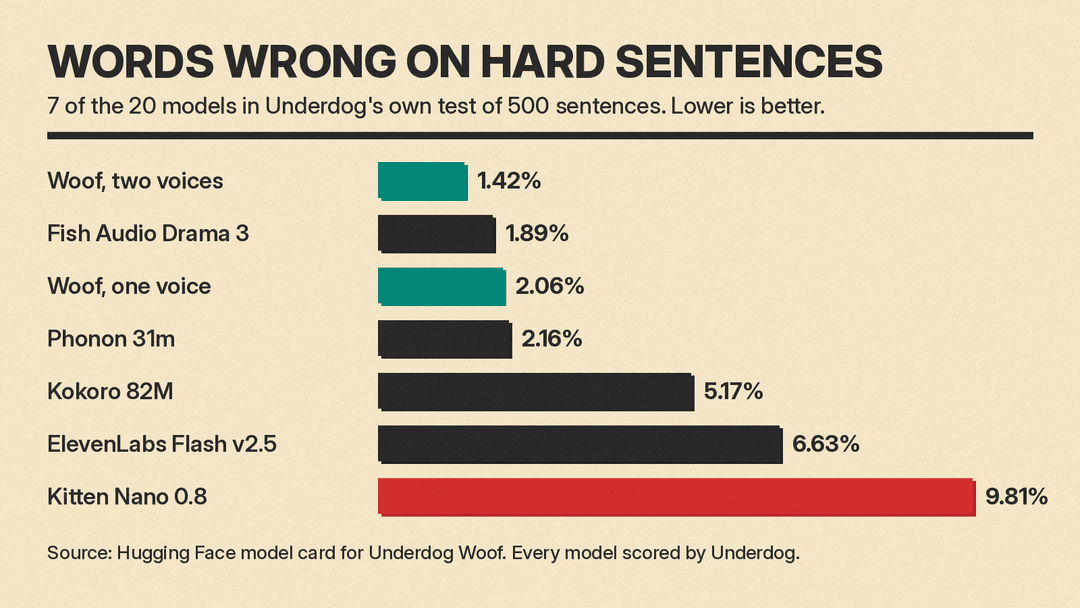
Underdog reports word error rate on a test it calls Gradium TTS Hard Cases: 500 English sentences packed with numbers, dates, prices, codes and URLs. Lower is better. These are the company's own numbers, and every model in the list was run and scored by Underdog.
Underdog's table lists 20 models. Among them, the two-voice Woof scored 1.42% using the Mira voice, Fish Audio Drama 3 scored 1.89%, the one-voice Woof scored 2.06%, Phonon 31m scored 2.16%, Kokoro 82M scored 5.17%, ElevenLabs Flash v2.5 scored 6.63% and Kitten Nano 0.8 scored 9.81%. Underdog says the two-voice model gets 25% fewer words wrong than Drama 3.
The scoring method is automated. qwen3.8-omni-flash transcribes each clip and gemma-4-31b-it counts the errors. A third-party report from Digital Market Reports on 9 November notes that the company has not provided comprehensive independent benchmarks. Treat the ranking as Underdog's measurement of Underdog's model.
How does Woof handle codes and dates?
Woof runs a built-in text normalizer before it speaks. It rewrites numbers, dates, times, money, codes and symbols the way people say them. Three of the six examples on the product page: "XK-4471" read as "X K four four seven one," "2.5 mg" as "two point five milligrams," and "14/03" as "the fourteenth of March."
The page says small voice models trip on these and "read a phone number as one enormous figure, or lose half of a code," and it frames Woof for voice assistants and phone agents, which spend much of their time reading text that is not plain prose.
How fast is Woof?
The model card says the two-voice model runs 13.8x faster than real time on one CPU thread of an Apple M5 Max with the Juno voice, and 7.2x with Mira. Peak memory is 402 MB for Juno and 601 MB for Mira. The product page reports the one-voice model making 13.2 seconds of speech in 0.73 seconds on one M5 Max CPU thread, with 852 MB peak memory for the process.
How do you run Woof?
Install numpy, pull the files from Hugging Face, then run the module. Add --voice mira for the second voice, and pass a seed if you want the same audio every time.
pip install numpy
hf download ConwayResearch/Underdog-Woof --local-dir underdog-woof
cd underdog-woof
python -m underdog_woof "Your text" -o hello.wav
python -m underdog_woof "Your text" -o hello.wav --voice mira
Can you use Woof commercially?
Not without a separate license. The model card and the LICENSE file in the repo both name the "Underdog Non-Commercial License 1.0." Its publisher is Conway, which the license calls "Underdog", and it covers the weights, code, voices and documentation. It is free for personal projects, research, teaching and non-profits, including publishing what Woof makes. You must credit Underdog: "Underdog Woof" or "underdog.ai" in the title or description of anything published with its audio, and "Voice by Underdog Woof" with a link to underdog.ai in any app. Commercial use, meaning a paid product, an ad, a monetized video or a company's work, needs a commercial license from Underdog. You also cannot use Woof or its audio to train, fine-tune or distill another speech or audio model. The full terms define commercial use broadly: any use by or for a company, including a business's internal operations, and any use that earns money. Two exceptions: a company may test Woof internally for up to 30 days to decide whether to buy a license, and anyone may use Woof through underdog.ai and Underdog's own apps for free, including for commercial purposes.
One wrinkle: the two Underdog pages name different licenses. The Woof web page says it is "open weights for non-commercial use, under CC BY-NC 4.0. It is not Apache 2.0." The LICENSE file in the repo is the Underdog Non-Commercial License 1.0. Check which one applies before you ship anything.
Who is behind Woof?
Underdog is building a locally hosted AI assistant. Founder Sigil Wen said he started building the technology after wanting a personal note-taking system that runs on his own devices, according to Digital Market Reports. The Underdog homepage describes the product as "Your own AI for email, calendar, meeting notes, dictation and errands. He runs on your computer, so nothing leaves the house." Access is an invite-only beta.
Why it matters
Per the product page, Woof is small enough to ship inside an app with no server in the loop, and what you type stays on your device, which is the privacy argument Underdog makes. That puts Woof in the same category as Klein TTS X1.5 and Linnet, other tiny on-device voices, and in a different category from Fish Audio Drama 3, the big open-weight model Underdog compares itself against. If you are new to how these systems turn text into audio, start with our explainer on how text-to-speech works. The open question is whether Underdog's accuracy claims hold up once someone outside the company runs the same hard sentences.
