
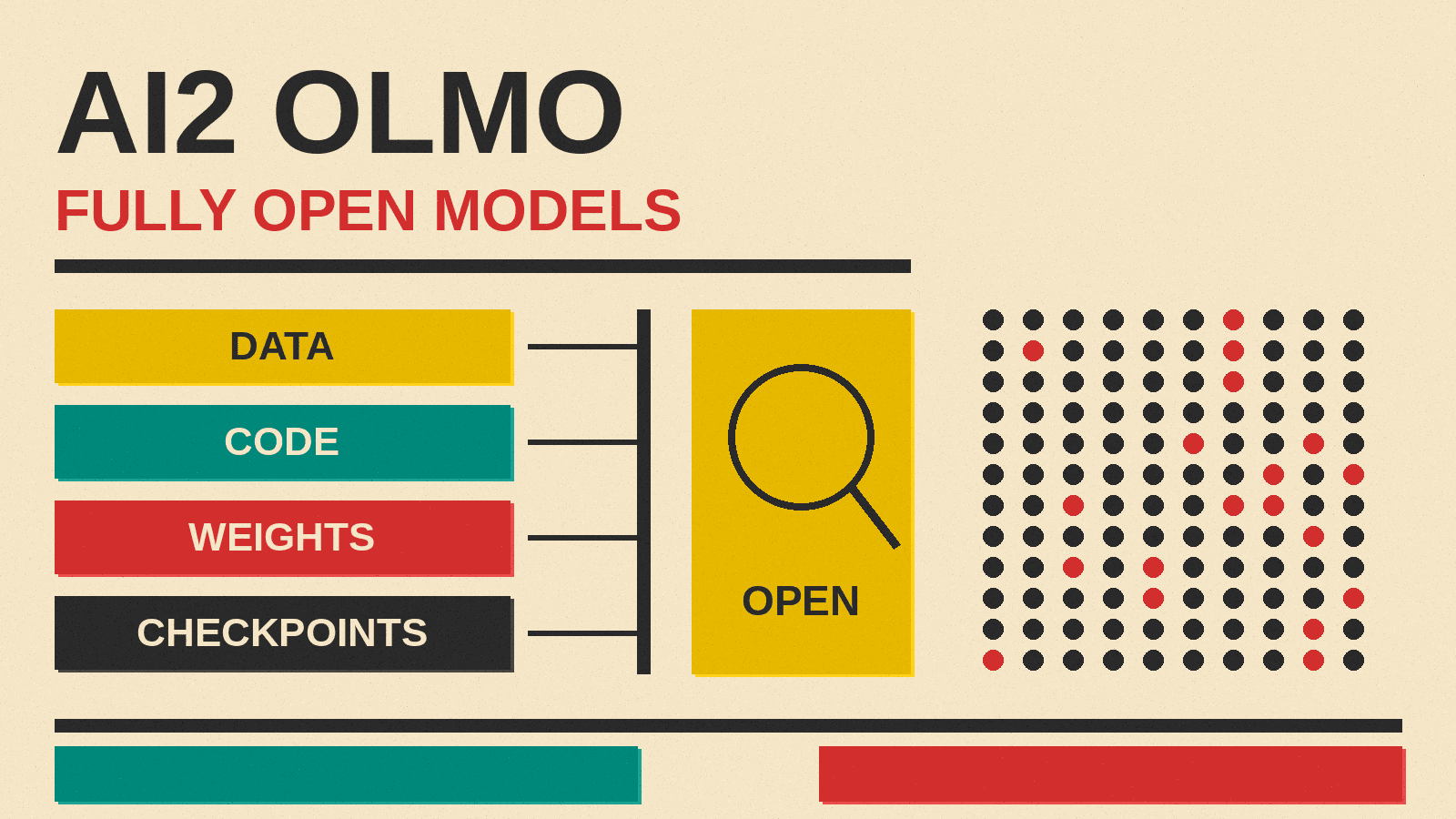
Olmo is a family of language models from the Allen Institute for AI (Ai2) that is built around a simple promise: publish everything. Most models described as "open" release only their weights, the numbers that let the model run. Ai2 says Olmo goes further, sharing the training data, the code, and the checkpoints too. This explainer covers what Olmo is, what "fully open" means in practice, which models exist, the license, and whether you can run one on your own hardware.
What is Olmo?
Olmo is made by Ai2. Its model card describes Olmo as "a series of Open language models designed to enable the science of language models," and says Ai2 is "releasing all code, checkpoints, logs (coming soon), and associated training details."
A few terms, in plain English. A language model is software trained on large amounts of text to predict and generate language. Parameters are the internal numbers the model adjusts during training; "7B" means roughly seven billion of them. Checkpoints are saved snapshots of the model at points during or after training. A model card is the documentation page that ships with a model, and we have a separate guide on how to read an AI model card if you want to know what to check before downloading anything.
The cards for Olmo list the language as English and give a knowledge date cutoff of December 2024, meaning the model was not trained on events after that point.
What does fully open mean?
Ai2 defines fully open models as ones "where training data, code, and weights are all publicly available." In the Olmo 3 announcement, Ai2 names Stanford's Marin and Swiss AI's Apertus as other examples of this approach.
The distinction matters because many models called open are open-weight: the weights are downloadable, but the full training data is not published. If that difference is new to you, our piece on open-weight vs closed AI models walks through what each term covers.
Ai2 calls the full lifecycle of a model the "model flow": "every stage, checkpoint, dataset, and dependency required to create and modify it."
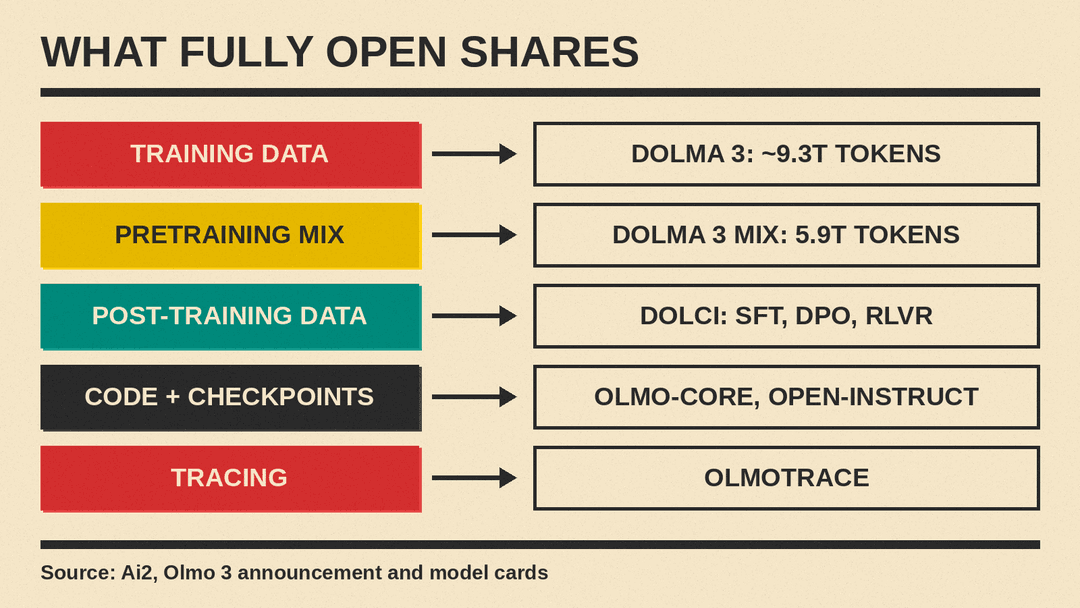
For Olmo 3, that includes the training data. Ai2 says Olmo 3 is pretrained on Dolma 3, "a new ~9.3-trillion-token corpus drawn from web pages, science PDFs processed with olmOCR, codebases, math problems and solutions, and encyclopedic text." A token is a chunk of text, roughly a word or part of one. The actual pretraining mix, called Dolma 3 Mix, is 5.9 trillion tokens. After pretraining, the models go through post-training using Dolci, a data suite with separate mixes for supervised fine-tuning, preference tuning, and reinforcement learning with verifiable rewards. Ai2 says it makes "every training and fine-tuning dataset available for download without any license restrictions." The dataset cards on Hugging Face still list an attribution license (see the license section below).
Ai2 also built OlmoTrace, a tool "for tracing model outputs back to training data in real time." In the Ai2 Playground, you can ask Olmo 3-Think (32B) a question and use OlmoTrace to inspect where the model may have learned parts of its answer.
Which Olmo models exist?
Olmo 3, announced November 20, 2025, is described by Ai2 as "a family of compact, dense models at 7 billion and 32 billion parameters that can run on everything from laptops to research clusters." Dense means every parameter is used on every input, as opposed to architectures that activate only a subset.
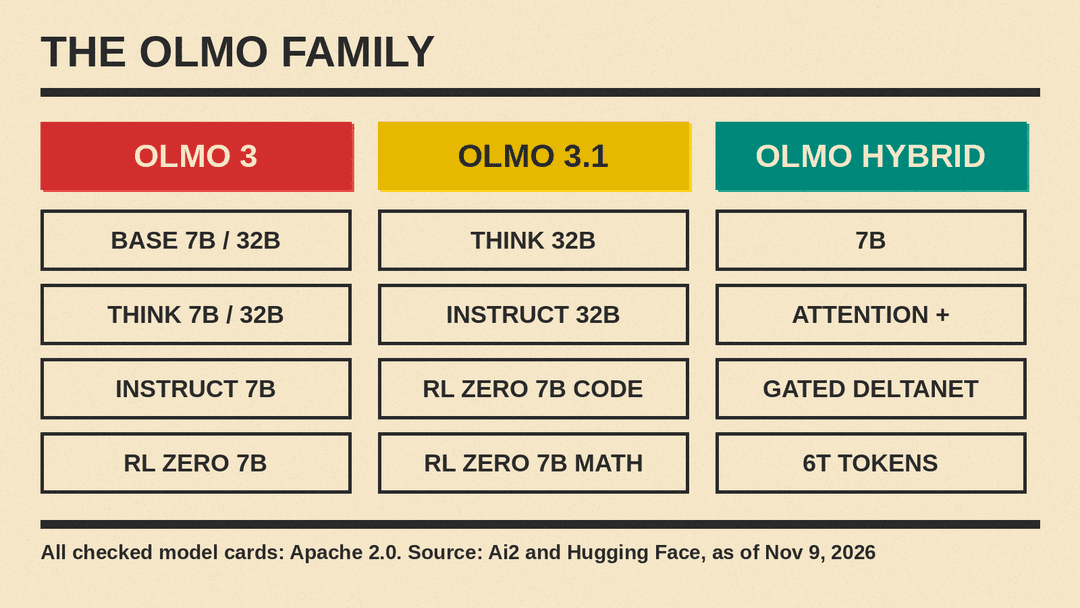
The Olmo 3 family has four variants:
- Olmo 3-Base (7B and 32B): the pretrained models, before chat tuning. Ai2 says Base maintains performance at extended context lengths "(~up to 65K tokens)," meaning roughly that much text can be in the model's working memory at once.
- Olmo 3-Think (7B and 32B): reasoning models that surface intermediate thinking steps for complex prompts.
- Olmo 3-Instruct (7B): tuned for chat, multi-turn conversation, instruction following, and tool use.
- Olmo 3-RL Zero (7B): reinforcement learning checkpoints aimed at researchers working on math, code, instruction following, and general chat.
Ai2 says Olmo 3-Think 32B is "the strongest fully open thinking model we're aware of," and that it narrows the gap to the best open-weight models of similar scale, such as Qwen 3 32B, "while training on roughly 6x fewer tokens." Those are Ai2's own evaluations, not independent benchmarks.
A December 2025 update on the same post introduced Olmo 3.1. Ai2 says Olmo 3.1 Think 32B came from resuming the reinforcement learning run for an extra 21 days on 224 GPUs, and that Olmo 3.1 Instruct 32B is "our most capable fully open chat model to date." Ai2 also refreshed Olmo 3.1 RL Zero 7B in Code and Math versions.
As of November 9, 2026, the newest Olmo language models on Ai2's Hugging Face page are Olmo 3.1 (32B Think and 32B Instruct) and Olmo Hybrid 7B. Ai2 also publishes research spin-offs such as Bolmo, a version of Olmo 3 7B retrofitted to read bytes instead of tokens.
What is Olmo Hybrid?
Ai2 announced Olmo Hybrid on March 5, 2026. It is a 7B fully open model family that mixes two kinds of layers. Transformer attention layers look back over the whole input, which helps recall precise earlier details. Gated DeltaNet linear recurrent layers instead keep a compact running state that updates as text comes in, which is cheaper when inputs get long.
The Olmo Hybrid 7B model card says 75% of layers use gated DeltaNet heads instead of attention heads. Ai2's announcement says it was pretrained on 6 trillion tokens; the card's architecture table lists 5.50 trillion training tokens. Ai2 says that on MMLU, a multiple-choice knowledge test, it "reaches the same accuracy as Olmo 3 using 49% fewer tokens," which amounts to about half the training data for the same MMLU score. As with the Olmo 3 claims, this is Ai2's own evaluation.
What licenses does Olmo use?
Ai2 licenses the weights, the code, and the data separately, and each has its own source.
Model weights: every Olmo 3, Olmo 3.1, and Olmo Hybrid model card we checked says "This model is licensed under Apache 2.0. It is intended for research and educational use in accordance with Ai2's Responsible Use Guidelines." Hugging Face tags each of these model repositories apache-2.0.
Training code: the LICENSE files on GitHub for OLMo-core, Ai2's training framework, and for Open Instruct, its post-training pipeline, are both Apache 2.0.
Training data: the Hugging Face cards for the Dolma 3 mix and the Dolci SFT data list the Open Data Commons Attribution License (ODC-By), and both say the data is intended for research and educational use.
Apache 2.0 is a standard permissive open source license, widely used in software, that generally allows use, modification, and redistribution with attribution. The model cards pair the weights license with a statement of intended use that points to Ai2's Responsible Use Guidelines. None of this is legal advice. If your use case is commercially sensitive, read the license text and the guidelines yourself, and talk to a lawyer.
Can you run Olmo on your own computer?
Possibly, depending on which model and what hardware you have. Ai2 says the 7B and 32B dense models can run on "everything from laptops to research clusters." Smaller models need less memory, so the 7B variants are the natural starting point on modest hardware. The Ai2 sources used here give no minimum memory figures, so check any specific hardware claim before you rely on it. Quantized versions, which shrink models to reduce memory needs, are commonly available for open models; look for them in general model repositories and check their cards before downloading.
Software requirements are stated on the cards. Olmo 3 needs Hugging Face transformers version 4.57.0 or higher, and Olmo Hybrid needs transformers 5.3.0 or higher.
The cards also say intermediate checkpoints are published as branches you can load by revision, and that fine-tuning can start from either the final or the intermediate checkpoints. If fine-tuning, adapting a pretrained model to your own data, is unfamiliar, start with our explainer on what fine-tuning is.
Who should use Olmo?
Olmo's full openness makes it a natural fit for a few specific groups.
Researchers and students who want to study how training data shapes model behavior get more to work with than an open-weight release provides, since the datasets, the OlmoTrace tool, and the training code are public. Companies that need to audit training data, for compliance or risk reasons, can actually inspect what a model was trained on rather than trusting a description. Builders who want to fine-tune from intermediate checkpoints can pick a point in training that suits their task instead of starting only from the final model.
A fair caveat: the performance comparisons quoted above are Ai2's own evaluations. If your priority is the highest raw capability and you do not need access to training data, closed or open-weight alternatives may fit better. And since the cards list English as the language with a December 2024 knowledge cutoff, Olmo may be a weaker fit for non-English work or questions about recent events.
What comes next for Olmo?
On October 9, 2026, Ai2 wrote that the next Olmo model is "now in pre-training with a hybrid mixture-of-experts architecture," an approach where only a subset of the model's experts activates per input. That came in a COLM 2026 recap post, which also noted that Google recreated the Olmo 3 7B training run in MaxText on Google Cloud TPUs. Ai2 said this highlights "the reproducibility that our fully open approach enables."
Ai2 also released Olmo-core 3, its open training framework, ahead of the conference. It is on GitHub. As of November 9, 2026, no new main-line Olmo language model beyond Olmo 3.1 and Olmo Hybrid 7B had been published on Ai2's Hugging Face page.
FAQ
Is Olmo free to use commercially? The model cards say every Olmo 3, 3.1, and Hybrid model is licensed under Apache 2.0, a permissive open source license, while also stating the models are "intended for research and educational use in accordance with Ai2's Responsible Use Guidelines." Ai2's training code on GitHub is also Apache 2.0, and the Dolma 3 and Dolci dataset cards list ODC-By. Read each license and the guidelines, and get legal advice for your situation.
What makes Olmo different from other open models? Ai2 defines fully open as training data, code, and weights all being publicly available. Many other models described as open share weights only, without the full training data.
What is the largest Olmo model? As of November 9, 2026, the largest published Olmo language models are the 32 billion parameter models in Olmo 3 and Olmo 3.1. The other Olmo 3 variants and Olmo Hybrid are 7B.
How current is Olmo's knowledge? The model cards list a knowledge date cutoff of December 2024 and English as the language.
Sources
- Ai2: Olmo 3, Charting a path through the model flow to lead open-source AI (with Olmo 3.1 update)
- Ai2: Introducing Olmo Hybrid
- Ai2: Ai2 at COLM 2026
- Ai2: Olmo project page
- Hugging Face: Olmo 3.1 32B Instruct model card
- Hugging Face: Olmo Hybrid 7B model card
- Hugging Face: Dolma 3 mix dataset card
- Hugging Face: Dolci Instruct SFT dataset card
- Hugging Face: Bolmo 7B model card
- Ai2 Responsible Use Guidelines
- GitHub: allenai/OLMo-core
- GitHub: allenai/open-instruct LICENSE
