
This is an opinion piece. The facts come from the linked sources; the argument is mine.
If you follow AI news at all, you have probably seen a model described as "open" and then seen people arguing about whether that word is accurate. Both sides often talk past each other, because "open" is doing two different jobs in the same conversation.
Here is where I land. Downloadable model weights are genuinely useful and worth having. They let you run an AI model on your own machine. But calling those weights "open source" blurs a real difference, and the blur costs readers the ability to judge what they are actually being offered.
Open source has an agreed meaning, and the Open Source Initiative (OSI) has written that meaning down for AI systems. It asks for considerably more than weights. My view is simple: companies should use the accurate label, "open weights," and readers should check the license and the contents of the release before trusting the word "open."
What "open weights" actually gives you
Start with what weights are. As the OSI puts it, "AI weights are the set of learned parameters that overlay the model architecture to produce an output from a given input."
In plainer terms, weights are the numbers a model ends up with after training. They are the learned part. When a company releases weights, you get files you can download and run on your own hardware. If you want to try this yourself, our guide to running a downloaded model with Ollama or LM Studio shows what that looks like in practice.
That is a real benefit, and our explainer on open-weight versus closed AI models covers what it means next to a model you can only reach online.
What weights do not give you is the recipe. You get the finished numbers, not the ingredients and not the method. You do not automatically get the training code, the data pipeline, or a description of what the model was trained on. You can run the thing and you can often adjust its behavior, but you cannot reconstruct it or verify how it came to be.
That distinction is the whole argument in miniature. A released artifact and a reproducible system are not the same object, and language that treats them as the same object makes it harder for readers to know which one they are looking at.
What open source means for AI
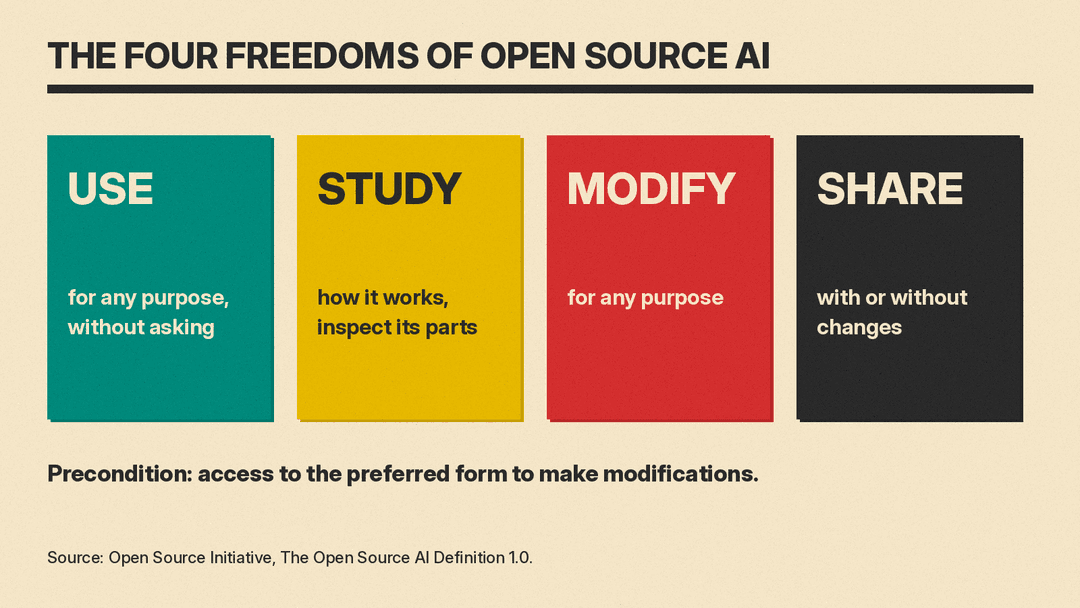
The OSI's Open Source AI Definition 1.0 describes an open source AI system as one made available under terms that grant four freedoms: to "Use the system for any purpose and without having to ask for permission," to "Study how the system works and inspect its components," to "Modify the system for any purpose, including to change its output," and to "Share the system for others to use with or without modifications, for any purpose."
Then comes the part that matters most for this argument. The definition says "A precondition to exercising these freedoms is to have access to the preferred form to make modifications to the system."
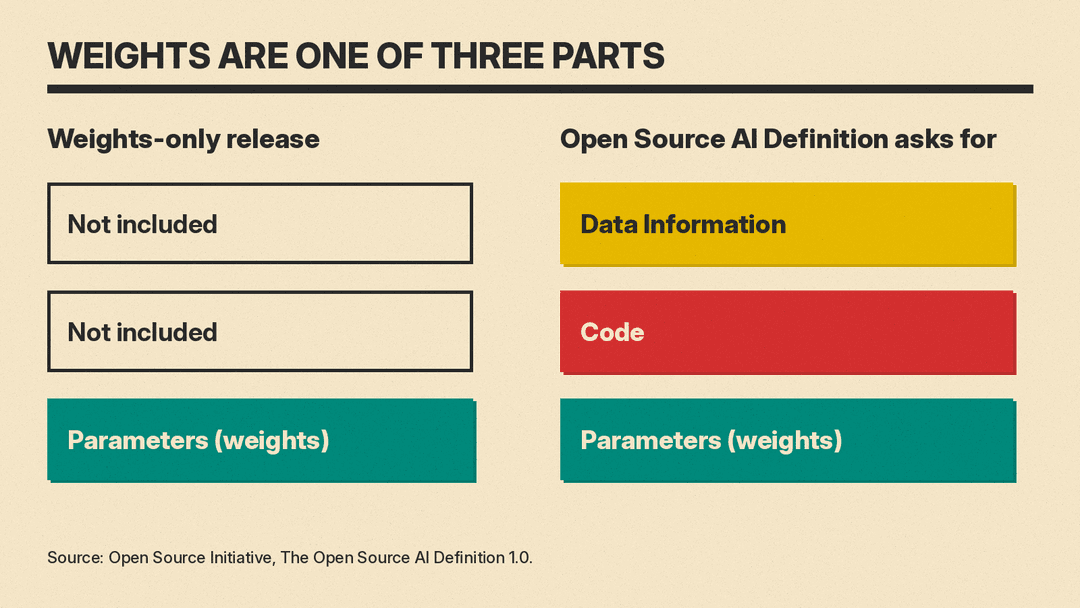
For an AI system, that preferred form has three elements. The first is Data Information, meaning "Sufficiently detailed information about the data used to train the system so that a skilled person can build a substantially equivalent system." The second is Code, meaning "The complete source code used to train and run the system." The third is Parameters, meaning "The model parameters, such as weights or other configuration settings."
Weights are one of the three. A release that offers only weights covers one part of the list.
One clarification. The definition asks for detailed information about the training data, including a complete description of all training data and lists of public and third-party training data with where to obtain them, but not necessarily the data files themselves. It anticipates "unshareable data" by asking for a description sufficient to build a substantially equivalent system. So the honest criticism of a weights-only release is not "they did not hand over their datasets." It is that they did not hand over enough to study or rebuild the system.
The definition closes this loop directly: "“Open Source models” and “Open Source weights” must include the data information and code used to derive those parameters."
Why the license matters as much as the download
There is a second gap, and it has nothing to do with missing files. Even a complete release stops being open source if the license limits who can use it or what they can use it for.
The OSI wrote about exactly this in a July 2023 post on the Llama 2 license, titled "Meta's LLaMa license is not Open Source." Its core complaint is about labeling. The OSI argues that Meta confused open source with "resources available to some users under some conditions," and calls those "two very different things." If you want background on the models at the center of that debate, our Llama explainer covers what they are and how they are distributed.
For a license to qualify, the OSI says "it may not discriminate against persons or groups or fields of endeavor." In its reading of Meta's Llama 2 terms at the time, the license "puts restrictions on commercial use for some users" and "also restricts the use of the model and software for certain purposes" through an Acceptable Use Policy.
The OSI does not object to the business choice itself: "OSI does not question Meta’s desire to limit the use of Llama for competitive purposes, but doing so takes the license out of the category of “Open Source.”" The post even opens by saying it is "pleased to see that Meta is lowering barriers for access to powerful AI systems."
I think that framing is correct and worth copying. Restricting use can be a reasonable choice. Calling a restricted release open source is the part that misleads.
Why the label matters
Labels are how readers who cannot audit a repository decide what to trust. When a word that has a definition gets used for something that does not meet the definition, the loss is not pedantic. It is practical.
First, trust. If "open" can mean anything from a full reproducible system to a downloadable file with usage limits, the word stops telling you anything. Readers then default to marketing, which is the opposite of an informed choice.
Second, the ability to study and fix. A model that misbehaves in some context can sometimes be understood and corrected if you can inspect how it was built. With weights alone, you can adjust the output side. You cannot see why the problem is there in the first place.
Third, the ability to build on it without asking. In my view, use without asking permission is much of what makes open source useful. A license that carves out fields of endeavor or classes of users reintroduces the asking, quietly, and it puts the decision about who gets to participate back in one company's hands.
I want to be clear that I am criticizing a labeling practice, not individuals. Nobody is required to release everything. Companies that release weights deserve credit for it. The ask is narrow: use the word that matches the thing.
What to check before you trust the word "open"
Here is the short version of what I check, in order.
- Is the license one the OSI approves? If the answer is unclear from the release page, that is information.
- Are there use restrictions? Look for acceptable use policies, field-of-use limits, or conditions tied to what you intend to do with the output.
- Are there user restrictions? Look for thresholds or clauses that exclude some people or organizations from commercial use.
- Is the training code released, not just the inference code? Running a model and building one require different things.
- Is there data information? A description detailed enough that a skilled person could build a substantially equivalent system is what the definition asks for, and it is not the same as a dataset dump.
- What did you actually get? If it is weights and a runtime, that is open weights. It may still be exactly what you need.
None of this diminishes open weights. A downloadable model you can run offline, inspect at the output level, and fine-tune for your own purposes is worth having, and releases like these lower real barriers. The checklist is just a way to know which offer you are holding.
The bottom line
Open weights and open source AI overlap without matching. Weights are one of three elements the Open Source AI Definition requires, and a license without limits on users or uses is what makes the four freedoms real. Remove either and you have something else, which may still be valuable and should be named accurately.
My ask of companies is to say "open weights" when that is what they mean. My ask of readers is simpler: check the license, check what was released, and treat "open" as a claim to verify rather than a compliment to accept.
