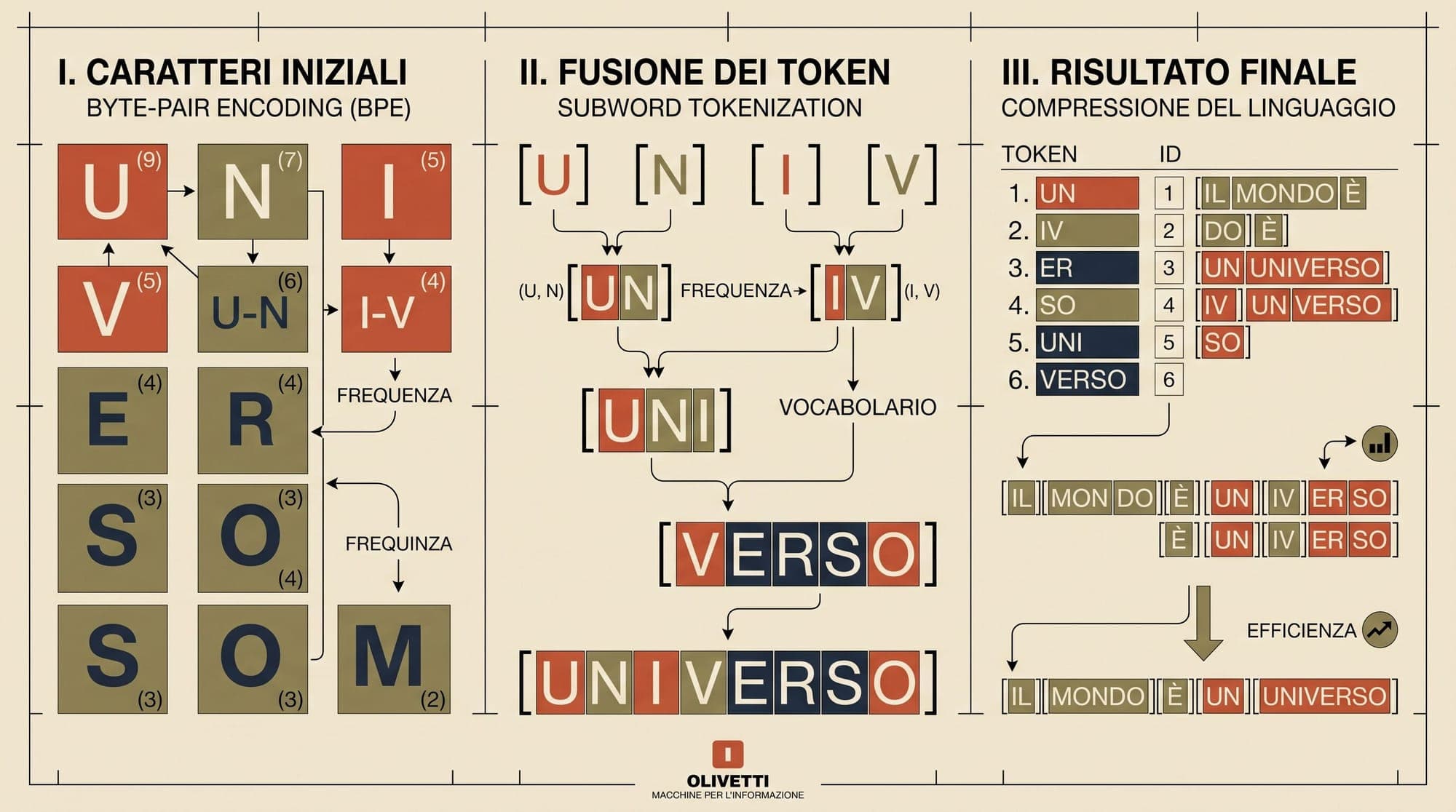
Large language models do not process strings directly. Before a single attention weight or linear projection executes, incoming text is converted into a sequence of discrete integers known as tokens. The choice and implementation of the tokenization algorithm establish the model's fundamental vocabulary, define the boundaries of its context window, dictate inference speed, and introduce unique behavioral quirks.
Across modern transformer architectures, subword tokenization via Byte-Pair Encoding (BPE) serves as the standard representation layer. From OpenAI's GPT family and Anthropic's Claude to Meta's Llama series, BPE bridges the gap between fixed-size neural network embeddings and open-vocabulary natural language.
The Subword Problem: Why Words and Characters Failed
Early neural language architectures faced a structural trade-off between word-level and character-level representations:
- Word-Level Tokenization: Treating every distinct word as a separate token requires vocabularies spanning millions of entries to cover morphological variations, technical jargon, and misspellings. This inflates the model's embedding tables to unsustainable memory footprints. Crucially, word-level models cannot handle out-of-vocabulary (OOV) terms, collapsing unseen words into generic
<unk>tokens that erase semantic meaning. - Character-Level Tokenization: Using individual characters yields a tiny vocabulary (dozens or hundreds of entries) with zero OOV tokens. However, sequence lengths explode. Because the computational complexity of standard self-attention scales quadratically with sequence length (), processing character streams consumes prohibitive memory and compute while forcing attention heads to learn basic spelling and morphology before learning syntactic or semantic reasoning.
Subword tokenization resolves this dilemma by decomposing common words into single tokens while breaking rare or compound words into reusable subword fragments (such as un, break, and able).
The Core Mechanics of Byte-Pair Encoding
Byte-Pair Encoding was originally introduced by Philip Gage in 1994 as a general-purpose data compression technique. In 2016, Rico Sennrich, Barry Haddow, and Alexandra Birch adapted the algorithm for neural machine translation in their foundational paper, Neural Machine Translation of Rare Words with Subword Units.
Raw Text: "low lower newest widest"
Base Vocabulary: ['l', 'o', 'w', 'e', 'r', 'n', 'w', 's', 't', 'd', 'i']

Step 1: Count most frequent adjacent symbol pairs
        Pair ('e', 's') appears 2 times
        Pair ('s', 't') appears 2 times
        Pair ('l', 'o') appears 2 times -> Merge ('l', 'o') -> 'lo'

Step 2: Update vocabulary: ['l', 'o', 'w', ..., 'lo']
Step 3: Repeat until target vocabulary size is reached.
1. Training the Tokenizer
Tokenizer training is an offline, unsupervised pre-processing stage executed over a representative text corpus:
- Initialization: The base vocabulary is initialized with all unique base characters (or all 256 individual byte values). Every word in the training corpus is split into individual base symbols, typically appended with an end-of-word marker.
- Frequency Counting: The algorithm scans the corpus to tally the frequency of all adjacent symbol pairs .
- Greedy Merge: The most frequent pair is merged into a single new symbol .
- Vocabulary Update: The new symbol is added to the vocabulary, and its formation rule is recorded sequentially in an ordered merge table.
- Iteration: The corpus is updated with the new composite symbol, and the frequency counting process repeats until the vocabulary reaches a predetermined size or no pairs exceed a minimum frequency threshold.
2. Inference Tokenization
During inference, new text is tokenized deterministically by applying the learned merge rules in the exact order they were created during training. The input string is broken into base characters and iteratively combined whenever an adjacent pair matches a rule in the merge table.
From Character BPE to Byte-Level BPE and SentencePiece
Early BPE implementations encountered significant operational challenges when deployed across multilingual internet text and code.

The OOV Problem and SentencePiece
Sennrich's original BPE operated on Unicode character sequences. If an incoming text contained an unseen Unicode character (such as an obscure emoji or a character from an unrepresented script), the tokenizer had no merge rules for it and was forced to output an unknown token (<unk>).
In 2018, Taku Kudo and John Richardson released SentencePiece, which introduced two architectural improvements:
- Whitespace Normalization: SentencePiece treats the input purely as a continuous stream of Unicode characters, encoding whitespace explicitly with a meta-symbol (such as
_orU+2581). This eliminated the need for language-specific rule-based word segmenters. - Byte Fallback: When an unknown Unicode character is encountered, SentencePiece falls back to encoding the character as its constituent UTF-8 bytes, mapping them to reserved byte tokens and eliminating
<unk>drops.
Byte-Level BPE in GPT-2 and tiktoken
In 2019, OpenAI's GPT-2 paper (Language Models are Unsupervised Multitask Learners) introduced pure Byte-level BPE. Rather than starting with Unicode characters, Byte-level BPE initializes its base vocabulary with the 256 raw byte values ( through ). Because all UTF-8 text decomposes into byte sequences, the model can represent arbitrary text without an out-of-vocabulary state.
However, naive byte-level merging risks merging punctuation across semantic word boundaries (such as merging dog. into a single token), which fragments the vocabulary. To solve this, modern tokenizers (including OpenAI's tiktoken and Hugging Face's tokenizers library) apply regex-based pre-tokenization rules before BPE merges.
For example, GPT-4's cl100k_base pre-tokenization regex segments text into distinct categories before applying merge tables:
# Simplified regex pre-tokenization pattern
import regex as re

pattern = re.compile(
    r"""'(?i:[sdmt]|ll|ve|re)|[^\r\n\p{L}\p{N}]?+\p{L}+|\p{N}{1,3}| ?[^\s\p{L}\p{N}]++[\r\n]*|\s*[\r\n]|\s+(?!\S)|\s+"""
)
This pattern ensures that letters, numbers, punctuation, contractions, and newlines are processed independently, preventing cross-category merges.
Architectural Trade-Offs of Vocabulary Scaling
The choice of vocabulary size represents a critical architectural compromise between parameter allocation, compute overhead, and sequence compression.
| Model | Tokenizer Type | Vocabulary Size () | Base Dimension () | Embedding Parameters | | :--- | :--- | :--- | :--- | :--- | | Llama 2 | SentencePiece BPE | 32,000 | 4,096 | ~262M () | | GPT-4 (cl100k) | Byte-level BPE (tiktoken) | 100,277 | Undisclosed | Undisclosed | | Llama 3 / 3.1 | Byte-level BPE (tiktoken) | 128,256 | 4,096 | ~1.05B () | | GPT-4o (o200k) | Byte-level BPE (tiktoken) | 199,998 | Undisclosed | Undisclosed | | Gemma 2 | SentencePiece (Unigram) | 256,000 | 2,304 / 3,584 | ~1.18B / ~1.83B |
The Parameter and Compute Footprint
The vocabulary size directly scales two major tensor operations in the transformer:
- Input Embedding Matrix:
- Output Unembedding Matrix (LM Head):
In Meta's Llama 3 8B architecture, expanding the vocabulary from Llama 2's 32,000 to 128,256 quadrupled the embedding parameter count. The input and output embedding matrices alone account for over 1 billion parameters (roughly 13% of the total 8B parameter budget). At generation time, computing the final softmax distribution across 128,256 logits adds measurable memory bandwidth overhead during decoding.
The Compression Dividend
Despite the parameter cost, frontier models continue to scale vocabulary sizes because larger vocabularies yield higher sequence compression ratios:
- Fewer Autoregressive Steps: A document that requires 1,000 tokens in a 32k vocabulary might compress into 750 tokens in a 128k vocabulary. Generating that document requires 25% fewer sequential forward passes through the transformer.
- KV Cache Memory Reduction: Because KV cache memory consumption scales linearly with sequence length ($2 \times n_{\text{layers}} \times n_{\text{heads}} \times d_{\text{head}} \times N$), higher token compression directly shrinks the memory footprint of active requests, enabling larger serving batch sizes.
- Multilingual Token Parity: In 32k vocabularies, non-Latin scripts (such as Hindi, Arabic, Japanese, or Cyrillic) suffered from severe fragmentation, requiring 3 to 5 times more tokens per word than English. According to Meta's technical report, Llama 3's 128k tokenizer improved compression efficiency by ~15% on English and up to 40% on multilingual corpora, drastically reducing inference latency and API cost for non-English users.
Subtle Tokenizer Failure Modes in Production
Because the tokenizer operates outside the neural network, its algorithmic edge cases create failure modes that the underlying transformer cannot easily override.
1. Token Healing and Boundary Artifacts
Standard tokenization is greedy and stateless. When user prompts end mid-word or with specific trailing punctuation, greedy splitting can lead to sub-optimal token boundaries.
For instance, consider a model prompted with a URL prefix:
- Full string
"http://"might tokenize as["http", "://"](2 tokens). - Partial prompt
"http:"tokenizes as["http", ":"].
When the model generates the next token following "http:", the valid continuation token "://" cannot be selected because the : character was already consumed in isolation. Instead, the model is forced to generate '/' as a separate token, resulting in degraded probability distributions.
To fix this, libraries such as Microsoft's Guidance implement Token Healing, a technique that strips the final token of the prompt, rolls the tokenizer state back to the penultimate boundary, and allows the model to predict across the partial boundary.
2. The Glitched Token Anomaly ("SolidGoldMagikarp")
In 2023, researchers Jessica Rumbelow and Matthew Watkins discovered anomalous tokens in GPT-2 and GPT-3 vocabularies, including strings like "SolidGoldMagikarp", "StreamerBot", and "TPPStreamerBot".
When prompted to repeat these strings, models hallucinated wildly, threw errors, or outputted bizarre insults.
The root cause was an artifact of the tokenizer training pipeline:
- The BPE tokenizer was trained on a large raw web corpus (which included scraped Reddit and Twitch user handles).
- The tokenizer assigned distinct vocabulary IDs to these recurring username strings.
- The subsequent dataset used for LLM pre-training was aggressively filtered and cleaned, removing or never encountering those specific strings.
- As a result, the embedding vectors for these token IDs received zero or near-zero gradient updates during pre-training, leaving their vectors near the random initialization center. When triggered during inference, their anomalous vector geometry produced erratic softmax activations.
3. Number Chunking and Arithmetic Degradation
How a tokenizer handles digits directly influences mathematical reasoning capability. Early tokenizers grouped arbitrary digit runs together (e.g., tokenizing 12345 as ["123", "45"]). This prevented the neural network from learning consistent positional digit arithmetic, as the number 5 was embedded differently when appearing in 15, 500, or 50000.
Modern LLM tokenizers enforce strict digit splitting in their pre-tokenization regex rules (such as \p{N}{1} or single-digit preservation), ensuring that every integer is processed digit-by-digit or in predictable uniform groupings, improving zero-shot arithmetic reliability.
Conclusion
Byte-Pair Encoding remains one of the most consequential architectural layers in modern language modeling. While seemingly an unglamorous string manipulation pre-step, tokenizer design establishes the fundamental vocabulary, dictates sequence length compression, governs multilingual economics, and shapes transformer failure modes. As vocabulary sizes push past 200,000 entries in frontier models, the subword tokenizer continues to define the boundary between raw text and deep neural computation.
Sources
- Sennrich, R., Haddow, B., & Birch, A. (2016). Neural Machine Translation of Rare Words with Subword Units. Proceedings of the 54th Annual Meeting of the Association for Computational Linguistics (ACL). https://arxiv.org/abs/1508.07909
- Kudo, T., & Richardson, J. (2018). SentencePiece: A simple and language independent subword tokenizer and detokenizer for Neural Text Processing. EMNLP 2018 System Demonstrations. https://arxiv.org/abs/1808.06226
- Radford, A., Wu, J., Child, R., Luan, D., Amodei, D., & Sutskever, I. (2019). Language Models are Unsupervised Multitask Learners. OpenAI Technical Report. https://cdn.openai.com/better-language-models/language_models_are_unsupervised_multitask_learners.pdf
- Dubey, A., Jauhri, A., Pandey, A., et al. (2024). The Llama 3 Herd of Models. Meta AI Technical Report. https://arxiv.org/abs/2407.21783
- Lundberg, S., et al. (2023). Guidance: A guidance language for controlling large language models (Token Healing). Microsoft Research. https://github.com/guidance-ai/guidance
- Rumbelow, J., & Watkins, M. (2023). SolidGoldMagikarp and other anomalous tokens in LLMs. AI Safety Research. https://www.lesswrong.com/posts/aPeJE8bSo3rAFBiqj/solidgoldmagikarp-plus-prompt-generation