
Anthropic CEO Dario Amodei says cancer, Alzheimer's, heart disease and mental illness will be "relics of the past" in, he thinks, less than a decade. He said it in the roadshow video on Anthropic's IPO site, which the company posted as it markets shares ahead of a Nasdaq listing under the symbol ANT. A former health minister and doctors pushed back on the timeline.
What Amodei said in the roadshow video
Business Insider says the video runs 42 minutes and came out on Tuesday, November 10, 2026. At about 40:38, in the Conclusion chapter, Amodei says, per Anthropic's own captions file:
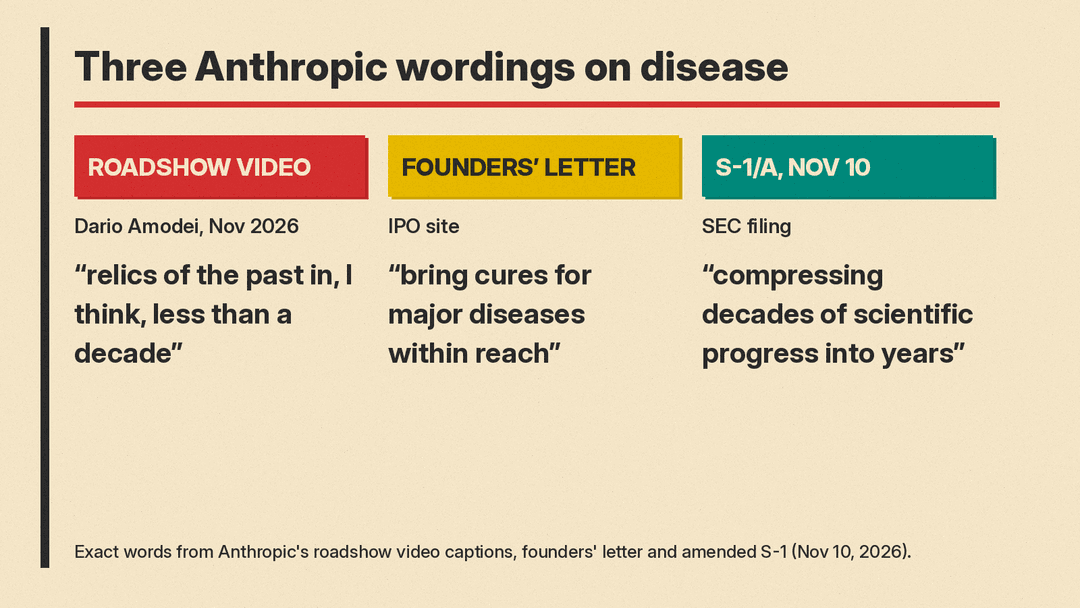
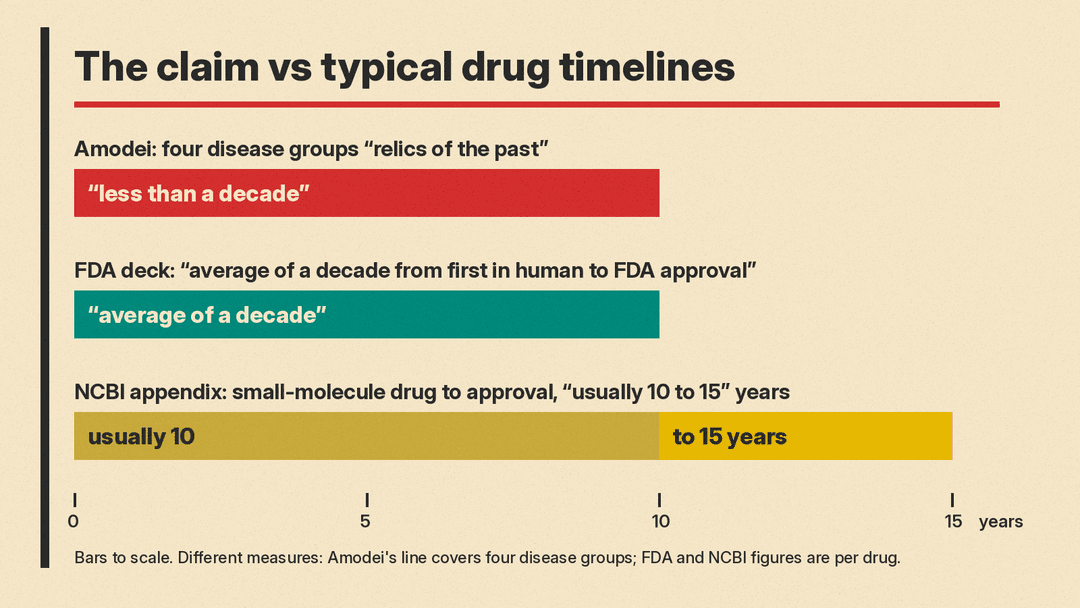
"You know, if today we look at things like cancer, Alzheimer's, heart disease, mental illness, these will be relics of the past in, I think, less than a decade."
A few lines later he adds: "I think if we do this right, we can create an age of miracles where humanity is able to solve problems that have eluded us for millennia."
The clip gives no study, trial or data behind the timeline.
The same video has a smaller, more specific estimate. In its Bristol Myers Squibb chapter, at about 13:25, a speaker says: "We think that AI will help us reduce the time to do a clinical trial by 20 to 30%."
The video also includes the Claude Mythos AMD chip claim, covered in our report on the Mythos AMD claim.
How the filing and founders' letter put it
Anthropic's amended S-1, filed with the SEC on November 10, 2026, does not contain "relics" or "less than a decade", based on our search of the filing on November 12, 2026. It says: "If Powerful AI is directed at solving humanity's hardest problems and the risks are managed responsibly, the potential is extraordinary. The possibilities include compressing decades of scientific progress into years; accelerating drug discovery, disease detection, and the delivery of personalized therapy".
The founders' letter on the IPO site is also conditional. It says that if AI is managed well, it "could rapidly accelerate scientific innovation, greatly increase economic growth rates, bring cures for major diseases within reach, and solve problems that have resisted generations of human effort."
What critics said
Business Insider collected reactions posted on X:
- Karl Lauterbach, Germany's former health minister, wrote in German. In Business Insider's translation: "Curing cancer, Alzheimer's and mental illnesses can definitely benefit from AI. But that is impossible in just 10 years." He added: "Unclear whether people like @DarioAmodei know so little about medicine or are deliberately misleading the public."
- Melinda B. Chu, described by Business Insider as an AI medical researcher with an MD from Saint Louis University, said: "Anthropic has done nothing to suggest they themselves will contribute meaningfully to these goals." Business Insider reports she said the prediction was meant to build hype for the IPO.
- Rami Elghandour, a biotech executive, said: "I've taken two companies public. These are insane things to say in an IPO pitch."
Business Insider also points to an August X post in which Amodei wrote that "saying that AI will cure cancer is more a cliché than it is inspiring, and most people think it is deceptive," and that the best way to win over skeptics is to "actually cure cancer." Anthropic has since started work in the field: it bought Mithril and started its own drug programs in October.
Firstpost reported that medical professionals and researchers questioned whether AI can deliver cures for several complex diseases in that short a period. NDTV reported that faster early molecule discovery does not skip clinical trials, regulatory reviews, or testing in animal and human models.
What drug development timelines show
Published estimates give context for the doubt:
- A 2009 report appendix on the NIH's NCBI Bookshelf, "The Pathway from Idea to Regulatory Approval", says a new small-molecule drug takes several years, "usually 10 to 15", to reach approval. It says FDA review alone "usually takes 10 to 12 months".
- An FDA training deck, "Primer on Drug Development" by FDA clinical reviewer Rosanna Setse, lists an "average of a decade from first in human to FDA approval". It says "<10% of drugs entering trials are eventually approved".
These are typical published figures for one drug. They do not show that AI cannot speed the process up.
Where the idea comes from: Machines of Loving Grace
The forecast is not new. In his essay Machines of Loving Grace, dated October 2024, Amodei wrote that his "basic prediction is that AI-enabled biology and medicine will allow us to compress the progress that human biologists would have achieved over the next 50-100 years into 5-10 years." His list included "Elimination of most cancer," "Prevention of Alzheimer's," and "Most mental illness can probably be cured."
The essay's clock had a start condition. Amodei wrote that powerful AI "could come as early as 2026, though there are also ways it could take much longer," and focused on "the 5-10 years after that." The video clip states no such condition.
Why it matters for the IPO
A roadshow video is a pitch to investors during a share sale. Anthropic has set a $70 to $78 price range, and its IPO site says the price is expected to be set on November 18 (EST). See also Amodei's pay and security costs in the S-1 and what people said about the S-1.
The disease line is a CEO's forecast, marked "I think", not a result. The test is outside evidence: trial results and drug approvals.
Sources
- Anthropic IPO site: roadshow video, captions, founders' letter and FAQ
- Anthropic, PBC amended Form S-1 (S-1/A), SEC, November 10, 2026
- Business Insider: Amodei Says AI Will Cure Cancer in a Decade. Doctors Are Skeptical. (Truman Dickerson, November 11, 2026)
- Firstpost: Anthropic CEO predicts AI could eliminate cancer and Alzheimer's within 10 years, experts disagree
- NDTV: Cancer Will Be History In 10 Years: Anthropic CEO's Big Promise
- NCBI Bookshelf (NIH): The Pathway from Idea to Regulatory Approval
- U.S. Food and Drug Administration: Primer on Drug Development (Rosanna Setse)
- Dario Amodei: Machines of Loving Grace (October 2024)
