
What is PAN 2?
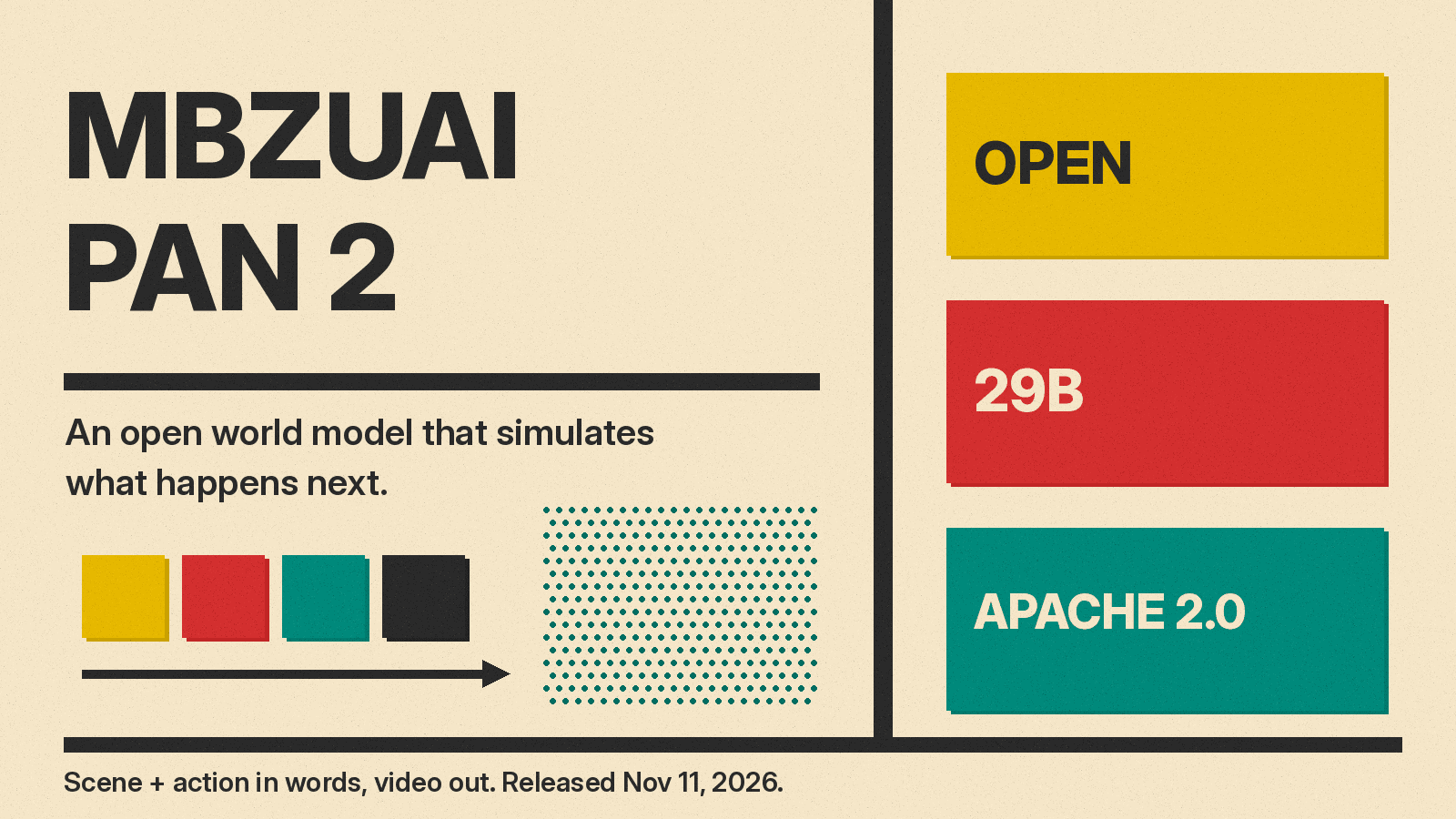
On November 11, 2026, the Institute of Foundation Models at MBZUAI released PAN 2, described in the press release as an open general-purpose world model. You give it a starting scene and an action written in words. It produces a video of what happens next, grounded in physics, time, and space.
IFM calls the approach "simulative reasoning." The pitch is that agents can plan and learn without costly, slow, or irreversible real-world trials. Professor Eric Xing, President of MBZUAI and Founder of IFM, put it plainly: "A language model learns the world as it has been written down. That is book knowledge, and it takes you a long way, but you cannot learn to swim from a book." He added: "Physical intelligence begins when a system can simulate what its actions would do. PAN 2 is our foundation for that."
The release lands the same day that Runway published Praxis-1, an open-weight robot model. Both releases take video models beyond clips for viewers and toward tools that predict what happens in the physical world.
How PAN 2 works
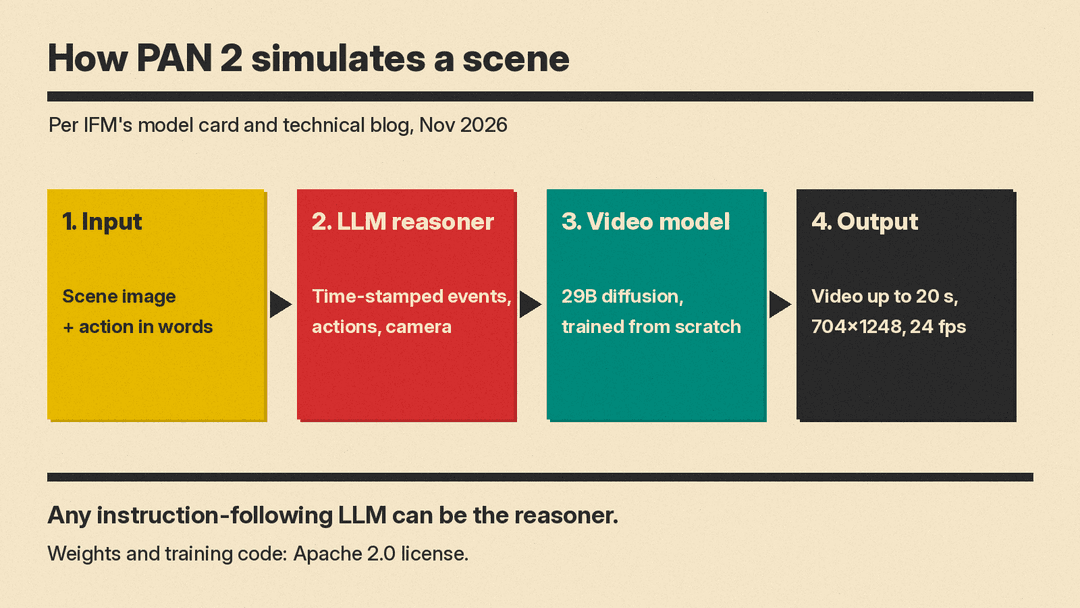
The model has two stages. Conceptual reasoning runs first: a large language model writes a time-stamped description of events, actions, and camera movement. Perceptual reasoning runs second: a video diffusion model turns that description into frames. The whole pipeline sits on what IFM calls the Generative Latent Prediction architecture.
Per the model card, the diffusion backbone is 29 billion parameters (29.2B on GitHub). IFM trained it from scratch on hundreds of millions of videos, chosen for physical dynamics rather than visual appeal. Output is 704 by 1248 pixels at 24 frames per second, up to 20 seconds long. Text-to-video and image-to-video run on the same checkpoint. The model uses the Wan 2.2 VAE decoder and the Qwen3.5-9B text encoder, both pulled from their own repositories. PAN 2 is also supported in Diffusers and vLLM.
Any instruction-following LLM can act as the reasoner. The model card lists the reasoners IFM tested: Claude Opus 5.5, GPT-6 Astra, Kimi K3, and Qwen 3.8 Flash. A Codex or Claude Code agent skill is provided for prompt rewriting. According to IFM's technical blog, after the earliest phase of training IFM removed gameplay, animation, CG renders, and simulation videos from the data. In a comparison of two 9B variants, the version trained without synthetic content won 58% of blinded votes.
How it compares
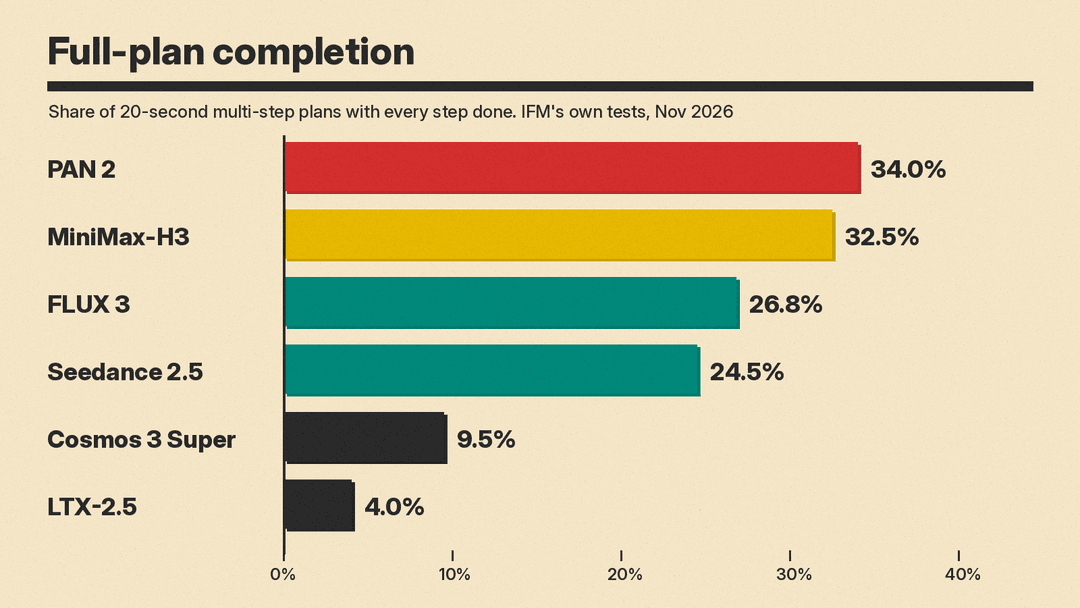
In IFM's own tests, PAN 2 completes 75.1% of individual steps and 34.0% of full multi-step plans. That full-plan figure is the highest among the six models studied. On the same plans, MiniMax-H3 scored 32.5%, FLUX 3 26.8%, Seedance 2.5 24.5%, Cosmos 3 Super 9.5%, and LTX-2.5 4.0%. Across six core dimensions, PAN 2 placed just behind MiniMax-H3. IFM says PAN 2 would rank third overall on the Physics-IQ Verified leaderboard, in the public leaderboard setting, and first among open-weight models. In blinded human comparisons, it took second place among four open models.
IFM also tested how much the language model step adds. When the action goes straight to the video model with no LLM step, full-plan completion falls to 0.0%. When the LLM only rewrites the action into the structured format, without reasoning, it reaches 27.8%. With full reasoning, it reaches 34.0%. So the structured description does most of the work, and the reasoning adds the rest.
PAN 2 joins a growing field of world models, such as DeepMind's Genie 4. Among open releases, Tencent's Hy-Nomas is an 8B interactive video world model. PAN 2's 29B video backbone is more than three times that size, and its split between a language reasoner and a video model is a different design choice.
What is released and under what license
PAN 2's code and weights are Apache 2.0. The release includes model weights, full training and inference code, the technical blog, and documentation. The press release points out that few world models ship with full training code. One gap worth noting: reward learning and the model soup that produced the released weights are described in the report but are not in the training code on GitHub.
Hector Liu, director of IFM's Silicon Valley lab, stated: "We want researchers to be able to test PAN 2's capabilities, understand its limits, and build on it."
Limits
The model card is direct about weak points. Roughly two in three simulated plans contain at least one step that is not carried out. The system is prompt sensitive. Appearance drifts across clips in longer interactions. Text describes dexterous moves, such as where each finger meets an object, only coarsely. It takes physics-breaking shortcuts, for instance showing pasta in the colander before it is drained. And it can generate video realistic enough to be mistaken for real footage.
Why it matters for AI video
For creators and researchers, PAN 2 functions as a test bed. Rather than filming every scenario or running a full 3D simulation, you write an action and let the model predict the consequence. The Apache 2.0 license and the released training code let teams adapt the model to their own data and products.
On safety, IFM recommends running PAN 2 behind a separate pan2-guardrail module. In internal tests, the guardrail cut the share of harmful text-to-video requests that produce an unsafe video from 33.9% to 1.5%. It also stopped 11.5% of benign text-to-video requests, so the filter has a cost.
